

Pagan loaves, Christian bread, a secular treat: a brief history of hot cross buns
- Written by The Conversation
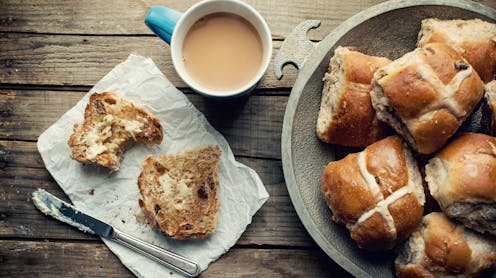
Hot cross buns aren’t just a sweet snack that appears around Easter. They carry centuries of storytelling in their dough. From ancient gods to modern supermarkets, these sticky spiced buns have crossed many borders and beliefs.
Today, you can buy them in all kinds of flavours. But their story is far richer than chocolate chips and salted caramel.
Ancient beginnings
In some ancient cultures, bread was more than just food. It was a symbol of faith. Ancient Greeks baked small round loaves marked with crosses to honour their gods. According to some historians, these marks could represent the four seasons or four phases of the moon.
Jewish people have also shared special bread during holy times like Passover, and scholars have debated whether these customs influenced early Christian bread traditions.
Pagan Saxons worshipped a spring goddess named Eostre. They baked bread during springtime festivals to celebrate new life and longer days. The name “Eostre” is where we get the English word “Easter”. Over time, some of these springtime bread traditions blended with Christian customs.
From Pagan loaves to Christian buns
Early Christians started marking bread with a cross to show their devotion, and ate it throughout the year.
They believed the cross kept away evil spirits and helped the dough rise. Over time, the Christian view of the bread marked with the cross shifted to focus on Jesus’ crucifixion and became associated with Easter.

By the Middle Ages, many bakers only kept the cross on Good Friday bread.
According to popular tales, one 12th-century English monk made spiced buns marked with a cross on Good Friday, because that day is the “Day of the Cross”.
Monks often used spices to show the day was special. These spiced buns helped people remember the crucifixion of Christ and the spices used in his burial.
In 1592, Queen Elizabeth I restricted the sale of spiced bread and buns, perhaps because of religious tensions. England had broken away from the Catholic Church, and new Church of England officials worried that “holy” buns looked too much like Catholic superstition. Others say it was an issue of bread prices and profits. Then again maybe they were just too special for just everyday.
Under these laws, commercial bakers could only make spiced bread on Christmas, Easter and for funerals.
Good Friday and magic buns
By the 18th century, English street vendors sold “hot cross buns” on Good Friday. We even see an old rhyme about them in Poor Robin’s Almanac in 1733, which says:
Good Friday comes this month, the old woman runs, With one a penny, two a penny, hot cross buns.
Soon, people believed these Good Friday buns had magical powers. Some hung them from kitchen rafters, believing they would never go mouldy. They kept them for protection against evil or illness. If someone felt sick, they crumbled part of an old hot cross bun into water, hoping it would cure them. Others placed buns in their grain stores to keep pests away.
These beliefs might sound odd today, but they were part of daily life for many.

In Victorian England, people exchanged hot cross buns with friends on Good Friday and said, “Half for you and half for me, between us two good luck shall be”.
Whatever ancient superstition the cross once warded off, today it’s the flavour roulette that keeps us coming back. Proof that tradition now serves taste, not fear.
An enduring symbol
Traditional buns contain dried fruit and spices like cinnamon and nutmeg, but many modern versions swap sultanas for chocolate chips or add flavours like salted caramel, orange – or even Vegemite and cheese. They have become a secular treat. Yet the crisscross pattern remains on top, hinting at the Christian origins.
When you smell a fresh batch of these buns, you’re sharing an experience people enjoyed centuries ago. Ancient Egyptians, Greeks, Poles, Romans, Saxons, medieval monks and 18th-century street sellers all had their versions of spiced, crossed bread. Each group gave the buns its own meaning, from honouring gods to celebrating Christ’s crucifixion and resurrection.
 A woman giving hot cross buns to two children, in an illustration from 1899.
British Library
A woman giving hot cross buns to two children, in an illustration from 1899.
British Library
Eating hot cross buns at Easter also shows how traditions change with each generation. At first, they were hard to find outside Good Friday. Now, you might see them in shops just after New Year’s. They once symbolised pagan festivals, then moved into Christian rites, survived royal bans, and sailed through waves of superstition. Yet they remain a symbol of Easter in Australia and around the world.


