

In the trade war, China has moved to curb supply of critical minerals. Can Australia seize the moment?
- Written by The Conversation
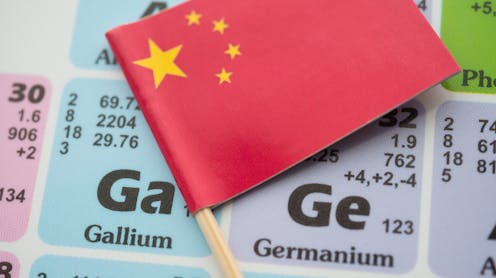
In the escalating trade war between the United States and China, one notable exception stood out: 31 critical minerals, including rare earth elements, were strategically exempted from tariffs.
This was not a gesture of goodwill. It was a tacit acknowledgment of the United States’ deep dependence on China for materials essential to its technological competitiveness, clean energy transition and national defence.
Beijing’s response was swift and calculated. China’s Ministry of Commerce announced expanded export controls and a shift in pricing principles. The move reflects China’s long-standing effort to shift rare earth pricing from market supply and demand to pricing based on their strategic value.
The impact was immediate. Rare earth exports from China effectively ground to a halt, as exporters awaited approvals under a new, opaque licensing regime.
The announcement prompted President Trump to issue a new executive order directing a review of national security risks stemming from the US reliance on imported, processed critical minerals.
As global supply chains reel from these disruptions, Australia finds itself in a unique strategic position. As a trusted US ally, it possesses the resources, partnerships and political capital to step into the breach. But can Australia seize this opportunity – or will it come with strings attached?
China’s new playbook
China’s latest restrictions target seven rare earths – such as dysprosium and terbium – crucial for electric vehicles, wind turbines, fighter jets and missile systems.
While stopping short of a full export ban, the policy functions as a chokepoint. It leverages China’s near-total global control of rare earth refining (around 90%) and its monopoly on heavy rare earth processing (98%).
Domestically, China’s rare earth sector is dominated by two state-owned giants which together control nearly 100% of national mining quotas.
These measures have exposed the vulnerability of Western supply chains. The US has only one operational rare earth mine – Mountain Pass in California – and minimal domestic refining capacity. A new processing facility in Texas owned by Australia’s Lynas is under development, but it will take years to establish a self-sufficient supply chain.
Europe faces similar challenges. While rare earths are vital to the EU’s green transition, domestic production remains limited. Efforts to diversify through partners like Australia and Canada show promise but are hindered by high production costs and continued reliance on Chinese technology.
China is also working to redefine how rare earths are priced. One proposal would tie the value of key elements like dysprosium to the price of gold, elevating them from industrial inputs to geopolitical assets. Another would settle rare earth transactions in yuan rather than US dollars, advancing Beijing’s broader ambition to internationalise its currency.
For China, this strategy goes beyond economics. It is a deliberate national resource policy comparable to OPEC’s management of oil, designed to link pricing to the strategic significance of critical minerals.
Australia’s window?
Investors are closely watching Australian producers. Strategic deposits such as Mt Weld in Western Australia have drawn renewed interest from Japan, Europe and the US.
Industry observers argue Australia is better positioned than the US to develop secure supply chains, due to its rich geological endowment and transparent regulatory environment.
To seize this opportunity, the government has begun to act.
Under its Future Made in Australia initiative, the federal government is considering measures such as strategic stockpiling, production tax credits and expanded support for domestic processing. Iluka Resources has secured A$1.65 billion to build a rare earth refinery, due to be operational by 2026.
Emerging projects like Browns Range and Lynas’s Malaysian refinery already serve as alternative nodes in the global rare earth supply chain network.
However, structural barriers remain. The Western allies, including Australia, still lack key processing technologies and have potentially high environmental compliance costs. Lynas’s Texas plant was intended to expand allied capacity but has faced delays due to environmental approvals.
Walking a diplomatic tightrope
Geopolitical tensions add another layer of complexity. Australia’s dual role – as a major upstream supplier to China and a strategic ally of the US – places it on a diplomatic tightrope.
Aligning too closely with the US could invite Chinese retaliation. Appearing overly aligned with China may provoke scrutiny from Washington.
Ownership concerns are also rising. The government has blocked or forced divestment of Chinese stakes in rare earth and lithium companies including Northern Minerals.
Market volatility compounds these challenges. Prices are currently buoyed by geopolitical risk, but have been volatile. Moreover, China’s ability to undercut global prices could erode the competitiveness of Australian exports.
A strategic opportunity – but with strings attached
Australia stands at the centre of a rare strategic inflection point. It is both a beneficiary of China’s retreat and a potential casualty of intensifying great power competition.
In a world where resources confer influence, the question for Australia is not simply whether it has the mineral deposits but whether it has the strategy to match.
If the government can capitalise on this moment – diversifying partnerships, investing in capabilities, and navigating allies and rivals with strategic care – it could emerge as a leader in a more diverse critical minerals landscape.
In the era of mineral geopolitics, possessing the resources is no longer enough. The real test is whether Australia has the foresight and the will to lead.


