

Low effort, high visibility: what bumper stickers say about our values and identity
- Written by The Conversation
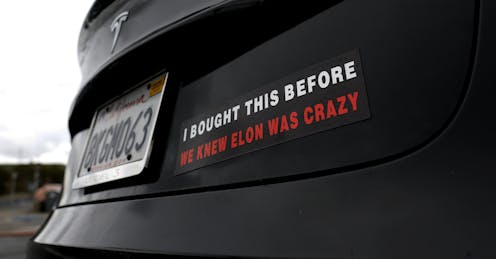
You may have seen them around town or in the news. Bumper stickers on Teslas broadcasting to anyone who looks: “I bought this before we knew Elon was crazy.”
You might assume it’s there to prevent someone from keying the car or as an attempt to defuse potential hostility in a hyper-politicised landscape. But while it may signal disapproval to like-minded passersby, a sticker is unlikely to dissuade someone already intent on committing a crime (which keying is).
What it does offer, though, is a form of symbolic insurance. You might call it a way to clarify identity in a hostile political environment.
Equal parts apology, protest and cultural timestamp, the message can say more in nine words than a full-blown op-ed. But it’s not just about a car. It’s also about values, identity management and the evolving politics of consumption.
A signal to others
At their core, car bumper stickers function as a vehicle (literally and metaphorically) for identity projection. They are symbols of what psychologists call “low-cost identity displays”, used to project who we are or perhaps more accurately, how we want to be seen.
Buying a Tesla may once have signalled innovation, environmental consciousness, or social progressivism. But Musk’s increasingly polarising public behaviour and political commentary have altered the cultural meaning of the brand.
This creates a sense of cognitive dissonance for those consumers whose values no longer align with what the brand’s owner now represents. Enter the bumper sticker.
In an increasingly fragmented society, where people are eager to differentiate themselves, even a sticker can be a subtle form of moral positioning. But more than anything, it’s often a way to signal to the groups that matter most to us, “please like me”.
Social identity theory suggests people derive part of their self-concept from their perceived membership in social groups. Bumper stickers make these group affiliations visible, projecting values, ideologies, affiliations, or even contrarian attitudes to the outside world.
My tiny fading Richmond Tigers sticker on my car may not be performative in the same way a bold political slogan might be. But it still signals a form of identity and belonging.
The North Face jacket
Bumper stickers act as a form of “peacocking”. It’s similar to wearing branded clothing, like Dan Andrews’ The North Face jacket during COVID that made him appear more approachable than he would have in a formal suit. Or like even curating a bio on LinkedIn. This is a behavioural strategy where people communicate their traits to others without words.
In marketing, this links closely to the theory of conspicuous consumption, which can include symbolic consumption, where we buy and display products not just for utility, but for what they say about us.
Bumper stickers are a literal version of this. They are symbolic, declarative and public. They’re low-effort, high-visibility communicators of group affiliation, virtue, humour, rebellion or outrage.
The intention might be to inform or persuade, but their actual influence is more complicated.
Marketing class 101
In introductory marketing classes, taught at pretty much every university, awareness is often presented as the first stage of the hierarchy of effects model. The model suggests consumer action progresses from awareness to knowledge, liking, preference, conviction, and finally, purchase.
But in practice, this progression is significantly more complicated. Bumper stickers may generate awareness, but there’s little evidence they influence behaviour – especially when considered in isolation.
This is particularly relevant in areas such as tourism promotion. For example, an unofficial, but nevertheless provocative tourism slogan like the “CU in the NT” ad campaign might spark conversation and recognition, but recognition does not equate to conversion.
Despite the hope that underpins the millions of dollars spent on slogans and taglines, awareness is necessary but not sufficient for behavioural change.
Most marketing efforts fail not because people are unaware of the brand, but because they have no reason, opportunity, or inclination to act – that is, to buy the product or change behaviour.
Culture has fragmented
Contemporary consumer culture is increasingly tribal and fragmented. Social media algorithms reinforce echo chambers, while physical signals such as car stickers or even political corflute signs signal belonging and in-group and out-group boundaries.
As a result, bumper stickers probably reinforce identity for the already converted, but are unlikely to persuade those outside the tribe.
Visible preferences, however, can serve as a form of shorthand for identity, especially when they align with the symbols and language of the in-group. Although their direct influence on behaviour is limited, these signals, when repeated and reinforced within a receptive community, can shape and shift social norms over time.
In the end, bumper stickers rarely change behaviour. But they do something more subtle. They allow people to express, perform and affirm identity. They act as signals to others, markers of tribe, values, humour or defiance. They help us say this is who I am, or maybe, this is what I am not.


