

Even experts disagree over whether social media is bad for kids. We examined why
- Written by The Conversation

Disagreement and uncertainty are common features of everyday life. They’re also common and expected features of scientific research.
Despite this, disagreement among experts has the potential to undermine people’s engagement with information. It can also lead to confusion and a rejection of scientific messaging in general, with a tendency to explain disagreement as relating to incompetence or nefarious motivations.
To help, we recently developed a tool to help people navigate uncertainty and disagreement.
To illustrate its usefulness, we applied it to a recent topic which has attracted much disagreement (including among experts): whether social media is harmful for kids, and whether they should be banned from it.
A structured way to understand disagreement
We research how people navigate disagreement and uncertainty. The tool we developed is a framework of disagreements. It provides a structured way to understand expert disagreement, to assess evidence and navigate the issues for decision making.
It identifies ten types of disagreement, and groups them into three categories:
- Informant-related (who is making the claim?)
- Information-related (what evidence is available and what is it about?)
- Uncertainty-related (how does the evidence help us understand the issue?)
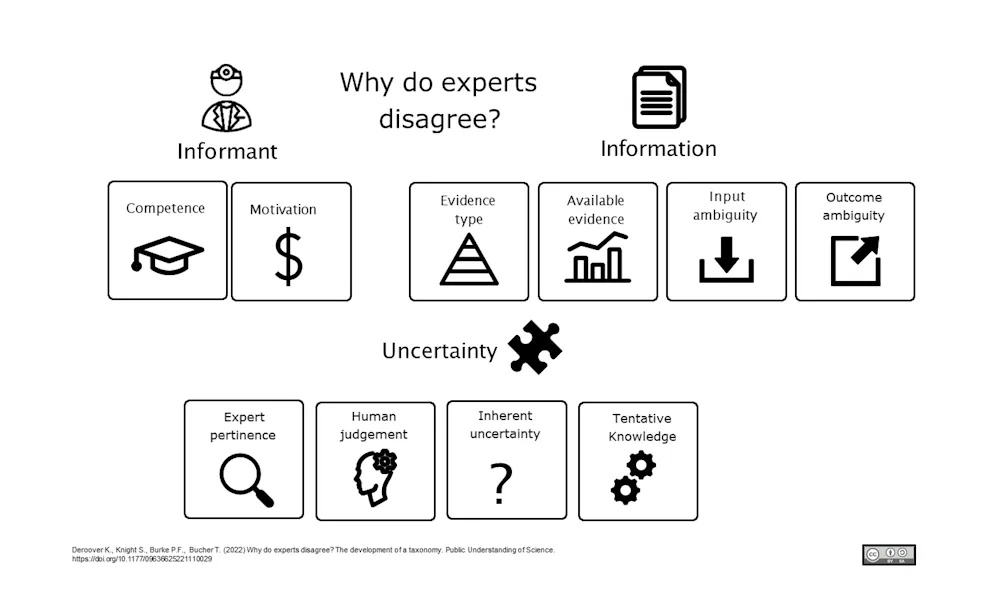
Mapping different viewpoints
The social and policy debate about the impacts of social media is rapidly evolving. This can present a challenge, as we try to apply evidence created through research to the messy realities of policy and decision making.
As a proxy for what experts think, we reviewed articles in The Conversation that mention words relating to the social media ban and expert disagreement. This approach excludes articles published elsewhere. It also only focuses on explicit discussion of disagreement.
However, The Conversation provides a useful source because articles are written by researchers, for a broad audience, allowing us to focus on clearly explained areas of acknowledged disagreement among researchers.
We then analysed a set of articles by annotating quotes and text fragments that reflect different arguments and causes of disagreement.
Importantly, we did not assess the quality of the arguments or evidence, as we assume the authors are qualified in their respective fields. Instead, we focused on the disagreements they highlighted, using the framework to map out differing viewpoints.
We focused on the Australian context. But similar social media bans have been explored elsewhere, including in the United States.

What did we find?
Applying our framework to this example revealed only a small amount of disagreement is informant-related.
Most of the disagreement is information-related. More specifically, it stems from input and outcome ambiguity. That is, in claims such as “X causes Y”, how we define “X” and “Y”.
For example, there is disagreement about the groups for whom social media may present particular risks and benefits and what those risks and benefits are. There is also disagreement about what exactly constitutes “social media use” and its particular technologies or features.
Harms discussed often refer to mental wellbeing, including loneliness, anxiety, depression and envy. But harms also refer to undesirable attitudes such as polarisation and behaviours such as cyberbullying and offline violence. Similarly, benefits are sometimes, but not always, considered.
The ban itself presents a further ambiguity, with discussion regarding what a “ban” would involve, its feasibility, and possible efficacy as compared to other policy options.
Two other information-related causes of disagreement involve data availability and the type of evidence. Researchers often lack full access to data from social media companies, and recruiting teens for large-scale studies is challenging. Additionally, there is a shortage of causal evidence, as well as long-term, high-quality research on the topic.
This information-related issue can combine with issues related to the uncertainty and complexity of science and real-world problems. This is the third category in our framework.
First, while a contribution may be from an expert, there may be questions about the pertinence of their background expertise to the debate. Complex issues such as a social media ban also require human judgement in weighing, integrating, and interpreting evidence.
Second, research on reducing social media use often yields varied results, which could stem from inherent uncertainty or the constantly evolving social media landscape, making it difficult to compare findings and establish firm conclusions (tentative knowledge).
 Researchers often lack full access to data from social media companies, which can make it difficult to conduct comprehensive studies.
UVL/Shutterstock
Why is this important?
Discussion regarding the social media ban is complex, with a range of issues at play.
By mapping out some of these issues, we hope to help people understand more about them and their implications.
Our taxonomy of disagreements provides a structured way to understand different views, assess evidence, and make more informed decisions. It also supports clearer communication about disagreements as researchers navigate communicating in complex debates.
We hope this helps people to integrate claims made across different sources. We also hope it helps people hone in on the source of disagreements to support better discourse across contexts – and ultimately better decision making.


