

Vietnam is poised to become a top 20 economy, so why is Australia taking so long to make trade and investment links?
- Written by The Conversation
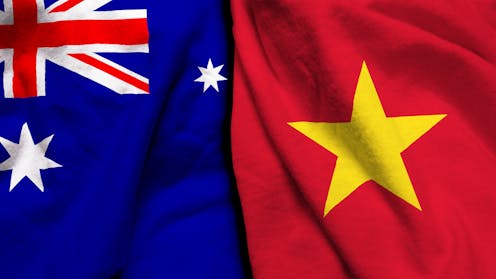
At a time of widespread global trade instability, Australia should be expanding and diversifying its economic partnerships. Supply chains remain fragile, and protectionist rhetoric is once again gaining traction in major Western economies.
US President Donald Trump’s America First agenda includes sweeping tariffs on imports, withdrawal from multilateral agreements and pressure to take production in-house.
At the same time, China, Australia’s largest trading partner, has often used trade for geopolitical leverage. In 2020, Beijing imposed tariffs of more than 200% on Australian wine. This wiped 30% off the sector’s export value.
So economic diversification is not only desirable but strategically imperative.
An opportunity
Fifty years on from the fall of Saigon, Vietnam presents a compelling opportunity for economic and strategic diversification. The reunited country is eager to move beyond its wartime image and assert itself as an emerging economic powerhouse.

Since the launch of the Doi Moi reforms in 1986, Vietnam has embraced economic liberalisation and market-oriented policies. The Doi Moi reforms opened the economy to foreign trade, allowed private ownership and restructured state-owned enterprises.
From a growth rate of just 1.6% in 1980, Vietnam is now set to become one of the world’s top 20 economies by 2050. In 2023 alone, it attracted A$8.5 billion in foreign direct investment, underscoring strong investor confidence.
The 50th anniversary of reunification on April 30 provided insights into the country’s growth. Celebrations included military parades, 3D virtual reality displays and exhibitions promoting advances in technology.
Slow to act
Yet Australia has been slow to act. Despite geographic proximity and shared interests, Australia’s economic footprint in Vietnam remains surprisingly small. In 2023, Australian foreign direct investment totalled just A$3 million. It ranked 22nd, behind countries including Switzerland and Seychelles.
In trade, the disparity is similarly stark. Vietnam accounts for only 2.33% of Australia’s exports and 1.4% of imports. Two-way trade between the two countries reached $26.3 billion in 2022. At the same time, Vietnam’s trade with the United States, topped A$191.9 billion.
Some Australian firms are already making inroads. BlueScope Steel, Linfox, and SunRice have invested significantly in manufacturing, logistics and agriculture. And RMIT University has been a key player in transnational education since it opened the first of three campuses in Vietnam in 2000.
ANZ and Qantas also have a visible presence. However, small and medium-sized enterprises – which comprise more than 98% of Australian businesses – remain largely absent. Many prefer export partnerships or distributor agreements over direct investment.
Potential obstacles
Australian companies have long favoured English-speaking or high-income markets. These offer greater institutional and cultural familiarity and regulatory certainty.
Vietnam’s relationship-based commercial environment poses challenges, especially for firms lacking embedded networks and local knowledge. Concerns around regulatory transparency, intellectual property protection, contract enforcement and corruption – though improving – continue to weigh on corporate decisions.
Small to medium enterprises, in particular, face extra barriers due to limited institutional support, regulatory understanding, market intelligence and in-country networks.
Help from government
The Australian government has taken some steps to catch up. The Enhanced Economic Engagement Strategy, launched in 2021, aims to double two-way investment and elevate both nations to top ten trading partner status.
It identifies priority sectors such as agriculture, education, clean energy, digital technology and manufacturing. However, the strategy contains no enforceable legal protections, tariff concessions or means of dispute resolution.

The lack of these matters. Japan, South Korea and the European Union have pursued coordinated economic strategies that include concessional loans, robust legal frameworks and in-market support services. These help their businesses thrive in Vietnam’s complex regulatory environment.
Similarly, the EU has integrated trade promotion with legal certainty under agreements like the EU Vietnam Free Trade Agreement.
More needs to be done
Without comparable tools, Australia’s initiatives risk being more aspirational than actionable.
Last year’s upgrade in bilateral ties to a Comprehensive Strategic Partnership, signals growing political will.
For Australia to realise the potential of its relationship with Vietnam it should back long-term policies. These policies should reduce market entry barriers, incentivise small to medium enterprises and increase joint skills development.
Investors also need legal and institutional support.
Australia has strong potential to expand into emerging sectors. These include renewable energy, digital technology, healthcare, vocational education and training, green and smart infrastructure and agritech.
Vietnam’s push for environmentally sustainable economic growth, digital transformation and workforce training aligns closely with Australian strengths. This creates opportunities for strategic investment and cooperation.
There is the potential for Australia to build a dynamic partnership with Vietnam central to its long-term economic position in the Indo-Pacific.


