

Fish driving cars and chimps doing maths: what teaching animals ‘irrelevant’ skills reveals about our own minds
- Written by The Conversation
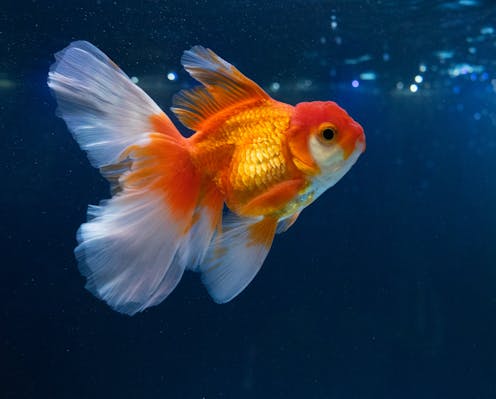
Did you know goldfish can learn to drive cars? Have you heard bumblebees can learn to pull on a string? Would you believe some primates can perform calculations with Arabic numerals?
These tasks seem completely irrelevant to these animals in their natural environment, so why are researchers interested in them?
As someone who studies the intelligence of insects, much of my own research has been labelled as “ecologically irrelevant”.
However, as I have argued in Trends in Cognitive Sciences, there are plenty of reasons to study this kind of animal intelligence.
Finding relevance in irrelevance
The study of animal intelligence often seeks to form a better understanding of the animal’s ecology. However, there are also many studies that aim to push the limits of animal cognition beyond what we would expect in their everyday life.
This honeybee has been trained to find sugar water where there are an even number of shapes.Ecologically irrelevant research can help us understand the limits of animal intelligence and develop bio-inspired technology. It can also help us explore behavioural responses to environmental change, and advance our understanding of the evolution of intelligence.
Understanding how animals respond to ecologically irrelevant tasks sheds light on how our own intelligence has evolved. We frequently use comparisons between humans and non-human primates to understand whether a cognitive capacity has evolved in modern humans, or if we observe similar abilities in other primates and animals.
For example, children as young as 24 months old can find a hidden object in a room when its location is pointed out to them in a photograph. This ability is known as representational insight.
Some chimpanzees can also pass this test. Do these results mean a chimpanzee has the same level of intelligence as a two-year-old child?
Furthermore, this test may allow us to estimate when representational insight evolved. It may have been before humans and chimpanzees split into different lineages.
Researchers trained goldfish to steer a tank on wheels.Imitating nature, comparing species
Biologically inspired (bio-inspired) solutions to modern computing problems use technology based on biology. Some bio-inspired technologies can cope well with uncertainty by using brain-like computations to process and solve real-world problems. Many animals are considered models for bio-inspired technologies based on their vision, behaviour and movement.
For example, the flight mechanics of dragonflies have been studied to build micro aerial vehicles. Since bio-inspired technology will undoubtedly be used in unnatural situations, it is useful to know how animals would respond in these same scenarios to build more accurate technology.
Comparing the behaviour and intelligence of different species can pose a huge challenge to scientists. To enable accurate comparisons we need to have a task of equal difficulty for both species.
If we use a task that animals perform regularly in their natural environments, we run the risk that one species may have an advantage from performing the task more frequently. However, if we use a task that neither animal is likely to ever need to perform, we can “level the playing field” for an accurate comparison.
Animals must often adapt to new and unfamiliar situations. Environmental changes such as urbanisation, climate change, habitat loss and invasive species introductions cause animals to encounter new challenges that may have previously been ecologically irrelevant.
A puzzle box may be seem irrelevant to many animals. However, cockatoos in Australia have learned how to open rubbish bins to forage. The cockatoos have then adapted to solve new puzzles as humans attempt to make bins harder to open.
This “innovation arms race” between humans and cockatoos shows how an initially ecologically irrelevant task may become relevant to an animal.
Does a true test of ecologically irrelevant intelligence exist?
One major question is whether we have been able to create a truly ecologically irrelevant task for animals to complete.
For example, bees have been trained to recognise images of human faces. This task may appear ecologically irrelevant to a bee.
However, to the bee, an image of a human face may actually represent an unfamiliar but rewarding flower, particularly when the correct option is paired with a reward of sugar water, which imitates a flower’s nectar. Is this task relevant or irrelevant to a bee? The answer is: it depends.
Many experiments provide food rewards. Therefore, animals may interpret these experiments as a foraging task, thus making even the most complex and arbitrary tasks during tests of intelligence still somewhat ecologically relevant to the animal. Other rewards for animals participating in experiments include shelter, social interactions, and play.
While the task itself may appear ecologically irrelevant, the reward may be highly relevant to animals looking for food, mating opportunities, safety, or fun. This leads us to question if any task we give animals is completely bereft of ecological relevance.


