

In Bradfield, the election is not yet over. What happens when a seat count is ultra close?
- Written by The Conversation
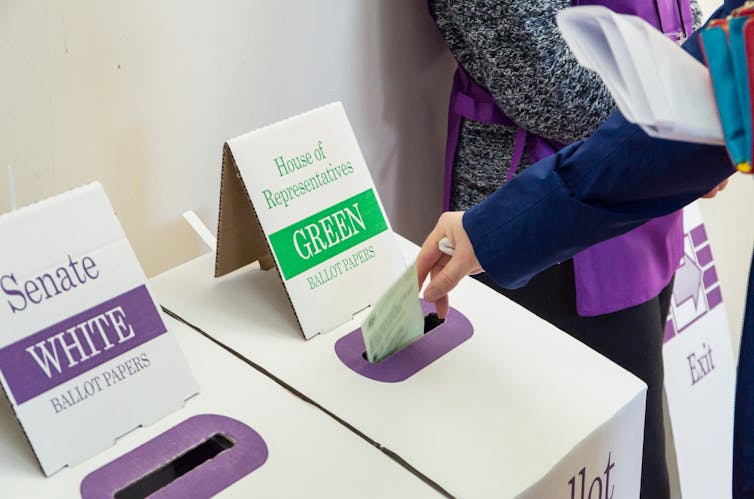
Election day was over four weeks ago. Yet the outcome in one House of Representatives remains unclear. That is the formerly Liberal Sydney electorate of Bradfield.
In real time, you can watch the lead tilt between Liberal hopeful, Gisele Kapterian and her teal independent rival, Nicolette Boele. The difference between them has been as small as one vote. As of Monday, that had shifted to 12 votes in the Teal’s favour. Still too close even for Antony Green to call.
What are the processes for resolving ultra-marginal results? And, more broadly, what accountability is there for problems in campaigning or the running of the election, such as the allegation that voters in one NSW town were misled about how to vote?
First, to the Bradfield saga. The Australian Electoral Commission (AEC) has until July 9 to declare the result. It then certifies a list of successful candidates, which it “returns”, attached to the original writ the governor-general used to formally begin the election.
Electoral challenges
Within 40 days of the writ being returned, any candidate or elector from the seat can “petition” its result. That’s not a petition calling for parliament to handle the matter. It means a formal pleading to the Court of Disputed Returns. For national elections, that means the High Court.
Remarkably few seats are challenged in Australia. On the happy side, this is because our election agencies are very professional. It’s also a matter of legal principle, arithmetic and resources.
To succeed in a challenge, you must show the outcome was likely to have been affected, by errors or breaches of the electoral act. With more than 100,000 voting in House of Representatives electorates, even a 0.5% margin means convincing a judge that a 500-vote lead was uncertain.
The last successful petition nationally was 12 years ago. The AEC admitted some lost ballots meant that the last couple of Western Australian Senate seats could have been different. The whole race had to be re-run.
In Bradfield, there’s no suggestion of impropriety. So it’s not like the last unsuccessful petition, from 2019, where the Liberals survived claims that misleading how-to-vote posters, directed at Chinese language speakers, might have affected the result.
Instead, the Bradfield loser would focus on disputed ballots. That would mean, for example, votes where their scrutineers noted some uncertainty. Such as whether a “1” was a “7”. A judge can then give a binding ruling on the intent of the ballot.
The loser might also try to find evidence of people being wrongly denied a ballot or wrongly issued one. The 40-day period to marshal evidence is strict.
Besides time limits, a challenger needs lawyers and risks paying the other side’s (and perhaps the AEC’s) legal costs if they lose the hearing.
Counts and recounts
Australian election counts are very thorough. This is in contrast to the United Kingdom, where local officials literally rush to be the first to declare, in the wee hours of Friday morning after voting closes at 10pm on a Thursday.
The figures we see on election night are “indicative” only, drawing on counts in thousands of polling places. Every ballot is transferred to a more central location, for official tallying. Ballots for weaker candidates are reviewed multiple times, as they pass on according to each elector’s preferences.
When a seat is ultra-close, the law permits a complete recount. AEC policy is to conduct one whenever the result is within 100 votes: in Bradfield, the initial result was a mere eight votes.
A losing candidate can also request a recount. Teal independent Zoe Daniel did that in her Melbourne seat of Goldstein, where Liberal Tim Wilson finished 260 votes ahead.
Recounts are resource intensive. So the AEC agreed to review all “1” votes for those candidates, and ballots put in the “informal” or invalid pile. Wilson finally won by 175 votes. A challenge to a margin of that size seems very unlikely.
Bad form or protest? Informal votes
What of votes that couldn’t be counted? We call these “informal”. Given turning-out to vote is compulsory – and the requirement to give preferences – Australia has long had a lot of informal ballots.
Upwards of half tend to be accidental, caused by people misnumbering the ballot or not understanding the rules. The highest rates are in seats with many new citizens from overseas, especially as long ballots of many of candidates is becoming common.
Maybe more than half, however, are deliberate, intended as protests against the system or parties. These include blanks and those scribbled with (sometimes obscene) comments. As faith in parties has declined, informals have risen. Also, due to “automatic enrolment”, more people are enrolled than ever, including some who’d rather not be. Informal ballots this year reached 5.6% of turnout. For perspective, that’s up just 0.4%.
Voters in the small town of Missabotti in the New South wales seat of Cowper, however, were miffed to find their polling booth had a 45% informal rate. That’s quite an outlier, even for a seat where electors had to rank a dizzying 11 candidates.
There are allegations a polling official misled some electors, by telling them they only had to number “6” candidates for the House. That is the rule for the Senate, not the House.
As preferences are not mandatory at NSW state elections, it’s understandable voters may have heeded such advice rather than the actual rule on the ballot. Such an error would be embarrassing for the AEC. But it could hardly ground an election challenge: the Nationals held Cowper by almost 5,500 votes.
Does that mean there’s no accountability? Anyone affected does not get to vote again. But the AEC is investigating. And after every election, it is grilled by a parliamentary inquiry that the public can contribute to.
In the end, every vote should be sacred. In reality, elections are huge logistical events and nothing is perfect. But there are courts and inquiries to offer remedies and improve things for the future.


