

What is cricket’s World Test Championship and how did Australia qualify for the final?
- Written by The Conversation
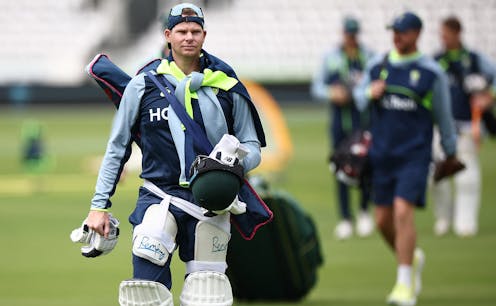
Cricket’s third World Test Championship final will begin on Wednesday night in London. Reigning champions Australia will compete with South Africa to be crowned the world’s best men’s Test cricket team.
This new tournament has faced controversy because of the points system used to determine the two finalists, with South Africa also criticised in recent years for allowing many key players to compete in T20 tournaments instead of Test matches.
Despite this, South Africa has earned its right to take on the Australians at Lord’s Cricket Ground.
What is the World Test Championship?
The World Test Championship is a tournament played between nine full members of the International Cricket Council (ICC): Australia, Bangladesh, England, India, New Zealand, Pakistan, South Africa, Sri Lanka and the West Indies.
The previous winners were New Zealand (2021) and Australia (2023).
The ICC introduced this tournament as a way to increase the relevance and importance of Test cricket in a world dominated by popular Twenty 20 tournaments such as the Big Bash and Indian Premier League.
Each country plays three series of between two and five Test matches at home, and three away.
The tournament takes two years to complete because each Test match can take five days and there are no dedicated times for Test match cricket throughout the year. This is because many cricketers also play in T20 and one-day tournaments.
Teams are awarded points for wins (12 points), ties (six) and draws (four) – there are zero points for a loss. Teams lose points if they bowl their overs too slowly.
While this point system is simple enough, ranking teams in the results table is more confusing, because some teams play more Tests than others.
Bigger, wealthier countries such as England, India and Australia commonly play four or five Tests in a series, whereas less affluent countries often play series with only two or three Tests.
Because of this difference, the results table is based on the percentage of points teams have won (how many points they won divided by how many points they could have won).
For example, if a team played ten tests, the maximum points they could earn would be 120 (10 x 12 points for each win). If they earned 60 points, then they would be ranked on the results table as winning 50% (60 divided by 120).
How did Australia and South Africa reach the final?
South Africa finished on top of the table by winning series against the West Indies, Bangladesh, Sri Lanka and Pakistan. They also drew with India and lost to New Zealand.
Australia beat Pakistan and India at home and New Zealand and Sri Lanka away. They also drew series with England (away) and the West Indies (home).
The final will be played at the “home of cricket”: Lord’s in London.
Neutral territory
Test matches are rarely played at neutral venues but the World Test Championship final is played in England for a variety of reasons.
The current two-year World Test Championship cycle ends in June, which is early summer in England and winter or monsoon season in most other major cricket nations.
England also offers good infrastructure, strong crowds, a time zone that aligns favourably with prime time viewing hours in India, and pitches that offer a fair contest between bat and ball, allowing for exciting and competitive cricket.
Despite these reasons, the repeated scheduling of finals in England has been criticised, predominantly by India.
Criticisms of the championship
South Africa’s qualification for the final has been criticised because they have played the least number of Tests and avoided playing some stronger teams.
While these criticisms are not unfounded, they are also not South Africa’s fault: the ICC is responsible for ensuring scheduling is fair.
Richer countries such as Australia, England and India face a dilemma in that five-Test series between them are generally high quality, exciting and profitable but are also difficult to win.
Smaller nations playing two-Test series receive less interest and money but also easier opponents and less fixture fatigue. This situation can make it easier for smaller, less affluent teams to have a higher winning percentage.
Other criticisms have focused on the points deductions for slow overs and the exclusion of Test playing nations Afghanistan, Ireland and Zimbabwe. When the World Test Championship was launched in 2019, only the nine full members were included. No specific reasons were given for the exclusion of Zimbabwe, Afghanistan and Ireland.
Including these countries and having two six-team divisions – with teams being relegated and promoted each year – has been suggested as way to make the Test championship more fair and more competitive.
However, this idea has also been criticised as focusing on profits instead of protecting and nurturing the game around the world.
These deductions and divisions, and other potential changes, were considered at a recent ICC meeting but no changes were made.
Final preparations
Australian players have prepared for the final in a variety of ways, such as playing in the IPL, county cricket in the United Kingdom and practice sessions at home.
They are favourites for the final and have a strong squad to choose from.
South Africa also has a strong team with several key players returning from injuries and a drugs ban.
A win for Australia would solidify its standing as the premier Test cricket team in the world. For South Africa, a victory would showcase a remarkable turnaround after being criticised for picking a weak squad for a tour of New Zealand, with most of its better players instead competing in T20 tournaments.
There is also record prize money at stake.
If the match is a draw, tie or washed out, Australia and South Africa will share the trophy. But there is a reserve day available in case of wet weather.


