

‘Microaggressions’ can fly under the radar in schools. Here’s how to spot them and respond
- Written by The Conversation
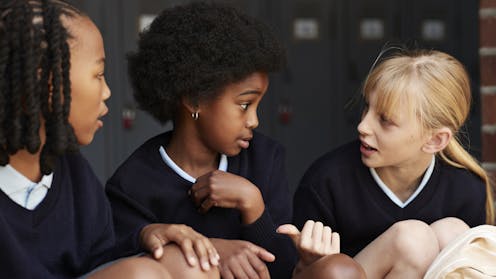
Bullying is sadly a common experience for Australian children and teenagers. It is estimated at least 25% experience bullying at some point in their schooling.
The impacts can be far-reaching and include depression and anxiety, poorer school performance, and poorer connection to school.
The federal government is currently doing a “rapid review” of how to better prevent bullying in schools. This do this, we need a clear understanding of the full spectrum of aggressive behaviours that occur in schools.
We already know bullying can be physical, verbal and social, and can occur in person and online. But there is less awareness among educators and policymakers of “microaggressions”. These can be more subtle but are nonetheless very damaging.
Read more: With a government review underway, we have to ask why children bully other kids
What’s the difference between bullying and microaggressions?
Bullying is unwanted aggressive behaviour by a person or group against a targeted victim, with the intent to harm. The behaviour is repeated and there is a power imbalance between the perpetrator and victim.
Microaggressions are a form of aggression that communicate a person is less valued because of a particular attribute – for example, their race, gender or disability.
Microaggressions are repeated, cumulative and reflect power imbalances between social groups. A key difference with traditional bullying is microaggressions are often unconscious on the part of the perpetrator – and can be perpetrated with no ill intent.
For example, traditional bullying could include a child always excluding another child from the group, always pushing them when they walk past them, or calling them a rude name.
Microaggressions could include:
saying “you don’t look disabled” to a student with an invisible disability
mispronouncing a student’s name with no attempt to correct the pronunciation
saying to a student of colour, “wow, you’re so articulate”, implying surprise at their language skills
minimising a student with disability’s experience by saying “it can’t be that difficult. Just try harder.”
We don’t have specific statistics on prevalence within Australia, although there is ample research to say those from minority groups frequently experience microaggressions.
For example, studies of young people in the United States found incidents of microaggressions, often focused on racism, homophobia, transphobia and fat stigma. Students who held more than one identity (for example, a minority race and sexual orientation), were more likely to be targets.
Microaggressions in schools
My 2025 research on microaggressions towards dyslexic students in Australia found both students and parents can be on the receiving end. Teachers, school support officers and other students could be perpetrators.
These interactions minimised the students’ experiences of dyslexia and made them feel like second class students compared to their peers.
Some of the children reported comments from peers such as “oh yeah, reading, writing is hard already” which minimised the difficulties caused by dyslexia. Another student recalled how a peer had corrected her spelling “by snatching my book and re-writing it”, assuming she couldn’t do it herself. One student was made to feel bad for using a laptop in class as “someone said it was cheating”.
The impact of microaggressions
Schools where microaggressions occur are not safe spaces for all students.
This can have serious implications for students’ school attendance, harm their mental health and ability to learn and socialise.
Research on US university students, showed students may also become hypervigilant waiting for future microaggressions to occur.
One Australian study found microaggressions can be so bad for some school students, they change schools in search of environments where staff and peers are more accepting.
How to address microaggressions
Research suggests addressing microaggressions can work as a prevention strategy to reduce other forms of bullying before it starts.
Studies also show teacher awareness of microaggressions is key to preventing and addressing incidents.
So a first step step is to make sure schools, teachers and students are aware of microagressions. Teachers should be educated about the relationship between microaggressions and bullying.
Schools need to create environments where microaggressions are understood, recognised and addressed. All students need to be taught how to respond appropriately as bystanders if they see microaggressions happening in the classroom, playground or online.
If a student feels that they or a friend has been made to feel less because of their identity, then they should be encouraged to seek help from an appropriate adult.
Schools also need proactive programs to foster inclusion in schools. Research shows school psychologists can help by delivering programs in mental health and social and emotional development.
Just as schools, teachers and school psychologists can be proactive in addressing microaggressions, so too can the federal government – by including microaggressions in its anti-bullying review.
If this article has raised issues for you, or if you’re concerned about someone you know, call Lifeline on 13 11 14 or Kids Helpline on 1800 55 1800.


