

The Middle East is a major flight hub. How do airlines keep passengers safe during conflict?
- Written by The Conversation
The Middle East is a region of intense beauty and ancient kingdoms. It has also repeatedly endured periods of geopolitical instability over many centuries.
Today, geopolitical, socio-political and religious tensions persist. The world is currently watching as longstanding regional tensions come to a head in the shocking and escalating conflict between Israel and Iran.
The global airline industry takes a special interest in how such tensions play out. This airspace is a crucial corridor linking Europe, Asia and Africa.
The Middle East is now home to several of the world’s largest international airlines: Emirates, Qatar Airways and Etihad Airways. These airlines’ home bases – Dubai, Doha and Abu Dhabi, respectively – have become pivotal hubs in international aviation.
Keeping passengers safe will be all airlines’ highest priority. What could an escalating conflict mean for both the airlines and the travelling public?
Safety first
History shows that the civil airline industry and military conflict do not mix. On July 3 1988, the USS Vincennes, a US navy warship, fired two surface-to-air missiles and shot down Iran Air Flight 655, an international passenger service over the Persian Gulf.
More recently, on July 17 2014, Malaysian Airlines Flight MH17 was shot down over eastern Ukraine as the battle between Ukrainian forces and pro-Russian separatists continued.
Understandably, global airlines are very risk-averse when it comes to military conflict. The International Civil Aviation Organization requires airlines to implement and maintain a Safety Management System (SMS).
One of the main concerns – known as “pillars” – of the SMS is “safety risk management”. This includes the processes to identify hazards, assess risks and implement risk mitigation strategies.
The risk-management departments of airlines transiting the Middle East region will have been working hard on these strategies.

Route recalculation
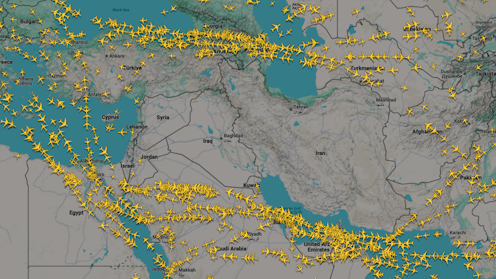
The most immediate and obvious evidence of such strategies being put in place are changes to aircraft routing, either by cancelling or suspending flights or making changes to the flight plans. This is to ensure aircraft avoid the airspace where military conflicts are flaring.
At the time of writing, a quick look at flight tracking website Flightradar24 shows global aircraft traffic avoiding the airspace of Iran, Iraq, Syria, Israel, Jordan, Palestine and Lebanon. The airspace over Ukraine is also devoid of air traffic.
Rerouting, however, creates its own challenges. Condensing the path of the traffic into smaller, more congested areas can push aircraft into and over areas that are not necessarily equipped to deal with such a large increase in traffic.
Having more aircraft in a smaller amount of available safe airspace creates challenges for air traffic control services and the pilots operating the aircraft.
More time and fuel
Avoiding areas of conflict is one of the most visible forms of airline risk management. This may add time to the length of a planned flight, leading to higher fuel consumption and other logistical challenges. This will add to the airlines’ operating costs.
There will be no impact on the cost of tickets already purchased. But if the instability in the region continues, we may see airline ticket prices increase.
It is not just the avoidance of airspace in the region that could place upward pressure on the cost of flying. Airliners run on Jet-A1 fuel, produced from oil.
If Iran closes the Strait of Hormuz, the “world’s most important oil transit chokepoint”, this could see the cost of oil, and in turn Jet-A1, significantly increase. Increasing fuel costs will be passed on the paying passenger. However, some experts believe such a move is unlikely.
A major hub
The major aviation hubs in the Middle East provide increased global connectivity, enabling passengers to travel seamlessly between continents.
Increased regional instability has the potential to disrupt this global connectivity. In the event of a prolonged conflict, airlines operating in and around the region may find they have increased insurance costs. Such costs would eventually find their way passed on to consumers through higher ticket prices.

Passenger confidence
Across the globe, airlines and governments are issuing travel advisories and warnings. The onus is on the travelling public to stay informed about changes to flight status, and potential delays.
Such warnings and advisories can lead to a drop in passenger confidence, which may then lead to a drop in bookings both into and onwards from the region.
Until the increase in instability in the Middle East, global airline passenger traffic numbers were larger than pre-pandemic figures. Strong growth had been predicted in the coming decades.
Anything that results in falling passenger confidence could negatively impact these figures, leading to slowed growth and affecting airline profitability.
Despite high-profile disasters, aviation remains the safest form of transport. As airlines deal with these challenges they will constantly work to keep flights safe and to win back passenger confidence in this unpredictable situation.


