

New cases of meningococcal disease have been detected. What are the symptoms? And who can get vaccinated?
- Written by The Conversation
Two Tasmanian women have been hospitalised with invasive meningococcal disease, bringing the number of cases nationally so far this year to 48. Health authorities are urging people to watch for symptoms and to check if they’re eligible for vaccination.
Invasive meningococcal disease is a rare but life-threatening illness caused by the bacteria Neisseria meningitidis. Invasive means the infection spreads rapidly through the blood and into your organs.
Early emergency medical care is important for survival and to reduce the chance of long-term complications. Even in those who survive, up to 30% suffer permanent cognitive, physical or psychological disabilities.
Thankfully, vaccines are available to protect against it.
How do you catch it?
Around one in ten people carry the meningococcal bacteria in their nose or throats.
The bacteria does not easily pass from person to person by breathing the same air or sharing drinks or food – and the bacteria do not survive well outside the human body.
It is spread through close and prolonged contact of oral and respiratory secretions, such as saliva, from others who live in your household or through deep, intimate kissing.
There is no way to know if you carry the bacteria, as carriers don’t have symptoms.
Who is most at risk?
Meningococcal disease can affect anyone.
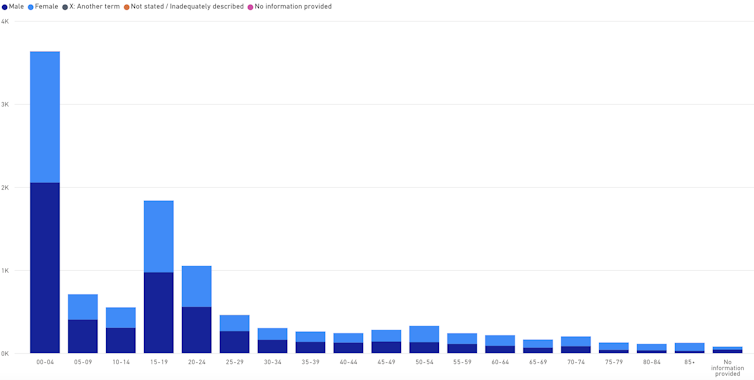
But infants under one, adolescents and young adults aged 15–25 years, and people without a spleen or who are immunosuppressed are at a higher risk of developing invasive disease.
Meningococcal disease notifications by age and sex
Although sensitive to common antibiotics such as penicillin, the meningococcal bacteria can cause severe infection and death in a matter of hours. The difficulty in picking up meningococcal disease early is that, early on, it can mimic common viral illnesses that people would recover from without any treatment.
Most people experience a sudden onset of fever, difficulty looking at light and/or a rash. The rash is non-blanching, meaning it doesn’t fade when you apply pressure to it. But early in the illness, it can start out as a blanching rash that fades with pressure.
Young infants may also become irritable, have difficulty waking up, or refuse to feed.
The bacteria usually causes a meningitis – inflammation of the lining around the brain and spinal cord – or a bloodstream infection, called septicemia or sepsis. But sometimes it can cause an infection of the bone, lungs (pneumonia) or eyes (conjunctivitis).
Protection against different strains
There are 13 types of meningococcal bacteria that cause invasive disease, but types A, B, C, W and Y cause the most illness.
The rapid disease progression occurs because the bacteria has a sugar capsule which allows it to evade the immune system.
But each of the 13 types has its own unique capsule. So immunity to one strain does not offer immunity to other strains.
Currently, two types of vaccines are available: a vaccine that protects against meningococcal A, C, W and Y (MenACWY); and another vaccine that protects against meningococcal B.
The vaccines are manufactured differently and therefore have different mechanisms of protection.
The MenACWY vaccine uses parts of the sugar capsule within each of the bacteria and joins them to a protein. This is called a “conjugate vaccine” and allows for a better immune response, especially in young infants.
The MenB vaccine does not contain the sugar capsule but includes four other proteins from the surface of the meningococcal B bacteria.
Both vaccines are registered for all people aged six months and older, and are safe for immunocompromised people.
MenACWY vaccine
The MenACWY vaccine is funded under the National Immunisation Program, and given for free, to all infants aged 12 months. There is also a free catch-up program for teens in Year 10.
The MenACWY vaccine protects against disease and also decreases the bacteria load in the throat, reducing the likelihood of transmission to others.
MenB vaccine
The MenB vaccine recommended for all infants aged six weeks or more. But it’s only available for free to infants in South Australia and Queensland, through state-based programs, and to Aboriginal and Torres Strait Islander infants nationally, via the National Immunisation Program.
Parents of non-Indigenous infants in other states will pay around A$220–270 for two doses of the MenB vaccine.
The MenB vaccine is highly protective against invasive disease for the person who receives the vaccine. But it does not eradicate the bacteria from the throat, nor does it decrease spread of the bacteria to others.
Reducing meningococcal disease
Other people who are at high risk of meningococcal exposure are also recommended for vaccination: people without a functional spleen, those with certain immunocompromising conditions, certain travellers and some lab workers.
Since the rollout of the conjugate MenC vaccine in 2001 and the MenACWY in 2018, rates of invasive meningococcal disease have dropped dramatically, from 684 cases in 2002, to 136 cases in 2024. The most common strain to cause disease is now meningococcal B.
Meningococcal notifications by jurisdiction
Another reason for adults to get vaccinated
The MenB vaccine has also been shown to lower rates of another bacterial infection, gonorrhoea, by 33–47%. This is because the gonococcal bacteria is closely related and shares similar surface protein structures to meningococcal bacteria.
In Australia, rates of gonorrhea have doubled over the past ten years , with higher rates among young Aboriginal and Torres Islander people.
The Northern Territory began offering the vaccine to people aged 14 to 19 last year as part of a research trial.
Further research is underway in Australia to better understand the meningococcal bacteria, its capability to evade the immune system and the cross protection against gonorrhoea.


