News Daily

The Times

Australia

  • Written by The Conversation
Much to celebrate as NAIDOC Week turns 50, but also much to learn

Aboriginal and Torres Strait Islander readers are advised this article contains names and/or images of deceased people.

In 1938, when Australia celebrated the sesquicentenary – 150 years since Captain Phillip and the First Fleet landed in Sydney Cove – the organisers wanted Aboriginal people to be involved in a re-enactment.

More than 25 Aboriginal men were rounded up from Menindee in western New South Wales. They were told if they did not perform the role of running up the beach away from the British, their families would starve.

Ngiyaampaa elder Beryl (Yunghadhu) Philp Carmichael, who was three at the time, recollected years later that all she could remember was the crying:

All the women were crying. Whether they were taking them away to be massacred, no one knew.

The re-enactment was of course a fallacy of what really happened on January 26 1788 – it was a “white-washing” of history.

The mistreatment of the Menindee men illustrates the anger that was simmering over the status and treatment of fellow Aboriginal kin.

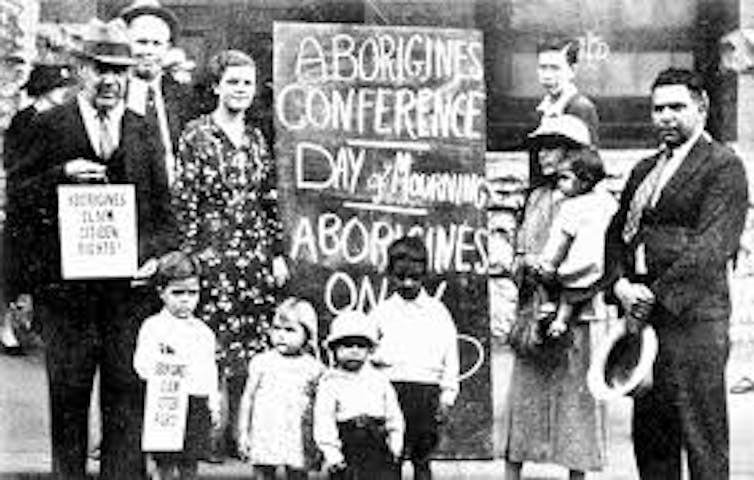
Protests against Australia Day, which had been growing since the 1920s, led to the Aboriginal Day of Mourning, the first national gathering of Indigenous people speaking up against discrimination and dispossession.

Adults and children gathered around a Aboriginal Day of Mourning banner.
The Aboriginal Day of Mourning was regarded as one of the first major civil rights movements in the world. National Museum of Australia, CC BY

The emergence of Aboriginal protest groups nearly a century ago gave birth in the 1970s to what eventually came to be known as the National Aborigines and Islanders Day Observance Committee (NAIDOC), which this year celebrates its 50th anniversary.

Celebrating culture

NAIDOC’s role is to encompass all Indigenous/First Nations peoples in Australia.

One week is set aside each July:

to celebrate and recognise the history, culture and achievements of Aboriginal and Torres Strait Islander peoples.

NAIDOC Week is essentially a celebration of the oldest, continuous living cultures on earth. Numerous events are held across the country – performances, art and photographic exhibitions, smoking ceremonies and the popular National NAIDOC Awards.

They present a crucial opportunity to increase awareness in the wider community of Indigenous history and excellence, while acknowledging the challenges that remain.

It is distinct from Reconciliation Week, which focuses on relations between Indigenous and non-Indigenous people.

As a current co-chair of the NAIDOC Committee, I recognise the ongoing need, as initially established by our Elders as the founders of NAIDOC Week, to highlight the continuing issues for us as Indigenous peoples in Australia.

NAIDOC themes

We do this by setting a theme each year focused on a specific challenge.

The themes are determined through deep consideration of the significant issues facing Indigenous peoples. They have evolved through political protests, social change, recognition, respect and appreciation of Indigenous rights.

Some examples down the years from the 1970s include:

  • Advance Australia Where? (1972)
  • Self Determination (1974)
  • White Australia has a Black History (1987)
  • Understanding It Takes the Two of Us (1985)
  • Justice not Tolerance (1995)
  • Gurindji, Mabo, Wik – Three Strikes for Justice (1997)
  • Bringing Them Home (1998)
  • Advance Australia Fair? (2008)
  • Our Languages Matter (2017)
  • Voice. Treaty. Truth. (2019)
  • Always Was, Always Will Be (2020).

NAIDOC Week helps promote to the wider community the importance of truth-telling and learning of societal issues, the heritage of culture and languages, and the history of interactions between Indigenous and non-Indigenous people.

Ask yourself: what do you know about the themes? Why are they relevant and what impact do they have on Indigenous peoples across Australia?

Next generation

The theme for 2025 is “The Next Generation: Strength, Vision and Legacy”.

It was selected following the committee’s distress at the way in which our youth are often demeaned in the media and presented as social pariahs and potential risks to the wider community’s safety.

To us, our youth are our cultural and social strength, and the continuity for our communities. We therefore celebrate our youth. We wish to highlight these amazing young people in our communities, as our vision and legacy for our future. Look no further than our past NAIDOC Youth winners: Dante Rodrigues 2024: a professional martial arts and kickboxer who runs health and wellbeing programs for young Indigenous people Courtney Burns 2023: a marine biologist who is deeply passionate about the connection between ocean, Country and our Mob Elijah Manis 20022: Young islander working in the fields of social justice issues and the effects of climate change on the Torres Strait. In NAIDOC and the ABC’s educational resource Culture Is Life, three young people speak of the kind of ancestor they would like to be to inspire future generations. Visual artist Irwin Lewis said he would want to be known for his conservation of cultural knowledge, stories and language. Foster care worker Shaylem Wilson nominated never turning away from hard truths, and working with young people who continue to be taken away from their families and Country, as well as maintaining and strengthening their family and cultural ties. Youth advocate Manny Williams noted he wanted to seek deeper connection to Country to help guide the next generations of young people: I want to be an ancestor who always nurtured everything from people to Country — guiding those who seek a deeper connection; sharing wisdom and knowledge to those who listen. An ancestor who is there to remind our people of the light we all have within ourselves. The future is in the hands of these remarkable Indigenous youth as they grapple with the human rights, political and societal issues facing their communities. Many Australians have much to learn from NAIDOC Week. All of us have much to celebrate.

Read more https://theconversation.com/much-to-celebrate-as-naidoc-week-turns-50-but-also-much-to-learn-259900

Split Corrugated Conduit for Flexible Cable Protection

For wiring assemblies in vehicles, machinery and equipment, choosing suitable cable protection helps keep cables organised and reduces direct contact with surrounding parts. Mojak Plastics supplies plastic tubing and conduit options for different installation needs, and split corrugated conduit can... Read more

Trailers Melbourne Buyers Can Compare: When Box Trailers Make Sense

For many homeowners, businesses and tradespeople, trailers Melbourne customers use every week need to be versatile enough for changing loads. A box trailer can be particularly useful because its enclosed sides help contain cargo while providing a straightforward loading area... Read more

Bottle Label Printing That Balances Design and Readability

Product labels need to attract attention while making information easy to find and understand. On a bottle, the available space may be limited by the container’s shape, so every design decision matters. Bottle label printing should account for visual hierarchy... Read more

Office Cleaning Melbourne: Planning a Consistent Workplace Routine

Businesses looking for office cleaning Melbourne need a plan that reflects the way their workplace operates. A clean office supports day-to-day organisation, helps shared spaces remain presentable and gives employees and visitors a more orderly environment. Eco Green Cleaning Management... Read more

Pinboard Solutions for Offices, Schools and Shared Information Spaces

Why a Pinboard Remains Useful A pinboard provides a simple way to display information that needs to remain visible without being rewritten. Lawdex supplies fabric and cork options for offices, schools, staff areas and other environments. A pinboard can be used... Read more

Retractable Hose Reel: A Practical Guide To Choosing The Right Hose Storage

A retractable hose reel can make hose storage more organised, accessible and practical in workshops, commercial facilities, service areas and other working environments. Instead of leaving a hose coiled across the floor or requiring staff to manually wind it after... Read more