

Is it okay to boil water more than once, or should you empty the kettle every time?
- Written by The Conversation
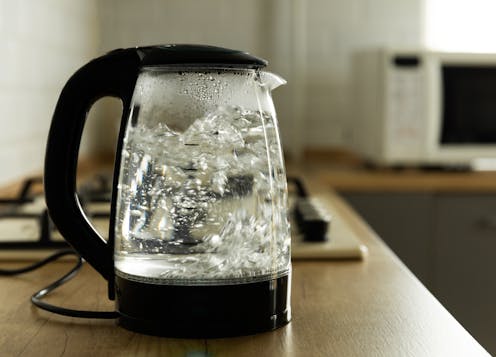
The kettle is a household staple practically everywhere – how else would we make our hot drinks?
But is it okay to re-boil water that’s already in the kettle from last time? While bringing water to a boil disinfects it, you may have heard that boiling water more than once will somehow make the water harmful and therefore you should empty the kettle each time.
Such claims are often accompanied by the argument that re-boiled water leads to the accumulation of allegedly hazardous substances including metals such as arsenic, or salts such as nitrates and fluoride.
This isn’t true. To understand why, let’s look at what is in our tap water and what really happens when we boil it.
What’s in our tap water?
Let’s take the example of tap water supplied by Sydney Water, Australia’s largest water utility which supplies water to Sydney, the Blue Mountains and the Illawarra region.
From the publicly available data for the January to March 2025 quarter for the Illawarra region, these were the average water quality results:
- pH was slightly alkaline
- total dissolved solids were low enough to avoid causing scaling in pipes or appliances
- fluoride content was appropriate to improve dental health, and
- it was “soft” water with a total hardness value below 40mg of calcium carbonate per litre.
The water contained trace amounts of metals such as iron and lead, low enough magnesium levels that it can’t be tasted, and sodium levels substantially lower than those in popular soft drinks.
These and all other monitored quality parameters were well within the Australian Drinking Water Guidelines during that period. If you were to make tea with this water, re-boiling would not cause a health problem. Here’s why.
It’s difficult to concentrate such low levels of chemicals
To concentrate substances in the water, you’d need to evaporate some of the liquid while the chemicals stay behind. Water evaporates at any temperature, but the vast majority of evaporation happens at the boiling point – when water turns into steam.
During boiling, some volatile organic compounds might escape into the air, but the amount of the inorganic compounds (such as metals and salts) remains unchanged.
While the concentration of inorganic compounds might increase as drinking water evaporates when boiled, evidence shows it doesn’t happen to such an extent that it would be hazardous.
Let’s say you boil one litre of tap water in a kettle in the morning, and your tap water has a fluoride content of 1mg per litre, which is within the limits of Australian guidelines.
You make a cup of tea taking 200ml of the boiled water. You then make another cup of tea in the afternoon by re-boiling the remaining water.
On both occasions, if heating was stopped soon after boiling started, the loss of water by evaporation would be small, and the fluoride content in each cup of tea would be similar.
But let’s assume that when making the second cup, you let the water keep boiling until 100ml of what’s in the kettle evaporates. Even then, the amount of fluoride you would consume with the second cup (0.23mg) would not be significantly higher than the fluoride you consumed with the first cup of tea (0.20mg).
The same applies to any other minerals or organics the supplied water may have contained. Let’s take lead: the water supplied in the Illawarra region as mentioned above, had a lead concentration of less than 0.0001mg per litre. To reach an unsafe lead concentration (0.01mg per litre, according to Australian guidelines) in a cup of water, you’d need to boil down roughly 20 litres of tap water to just that cup of 200ml.
Practically that is unlikely to happen – most electric kettles are designed to boil briefly before automatically shutting off. As long as the water you’re using is within the guidelines for drinking water, you can’t really concentrate it to harmful levels within your kettle.
But what about taste?
Whether re-boiled water actually affects the taste of your drinks will depend entirely on the specifics of your local water supply and your personal preferences.
The slight change in mineral concentration, or the loss of dissolved oxygen from water during boiling may affect the taste for some people – although there are a lot of other factors that contribute to the taste of your tap water.
The bottom line is that as long as the water in your kettle was originally compliant with guidelines for safe drinking water, it will remain safe and potable even after repeated boiling.


