

From grasslands to killing fields: why trees are bad news for one of Australia’s most stunning birds
- Written by The Conversation
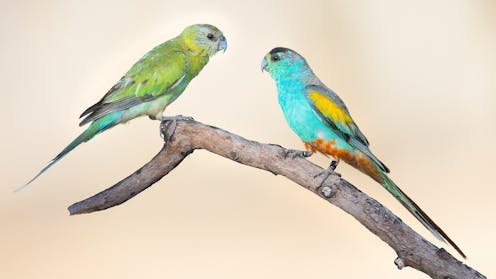
Picture this. A small, rainbow-coloured chick emerges from its nest for the first time. It stretches its wings and prepares to take flight. But before the fledgling’s life in the wild has begun, a sharp-beaked predator swoops in, leaving nothing but a tiny skeleton.
This is the sad scenario playing out on Cape York Peninsula, new analysis shows. There, trees are invading the open, grassy habitat of the endangered golden-shouldered parrot (Psephotellus chrysopterygius). The trees give cover to predators – meaning they can lie in wait, before striking the adult birds and their young.
The golden-shouldered parrot is endangered, now found in just 5% of its original range. The new findings suggest more work is needed to restore grassland habitat to its former open state, to ensure the parrots’ survival.
A vanishing species
The initial decline of the golden-shouldered parrot was likely caused by a loss of food plants and degradation of the termite mounds in which it nests. Birds that remained in two small areas in central Cape York Peninsula faced other issues.
In the 1990s, researchers began studying the parrot on Artemis Station, to better understand why numbers were declining. A new suspect was identified: native woody plants, such as the broad-leaved tea-tree (Melaleuca viridiflora), which had crept into the birds’ grassy habitat.
The change was largely due to overgrazing, which reduced fuel loads and led to fewer fires. This allowed the woodland trees to overtake the grasslands. But exactly how were these trees affecting the survival of the golden-shouldered parrot? New research by my colleagues and I set out to answer this question.
Counting eggs, nest by nest
We monitored 108 termite-mound nests over three years, tracking the success of 555 eggs. We visited each nest every few days to record whether chicks successfully fledged (grew strong enough to leave the nest) or died.
We also counted the number of trees around the nests, and recorded signs of interference from predators.
So what did we find? The proportion of nests that produced a fledgling from every egg decreased in proportion to the number of trees around the nest. The percentage of eggs, chicks and adults that were killed or disappeared from a nest also increased in line with tree numbers.
That’s because the trees bring different predators – and places for them to hide.
We suspected reptiles were the main predators. This was due to scratches on the nests and disappearance of eggs without any other signs of damage. While the exact species of reptile predator was hard to pinpoint, we know tree snake numbers increase as woodlands encroach.
However, of all predators, we found butcherbird numbers increased most strongly as trees crept in. Butcherbirds tear prey apart with their strong, hooked beaks. Trees close to the nests give butcherbirds cover, enabling them to wait for adults or their young to emerge.
Tragically, we found skulls of chicks pierced by the butcherbirds’ sharp bills. In one case, the shredded flesh of a bird was wedged atop a termite mound.
Parrots successfully fledged from just over half of the 555 eggs we monitored.
In the most dense woodlands, the number of birds that successfully fledged was just one-third of the rate needed to maintain the golden-shouldered parrot’s population.
Adult birds were lost from one-third of the nests we studied. This is especially troubling. Modelling from similar tropical birds shows this rate of adult deaths can push a species towards extinction.
Restoring the parrots’ grassland home
The world’s grassland habitats are under threat. This has devastating consequences for species that depend on them – including the golden-shouldered parrot.
Our findings show Cape York’s grasslands should be maintained and restored to ensure the survival of the golden-shouldered parrot. Much work is needed to ensure the species avoids the fate of its closest relative, the paradise parrot, which is presumed extinct.
Work is already underway. Golden-shouldered parrot habitat in national parks and on Indigenous-owned land has been destocked, and more traditional Indigenous fire regimes reinstated. This will help maintain open grasslands and reverse early woodland encroachment. Such work is also being undertaken at the study site on Artemis Station.
Where woody plant invasion is more advanced, more intensive methods have been deployed. At the study site, this includes using chainsaws and brush-cutters to clear trees, before the stump is poisoned.
Other measures include installing electric fences to keep out reptiles, reseeding grasslands with food plants and providing feeding stations in seasons when food is scarce.
Land managers across Cape York have also been provided guidelines for managing woodland encroachment.
These efforts must be sustained in the long-term, to ensure the golden-shouldered parrot can return to its former range.


