

Precious finger traces from First Nations ancestors revealed in a glittering mountain cave in Australia
- Written by The Conversation
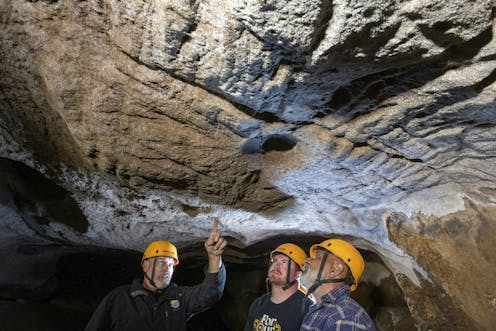
Australia’s First Nations history stretches back many tens of thousands of years, rich in depth and diversity.
Archaeological research has revealed much about this deep past, but it has rarely captured the gestures of the ancestors – their movements, postures and physical motions. Material traces like tools and hearths tend to survive; fleeting movements usually do not.
Newly published research in the journal Australian Archaeology has revealed something different: traces of hand movements preserved in soft rock deep within GunaiKurnai Country.
In a limestone cave in the foothills of the Victorian alps, a team of researchers led by the GunaiKurnai Land and Waters Aboriginal Corporation in partnership with Monash University and international archaeologists from Spain, France and New Zealand studied finger impressions dragged into the walls and ceilings. They reveal the hand movements of ancestors from thousands of years ago.

The glittering Waribruk
The cave, referred to by GunaiKurnai Elders as Waribruk, contains a pitch-black chamber beyond the reach of natural light. To enter and mark these walls, the ancestors would have needed artificial light: firesticks or small fires.
The cave’s deeper interior walls became soft over millions of years as underground waters penetrated the limestone, slowly weathering and dissolving the rock into cavernous tunnels.

The remaining wall surfaces and ceilings became spongy and malleable, much like the texture of playdough.
Over time, cave-dwelling bacteria living on the soft, moist rock produced luminescent microcrystals, so that today, the walls and ceiling glitter when exposed to light.
It is on these glittering surfaces that the finger grooves are found.
We don’t know exactly when they were made, but people would have needed artificial light to reach this part of the cave. They would have either carried firesticks or lit fires on the ground.
 The ceiling deep in the cave, the microcrystals in the rock glittering in low light.
Photo by Bentley Dean, courtesy of GunaiKurnai Land and Waters Aboriginal Corporation
Archaeological excavations below and near the panels failed to uncover evidence of fires on the ground, but we did find millimetre-long fragments of charcoal and tiny patches of ash, likely dropped embers from firesticks.
These were found buried in the cave floor under and near the decorated walls. They date between 8,400 and 1,800 years ago, about 420 to 90 generations past.
This, then, is the best estimate for how long ago the old ancestors moved through the dark tunnels of the cave, firelight in hand, to create the finger impressions on the walls.
 Panel of finger grooves deep in the cave at Waribruk.
Photo courtesy of GunaiKurnai Land and Waters Aboriginal Corporation
Rare ancestral gestures
What they made when they dragged their fingers along the soft rock surfaces deep in the cave is remarkable, revealing rare evidence of ancestral gestures: fleeting bodily movements captured in soft cave surfaces.
On one panel, 96 sets of grooves were recorded. The first marks run horizontally, made by multiple fingers, sometimes both hands side by side. Later, vertical and diagonal grooves were added, intersecting the earlier ones.
 Panel of finger grooves at Waribruk, showing how the finger grooves were added to over time.
Figure courtesy of GunaiKurnai Land and Waters Aboriginal Corporation
Among them are two parallel sets of narrow impressions, only 3 to 5 millimetres wide for each finger. They are each set a short distance apart, indicating they were made by a small child. However, they’re so high up, the child must have been lifted by an adult.
Deeper in the cave, a low ceiling panel bears 262 grooves above a narrow clay bench sloping steeply toward a creek bed. The grooves indicate people moved along the ledge, crawling, sitting, or balancing to reach the ceiling.
Farther along, 193 grooves trace a path above the creek bed. Fingers were pressed into the soft ceiling, gradually releasing 1.6 metres farther along as the people walked forward.
All impressions point the same way, suggesting arms and hands raised overhead, capturing a deliberate, embodied gesture as the ancestors moved deeper into the cave.
A place only few could enter
Altogether there are 950 sets of finger grooves deep within Waribruk. Their meaning remained unclear for years, but a close analysis of where the marks appear, and where they don’t, offers key insights.
The grooves are always located in areas where calcite microcrystals coat the cave walls or ceiling, sometimes just extending past the glitter’s edges. They never appear in areas of the cave where the soft walls are without glitter.
Crucially, they occur far from any archaeological evidence of domestic life: no hearths, no food remains, no tools.
This absence matters. GunaiKurnai oral traditions hold that such caves weren’t used for ordinary living. They were only frequented by special individuals, mulla-mullung – medicine men and women who wielded powerful knowledge.
Mulla-mullung healed and cursed through ritual, using crystals and powdered minerals as part of their practice.
 Panel of finger grooves above the creekbed, here lit by artificial light.
Photo courtesy of GunaiKurnai Land and Waters Aboriginal Corporation
In the late 1800s, GunaiKurnai knowledge-holders told the pioneer ethnographer Alfred Howitt about the powers of these crystals, and of the caves. The role of mulla-mullung, they explained, was usually passed on from parent to child, and when a mulla-mullung lost their crystals, they lost their powers.
The finger grooves at Waribruk matches these traditions. They are not casual decorations. They are deliberate gestures, linked to crystal-coated surfaces, made in places only a few could enter.
The grooves reflect movement, touch, and sources of power for special individuals in the community: an embodied record of people interacting with the sacred.
What survives is not just ancient “rock art”. These are the gestures of ancestors, mulla-mullung it now seems, who ventured into the deepest darkness of the cave to access the power of the glittering surfaces.
Through these finger trails, we glimpse not only a physical act, but a cultural practice grounded in knowledge, memory and spirituality. A momentary movement, preserved in stone, connecting us to lives lived long ago – and breathing the cave to life through the actions of the ancestors and culture.
Acknowledgements: The authors are just three of the 13 authors of the journal article, including Olivia Rivero Vilá and Diego Garate Maidagan, who undertook the photography to create the digital 3D models of the panels to record and measure the size of the finger grooves.


