

Grape growers are adapting to climate shifts early – and their knowledge can help other farmers
- Written by The Conversation

It’s commonly assumed Australia’s farmers and cities are divided over climate issues. This is not true. After all, farmers are on the front line and face the realities of our shifting climate on a daily basis.
In regional Australia, our research has found many farmers are already responding to climate change threats and finding ways to adapt.
Wine grape growers are among those who are responding fastest. That’s because their crop is extremely sensitive to weather and climatic shifts. Growers have had to learn quickly how to adapt to safeguard their industry. Think pruning for better canopy management, growing cover crops to keep the ground cooler and promote soil health, and reducing how much water they use in irrigation.
Establishing a vineyard takes a long time – up to five years until the vines produce a full yield. Grape growers have to take a medium to long term perspective to farming, weighing up forecasts about climate change and market trends a decade or more in advance. Successful vignerons recognise the need to work together in a coordinated way to achieve positive outcomes. Maintaining local agency is crucial, and relinquishing this can open up new risks.
Australia’s broader farming community will have to draw on similar adaptations – preparing for less rainfall in some areas, or finding ways to capture the enormous but less frequent rain bursts predicted for other areas.
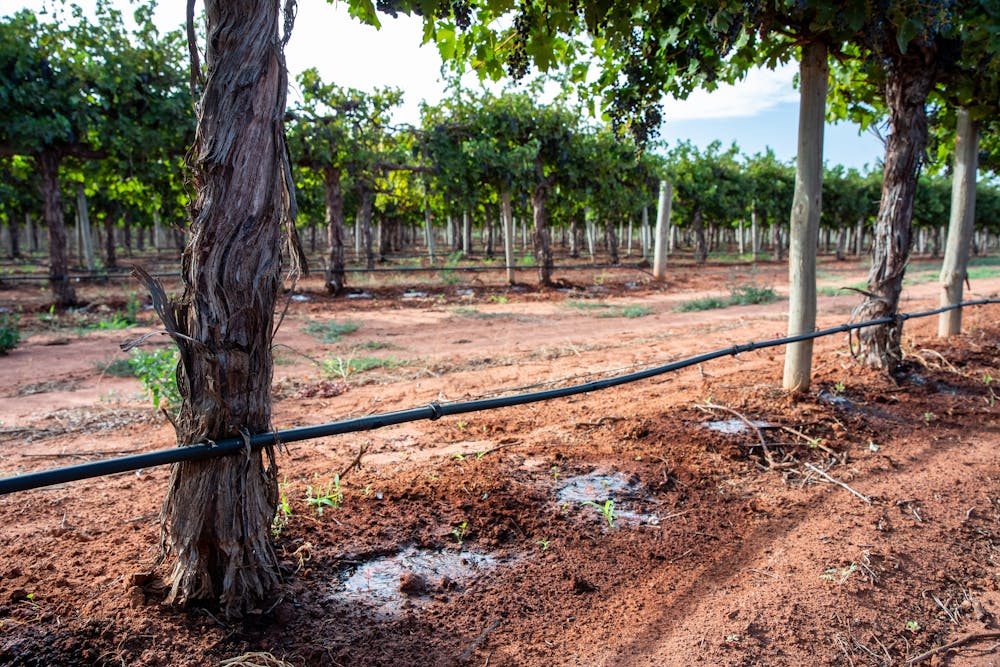
Wine grape growers have had to act early because wine has enormous market differentiation based on variety. In turn, choice of varieties depends heavily on water and soil.
During the 1990s and 2000s, Australian wine exports boomed. The lion’s share of the cheap and cheerful Aussie wines bound for supermarket shelves around the world came from grapes from extensive irrigated vineyards throughout the Murray-Darling Basin, where grapes are grown relatively cheaply with lots of sunshine and lots of water. But the days of water abundance are no longer guaranteed.
Our research in South Australia’s Langhorne Creek wine region has found climate change is having most impact in respect to water.
Historically, this region has relied on groundwater or surface irrigation from seasonal floods along local watercourses. But as groundwater suffered from over-extraction, the aquifers became saltier.
In response, farmers sought to minimise reliance on groundwater. Some vineyards even installed desalination plants to make groundwater usable again. Community leaders spearheaded a push to cut their own allocations and seek supply from nearby Lake Alexandrina, which the Murray and other rivers empty into.
Read more: Australia's farming future: Tasmania
Then came the 2001–2009 Millennium Drought, which led to the shallow lake beginning to dry up through lack of inflow. The crisis of these drought years is seared into regional memory. Without a clear end in sight, many began to wonder if the region had a future.
 South Australia’s Lake Alexandrina shrank markedly during the Millennium Drought, as this image from 2009 shows.
Larine Statham/AAP
South Australia’s Lake Alexandrina shrank markedly during the Millennium Drought, as this image from 2009 shows.
Larine Statham/AAP
The community backed a new private-public pipeline drawing directly from the Murray. When the new pipeline opened in 2009, it gave Langhorne Creek an important boost to water security. But it did so at the expense of tying its future directly to that of the Murray Darling Basin.
Now, farming in Langhorne Creek is at the mercy of everything that happens upstream. After two years of La Niña rains, there’s plenty of water in the system. For the time being, things are good – but farmers know better than most that good times don’t last.
In response to the broader shifts, many grape growers have increased plantings of southern Mediterranean varieties such as tempranillo or vermentino, better suited to hotter and drier conditions than traditional mainstays like shiraz and cabernet sauvignon grapes.
To date, Langhorne Creek offers an excellent example of how a strong community can act effectively in the face of environmental threat. As the region becomes integrated into the wider basin, there will be new challenges in navigating basin-wide management policies, a broadening bureaucratisation of decision making, and falling public trust in basin management.
While the technological fix of a new pipeline has helped grape growers overcome an immediate water supply issue, it does not defeat broader climate risk. What it does show is the need for forward thinking. The task for current and future farmers is to remain vigilant in confronting new climate risks, and responding through strong and coordinated local action and political cooperation.
Read more: Developing a taste for Sagrantino: climate change and Australia's wine industry


