

New horror film Went Up The Hill is a chilling exploration of trauma and memory
- Written by The Conversation
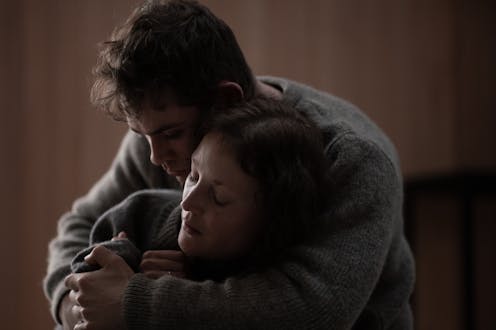
Evocative of the familiar nursery rhyme Jack and Jill, New Zealand-born filmmaker Samuel Van Grinsven’s Went Up the Hill is a hauntingly tender play on the “ghost story” genre.
Went Up the Hill explores the darkest corners of trauma. It is set almost entirely within the confines of a home in New Zealand’s Canterbury High Country, overlooking Lake Pearson.
Employing many familiar genre conventions, such as bodily possession, Van Grinsven’s ghost story is an affecting meditation on how people understand, confront and overcome the pain buried in their past.
An austere tale of afterlife
The film focuses extensively on the relationship between three characters, played by two people: Jack (Dacre Montogomery), Jill (Vicky Krieps) and Elizabeth (Montgomery/Krieps).
Jack and Jill become intertwined when the former arrives unannounced at the home, and funeral, of his estranged mother, Elizabeth.
Here, he encounters her widow, Jill. The initial markers of “other forces” are foregrounded: Jack insists it was Jill who invited him to the funeral, while Jill remains adamant she had no prior knowledge of the young man’s existence.
The psychological intensity of the narrative unfolds within the confines of the home’s brutalist architecture, as Van Grinsven renders the parameters between the natural and supernatural increasingly thin.
It soon becomes clear, when both Jack and Jill fall asleep, they are alternately possessed by the spirit of Elizabeth. Through their interactions with their mother/wife, the characters edge closer to the source of their respective traumas, beginning to confront their shadowed pasts.
The haunting presence of abusive relationships lingers throughout the film. This is reinforced by Elizabeth’s sister, Helen (Sarah Perise), who discloses that when Jack was in preschool, she “made the call” to have custody revoked due to Elizabeth’s mistreatment of him.
Jill’s multiple wounds are also indicative of an abusive power dynamic, while Elizabeth’s dangerous behaviour becomes increasingly apparent as the narrative unfolds.
The film notably avoids a shallow depiction of abusive relationships. With delicate ambiguity, it is inferred on several occasion that Elizabeth, who took her own life, may have been suffering from mental illness.
Nonetheless, the wounds of Jack’s and Jill’s buried pasts continue to resurface. Pushed to their physical and psychological edge, the pair ultimately accept the past can’t be outrun. In order to let Elizabeth go, they must confront the source of their pain.

Trauma and the body
The film’s interest in the link between memory and trauma becomes evident through the pair’s intense encounters with Elizabeth.
Touch becomes a focal point for the camera in strikingly directed scenes of intimacy, as the characters revisit their painful memories.
Here, the film draws attention to the physicality of memory. It captures how, while memory alone can help us understand the past, particular moments and feelings can only be conjured through the visceral.
One powerful example exploring the relation between memory and trauma comes when Elizabeth, inhabiting the body of Jill, gives her son a bath, in a return to a childhood memory that was perhaps never forged. Jack longs for the maternal care.
However, the gentle motherly display quickly becomes sinister when Elizabeth, still in Jill’s body, attempts to drown Jack in bloodied water. Both loving and sadistic, the bathtub sequence is indicative of the film’s focus on the body, and representative of the pair’s painful histories.
As this sequence illustrates, it is through possession – and particularly a focus on the body – that Van Grinsven’s film reaches its most tender and disturbing heights.
The possessions depict the abused welcoming the abuser into their bodies, intimately returning to the source of their pain.

The film succeeds in using the spirit-like entity as a vehicle for exploring how trauma itself is the ultimate ghost living with us. At times, the chaotic moments appear to release the emotional tension produced during the more sombre, chilling sequences.
Underpinned by commanding lead performances and unnervingly sharp cinematography and sound, Went Up the Hill is an inventive play on the ghost story.
The film speaks loudest in moments of silence and darkness. It offers a nuanced and moving cinematic exploration of how the ghosts of trauma relentlessly linger through time and space.
Went Up the Hill is in Australian cinemas from today, and in New Zealand cinemas from October 9.


