

Want more protein for less money? Don’t be fooled by the slick black packaging
- Written by The Conversation
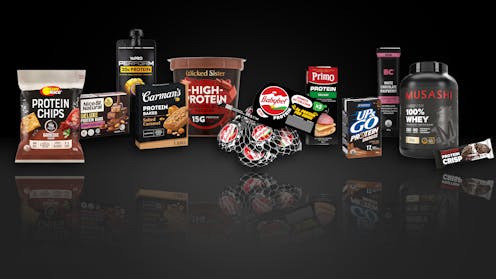
If you’ve been supermarket shopping lately, you might have noticed more foods with big, bold protein claims on black packaging – from powders and bars to yoghurt, bread and even coffee.
International surveys show people are shopping for more protein because they think it’ll help their fitness and health. But clever marketing can sway our judgement too.
Before your next shop, here’s what you should know about how protein is allowed to be sold to us. And as a food and nutrition scientist, I’ll offer some tips for choosing the best value meat or plant-based protein for every $1 you spend – and no, protein bars aren’t the winner.
‘Protein’ vs ‘increased protein’ claims
Let’s start with those “high protein” or “increased protein” claims we’re seeing more of on the shelves.
In Australia and New Zealand, there are actually rules and nuances about how and when companies can use those phrases.
Under those rules, labelling a product as a “protein” product implies it’s a “source” of protein. That means it has at least 5 grams of protein per serving.
“High protein” doesn’t have a specific meaning in the food regulations, but is taken to mean “good source”. Under the rules, a “good source” should have at least 10 grams of protein per serving.
Then there is the “increased protein” claim, which means it has at least 25% more protein than the standard version of the same food.
If you see a product labelled as a “protein” version, you might assume it has significantly more protein than the standard version. But this might not be the case.
Take, for example, a “protein”-branded, black-wrapped cheese: Mini Babybel Protein. It meets the Australian and New Zealand rules of being labelled as a “source” of protein, because it has 5 grams of protein per serving (in this case, in a 20 gram serve of cheese).
But what about the original red-wrapped Mini Babybel cheese? That has 4.6g of protein per 20 gram serving.
The difference between the original vs “protein” cheese is not even a 10% bump in protein content.
Black packaging by design
Food marketers use colours to give us signals about what’s in a package.
Green signals natural and environmentally friendly, reds and yellows are often linked to energy, and blue goes with coolness and hydration.
These days, black is often used as a visual shorthand for products containing protein.
But it’s more than that. Research also suggests black conveys high-quality or “premium” products. This makes it the perfect match for foods marketed as “functional” or “performance-boosting”.
The ‘health halo’ effect
When one attribute of a food is seen as positive, it can make us assume the whole product is health-promoting, even if that’s not the case. This is called a “health halo”.
For protein, the glow of the protein halo can make us blind to the other attributes of the food, such as added fats or sugars. We might be willing to pay more too.
It’s important to know protein deficiency is rare in countries like Australia. You can even have too much protein.
How to spend less to get more protein
If you do have good reason to think you need more protein, here’s how to get better value for your money.
Animal-based core foods are nutritionally dense and high-quality protein foods. Meats, fish, poultry, eggs, fish, and cheese will have between 11 to 32 grams of protein per 100 grams.
That could give you 60g in a chicken breast, 22g in a can of tuna, 17g in a 170g tub of Greek yoghurt, or 12g in 2 eggs.
In the animal foods, chicken is economical, delivering more than 30g of protein for each $1 spent.
But you don’t need to eat animal products to get enough protein.
In fact, once you factor in costs – and I made the following calculations based on recent supermarket prices – plant-based protein sources become even more attractive.
Legumes (such as beans, lentils and soybeans) have about 9g of protein per 100g, which is about half a cup. Legumes are in the range of 20g of protein per dollar spent, which is a similar cost ratio to a protein powder.

Nuts and seeds like sunflower seeds can have 7g in one 30g handful. Even one cup of simple frozen peas will provide about 7g of protein.
Peanuts at $6 per kilogram supply 42g of protein for each $1 spent.
Dry oats, at $3/kg have 13g of protein per 100g (or 5g in a half cup serve), that’s 33g of protein per dollar spent.
In contrast, processed protein bars are typically poor value, coming in at between 6-8g of protein per $1 spent, depending on if you buy them in a single serve, or in a box of five bars.
Fresh often beats processed on price and protein
Packaged products offer convenience and certainty. But if you rely on convenience, colours and keywords alone, you might not get the best deals or the most nutritious choices.
Choosing a variety of fresh and whole foods for your protein will provide a diversity of vitamins and minerals, while reducing risks associated with consuming too much of any one thing. And it can be done without breaking the bank.


