

12,000-year-old smoked mummies reveal world’s earliest evidence of human mummification
- Written by The Conversation
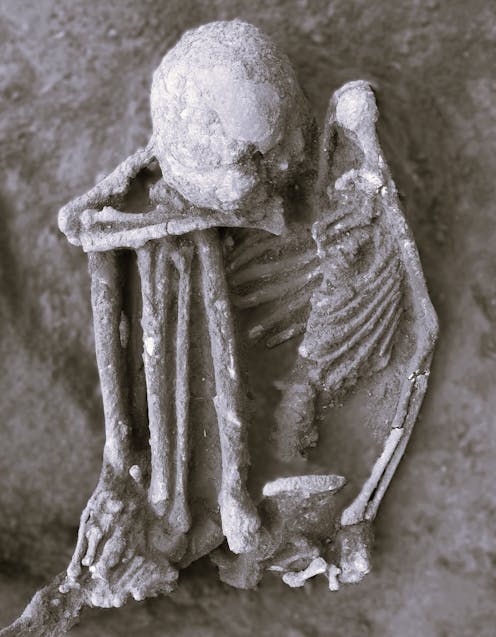
Smoke-drying mummification of human remains was practised by hunter-gatherers across southern China, southeast Asia and beyond as far back as 12,000 years ago, my colleagues and I report in new research published today in the Proceedings of the National Academy of Sciences.
This is the earliest known evidence of mummification anywhere in the world, far older than better-known examples from ancient Egypt and South America.
We studied remains from sites dated to between 12,000 and 4,000 years ago, but the tradition never vanished completely. It persisted into modern times in parts of the New Guinea Highlands and Australia.
Hunter-gatherer burials in southern China and Southeast Asia
In southern China and Southeast Asia, tightly crouched or squatting burials are a hallmark of the hunter-gatherers who inhabited the region between roughly 20,000 and 4,000 years ago.
Archaeologists working across the region for a long time have classified these graves as straightforward “primary burials”. This means the body was laid to rest intact in a single ceremony.

However, our colleague Hirofumi Matsumura, an experienced physical anthropologist and anatomist, noticed some skeletons were arranged in ways that defied anatomical sense.
Combined with this observation, we often saw some bones in these bodies were partly burnt. The signs of burning, such as charring, were visible mainly in the points of the body with less muscle mass and thinner soft tissue coverage.
We began to wonder if perhaps the deceased were treated through a more complicated process than simple burial.
A casual conversation in the field
A turning point came in September 2017, during a short break from our excavation at the Bau Du site in central Vietnam.
The late Kim Dung Nguyen highlighted the difficulties of interpreting the situation where skeletons were found, likely intentionally placed and seated against large rocks. Matsumura noted problems with their bone positions.

I remember blurting out – half joking but genuinely curious – “Could these burials be similar to the smoked mummies of Papua New Guinea?”
Matsumura thought about this idea seriously. Thanks to generous support and cooperation from many colleagues, that moment marked the real beginning of our research into this mystery.
How we identified the ancient smoked mummies
With our new curiosity, we began looking at photographs of modern smoked-dried mummification practices in the New Guinea Highlands in books and on the internet.
In January 2019, we went to Wamena in Papua (Indonesia) to observe several modern smoked mummies kept in private households. The similarity to our ancient remains was striking. But most of the skeletons in our excavation showed no outwardly obvious signs of burning.
 A modern smoke-dried mummy kept in Pumo Village, Papua (Indonesia).
Hsiao-chun Hung
A modern smoke-dried mummy kept in Pumo Village, Papua (Indonesia).
Hsiao-chun Hung
We realised we needed a scientific test to prove our hypothesis. If a body was smoked by low-temperature fire – while still protected by skin, muscle and tissue – the bones would not be obviously blackened. But they could still retain subtle signs or microscopic traces of past firing or smoking.
Then came the COVID pandemic, which led to travel restrictions, preventing us from travelling anywhere. My colleagues and I were spread across different regions, but we sought various ways to continue the project.
Eventually, we tested bones from 54 burials across 11 sites using two independent laboratory techniques called X-ray diffraction and Fourier-transform infrared spectroscopy. These methods can detect microscopic changes in the structure of bone material caused by high temperatures.
The results confirmed the remains had been exposed to low heat. In other words, almost all of them had been smoked.
More than 10,000 years of ritual
The samples, discovered in southern China, Vietnam and Indonesia, represent the oldest known examples of mummification. They are far older than the well-known practices of the Chinchorro culture in northern Chile (about 7,000 years ago) and even ancient Egypt’s Old Kingdom (about 4,500 years ago).
Remarkably, this burial practice was common across East Asia, and likely also in Japan. It may date back more than 20,000 years in Southeast Asia.
It continued until around 4,000 years ago, when new ways of life began to take hold. Our research reveals a unique blend of technique, tradition and belief. This cultural practice has endured for thousands of years and spread across a very broad region.
A visible form bridging time and memory
Ethnographic records show this tradition survived in southern Australia well into the late 19th and early 20th centuries.
In the New Guinea Highlands, some communities have even kept the practice alive into recent times. Significantly, the hunter-gatherer groups of southern China and Southeast Asia were closely connected to Indigenous peoples of New Guinea and Australia, both in some physical attributes and in their genetic ancestry.
In both southern Australia and Papua New Guinea, ethnographic records show that preparing a single smoked mummy could take as long as three months of continuous care. Such extraordinary devotion was possible only through deep love and powerful spiritual belief.
This tradition echoes a truth as old as humanity itself: the timeless longing that families and loved ones might remain bound together forever – carried across the ages, in whatever form that togetherness may endure.


