

New entanglement breakthrough links cores of atoms, brings quantum computers closer
- Written by The Conversation
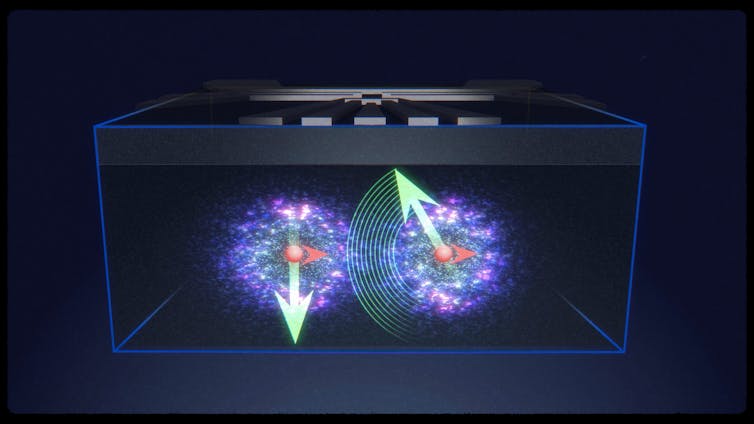
Quantum entanglement — once dismissed by Albert Einstein as “spooky action at a distance” — has long captured the public imagination and puzzled even seasoned scientists.
But for today’s quantum practitioners, the reality is rather more mundane: entanglement is a kind of connection between particles that is the quintessential feature of quantum computers.
Though these devices are still in their infancy, entanglement is what will allow them to do things classical computers cannot, such as better simulating natural quantum systems like molecules, pharmaceuticals or catalysts.
In new research published today in Science, my colleagues and I have demonstrated quantum entanglement between two atomic nuclei separated by about 20 nanometres.
This may not seem like much. But the method we used is a practical and conceptual breakthrough that may help to build quantum computers using one of the most precise and reliable systems for storing quantum information.
Balancing control with noise
The challenge facing quantum computer engineers is to balance two opposing needs.
The fragile computing elements must be shielded from external interference and noise. But at the same time, there must be a way to interact with them to carry out meaningful computations.
This is why there are so many different types of hardware still in the race to be the first operating quantum computer.
Some types are very good for performing fast operations, but suffer from noise. Others are well shielded from noise, but difficult to operate and scale up.
Getting atomic nuclei to talk to each other
My team has been working on a platform that – until today – could be placed in the second camp. We have implanted phosphorus atoms in silicon chips, and used the spin of the atoms’ cores to encode quantum information.
To build a useful quantum computer, we will need to work with lots of atomic nuclei at the same time. But until now, the only way to work with multiple atomic nuclei was to place them very close together inside a solid, where they could be surrounded by a single electron.
We usually think of an electron being far smaller than the nucleus of an atom. However, quantum physics tells us it can “spread out” in space, so it can interact with multiple atomic nuclei at the same time.
Even so, the range over which a single electron can spread is quite limited. Moreover, adding more nuclei to the same electron makes it very challenging to control each nucleus individually.
Electronic ‘telephones’ to entangle remote nuclei
We could say that, until now, nuclei were like people placed in soundproof rooms. They can talk to each other as long as they are all in the same room, and the conversations are really clear.
But they can’t hear anything from the outside, and there’s only so many people who can fit inside the room. Therefore, this mode of conversation can’t be scaled up.
In our new work, it’s as if we gave people telephones to communicate to other rooms. Each room is still nice and quiet on the inside, but now we can have conversations between many more people, even if they are far away.

The “telephones” are electrons. By their ability to spread out in space, two electrons can “touch” each other at quite some distance.
And if each electron is directly coupled to an atomic nucleus, the nuclei can communicate via the interaction between the electrons.
We used the electron channel to create quantum entanglement between the nuclei by means of a method called the “geometric gate”, which we used a few years ago to carry out high-precision quantum operations with atoms in silicon.
Now – for the first time in silicon – we showed this method can scale up beyond pairs of nuclei that are attached to the same electron.
Fitting in with integrated circuits
In our experiment, the phosphorus nuclei were separated by 20 nanometres. If this seems like still a small distance, it is: there are fewer than 40 silicon atoms between the two phosphorus ones.
But this is also the scale at which everyday silicon transistors are fabricated. Creating quantum entanglement on the 20-nanometre scale means we can integrate our long-lived, well-shielded nuclear spin qubits into the existing architecture of standard silicon chips like the ones in our phones and computers.
In the future, we envisage pushing the entanglement distance even further, because the electrons can be physically moved, or squeezed into more elongated shapes.
Our latest breakthrough means that the progress in electron-based quantum devices can be applied to the construction of quantum computers that use long-lived nuclear spins to perform reliable computations.


