

Spiders inspired biologists to create artificial webs to capture airborne DNA for biodiversity monitoring
- Written by The Conversation
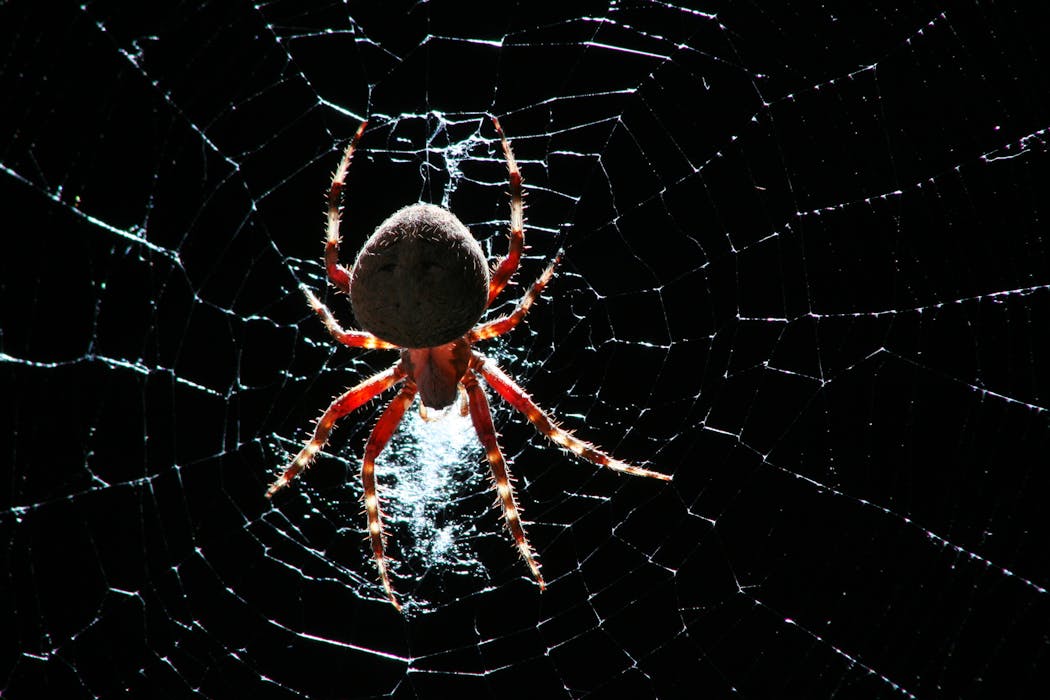
The global crisis of diminishing biological diversity is challenging our current ability to monitor changes in ecosystems.
Environmental DNA, or eDNA, has become a popular method. It involves taking a sample from the environment and extracting the DNA to document the species that are (or were recently) present.
Just like matching barcodes to an item’s price at the supermarket, eDNA data are matched to a corresponding identification record in a reference database.
But most eDNA sampling takes place in water, passing litres of liquid through a filter that retains DNA fragments for analysis. This method works very well for freshwater and marine species, but less so on land.
Enter airborne DNA, or airDNA, an emerging method not yet optimised for widespread commercial applications but with great promise for capturing signals of land-based biodiversity.
Researchers have been exploring the question of whether natural spiderwebs could be used to collect DNA, but our research takes this a step further.
Inspired by a bit of Halloween decoration, we designed artificial spiderwebs to see if they are as good as the real thing in capturing airborne DNA. Our data show artificial spiderwebs performed similarly to real spiderwebs in detecting land-dwelling species.
History of DNA capture
eDNA has been used to monitor changes in biodiversity, detect new species and evaluate the success of restoration or eradication projects. It is easy to use, cheap and non-invasive, and is now being deployed by citizen scientists, community groups and mana whenua.
But species living mostly on land – mammals, birds, bats, reptiles, insects – are less well detected by this method.
One of the first studies to showcase the potential of methods to analyse airborne DNA vacuumed air at a zoological park in Huntingdonshire (United Kingdom). It picked up DNA from 17 of the resident land species, including black and white lemurs, howler monkeys, sloths and tigers, as well as their food items and other mammals and birds.
This stimulated further research, including into the use of cheaper, passive methods of airDNA collection that rely on the settling of air onto inert biofilters. A recent study explored whether natural spiderwebs might provide a new way to capture traces of vertebrate DNA from the environment.
This work sparked excitement among researchers, who immediately saw the potential of spiderwebs to provide aerosol DNA alongside DNA derived from the spiders themselves and their recent prey.
We shared the general excitement of our colleagues but couldn’t help but wonder about the potential negative impacts of this methods’ widespread use on spiders. Spiders are already on the receiving end of bad press, but they have important roles in the ecosystem as nature’s pest and disease control agents. They eat about 800 million tonnes of insects annually across the globe.
Using natural webs is also less robust, as their size and shape, and how long and where they are deployed, are left to chance.
How do artificial webs perform?
In comparison to water eDNA methods, both types of spiderwebs in our research revealed a distinct signature of terrestrial communities. But they were also good biofilters for capturing fungi, possibly by trapping floating fungal spores.
The ecosystem picture drawn from both types of webs compared to water eDNA also shows these methods are likely complementary, capturing a more complete catalogue of species in both terrestrial and aquatic ecosystems.
This is great news: artificial spiderwebs are easy and cheap to construct and provide better control over location, frequency and duration of DNA collection – all at a reduced cost to nature.
Where to from here? Further refinements are on the way. Outstanding questions include how many artificial spiderwebs we need to sufficiently capture biodiversity, whether these webs will perform better or worse in windy or wet conditions, and whether other materials besides Halloween decorations could provide an even better artificial web.
As we continue to explore such questions, perhaps nature’s weavers will provide further inspiration that helps us fashion even better biomechanic solutions for measuring biodiversity.


