

Most of NZ’s flowering plants grow nowhere else – and Christmas falls in peak blooming season
- Written by The Conversation
Traditionally, the plants associated with Christmas in the Northern Hemisphere – holly, ivy, mistletoe – are celebrated for their evergreen leaves in winter or their fruits.
But in the Southern Hemisphere, Christmas falls in peak flowering season, a time of rebirth and reproduction more akin to the northern Easter.
For plants, finding and attracting mates is a challenge. They can’t sense their mates in order to choose, nor can they move to contact a partner.
Seed plants use pollen to safely carry sperm to eggs. Some transfer their pollen on the wind, but about 90% of flowering plants enlist the involuntary help of animals to find their mates and to carry their pollen from anthers (the pollen-producing part of a flower’s stamen) to stigmas (the receptive tip of a flower’s female reproductive organ).
Outsourcing mate-finding and sperm transport in this way means the flowers need to attract, reward and sometimes control their animal visitors rather than their mates.
Human senses notice colour, shape, scent and taste just as other animals do, so what attracts a bird or a bee often attracts us as well.
I was drawn to flowers early, long before I understood any of this. I remember a mass of bluebells in an English wood when I was four, and the satiny petals of Californian poppies in our Whanganui garden when I was five.
Later, as a student and a young researcher in botany, I was fortunate to work with and learn from some of New Zealand’s – and the world’s – leading flower biologists.
In retirement, I’ve been applying stereo pair photography to flowers in order to show their shapes and demonstrate their functions. My love of flowers, botany and stereo pair photography all came together in my book He Puāwai: A Natural History of New Zealand Flowers.
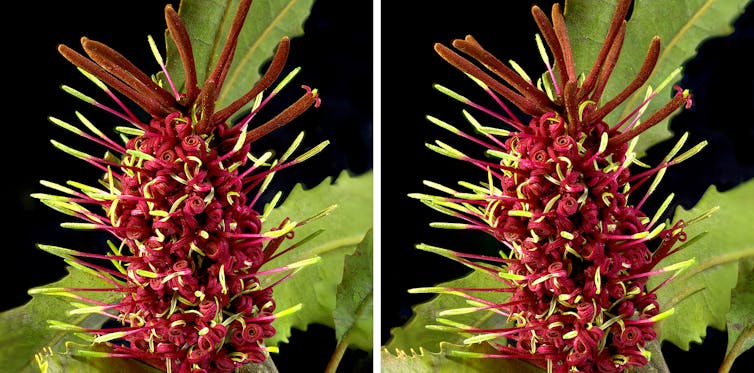
To view these side-by-side stereo pairs of rewarewa flowers in 3D, your right eye must see the right picture while your left eye sees the left one.
My book has a folding viewer that makes this comfortable, but for viewing on screen you can make a simpler device: use two cardboard tubes of about 30 centimetres in length, or make your own by rolling two sheets of A4 card lengthwise into tubes about five centimetres wide.
Use these tubes to direct each eye to its correct photo, and relax. You might need to make the pictures smaller on screen and to move closer or further away for focus.
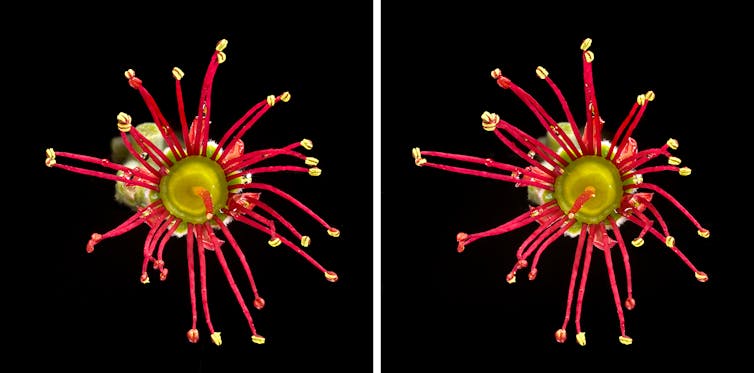
New Zealand’s Christmas tree
Pōhutukawa (Metrosideros excelsa) trees are often completely covered in bright-red flowers, in shades from scarlet to carmine, by early December. At Christmas time, fallen stamens collect as a red carpet under large trees.
Pōhutukawa’s natural range is the north of the North Island, but it is such a prolific seeder that its weedy tendencies have helped it spread far afield, including to Wellington city. It has even become naturalised in Australia, South Africa and California.
Pōhutukawa flowers reflect strongly in both the red and ultraviolet wavelengths, but they absorb most of the blue and green wavelengths also found in sunlight. This is a pattern characteristic of bird-pollinated flowers, as is the fact that the flowers have no scent but produce a lot of nectar. Pōhutukawa flowers are also visited and pollinated by pekapeka, native short-tailed bats.
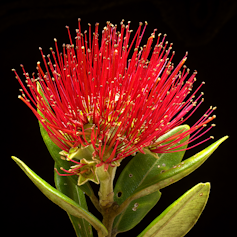
We know more about the flower biology of pōhutukawa than many other native trees. Each flower in a pom-pom cluster has a ring of long red stamens that present pollen on yellow anthers. A little later, the central style elongates, placing its small stigma beyond the anthers. The timing difference makes self-pollination less likely.
Pōhutukawa, mānuka, kānuka and others in the myrtle family are all at risk from the fungal disease myrtle rust. It seems though that fleshy-fruited members of the family, like guava and the native swamp maire and ramarama, are most susceptible.
Native mistletoe
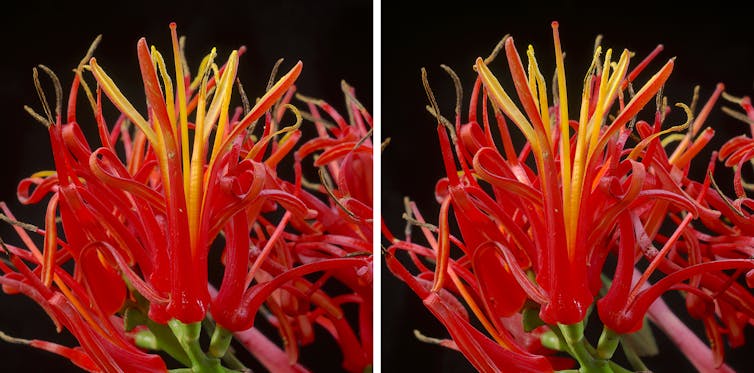
Mistletoes are parasites on tree branches and have long cultural associations with magic and druidic rites, and all sorts of botanical interest as well. Their green leaves show that they’re not completely parasitic, taking water and some of their food from their hosts but still photosynthesising.
Many, including some of New Zealand’s native species, have white or green rather insignificant flowers, but others like korukoru (scarlet mistletoe) have spectacular flowers that attract birds as their main pollinators.
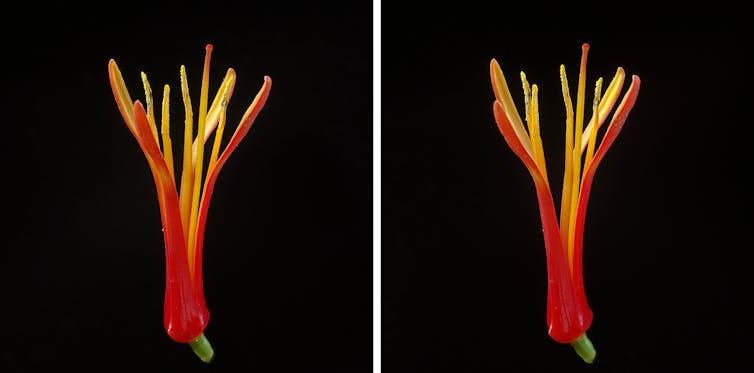
The brightly coloured korukoru flowers appear in midsummer. They are pollinated by birds, especially tūī and korimako. The flowers are closed-access blossoms, meaning the sexual parts and rewards remain hidden until a pollinator opens them.
Many native mistletoes are endangered because their leaves are very attractive food for possums, but they might also face a significant threat from the loss of their pollinators.
Almost lost in the wild
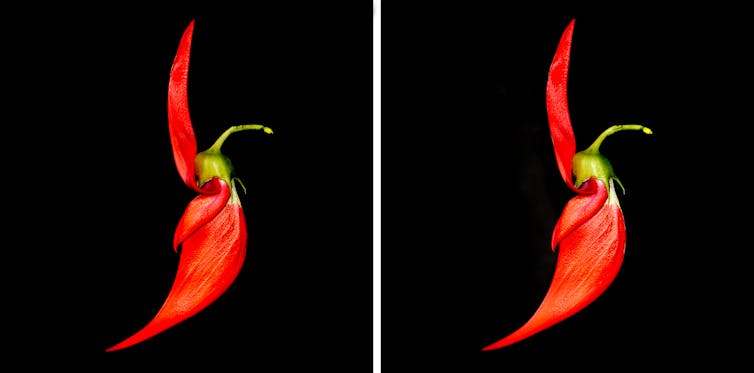
Ngutukākā (kākābeak) is a very common plant in New Zealand gardens, but sadly very rare in the wild. There are two very similar kinds of ngutukākā: Clianthus puniceus, known from just one population in Northland, and this one, C. maximus, found in a few populations in the east of the North Island.
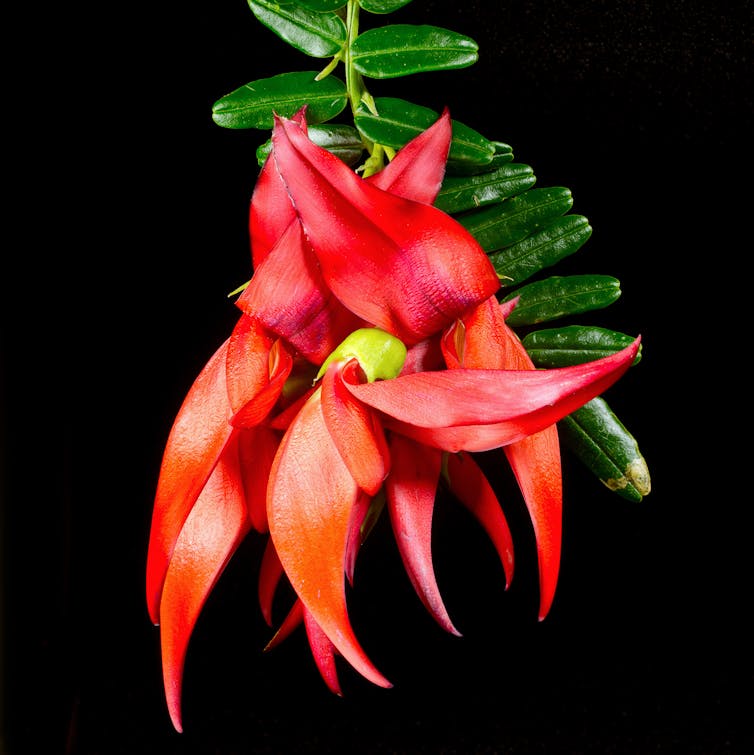
The flowers, which open from late winter to early spring, are among the largest native flowers in Aotearoa. Their underlying structure is typical of pea flowers, but their shape and bright-red colour show they’re adapted for pollination by nectar-feeding birds.
Closed-access flowers that hide their nectar, pollen and stigmas – requiring both knowledge and physical strength from their pollinators – are rare in the New Zealand flora.
These three spectacular native flowers are unusual in the native flora, where many flowers are small and drab. About 85% of New Zealand’s 2,200 native flowering plants grow nowhere else. While that makes them uniquely ours to enjoy and study, it also gives us the grave responsibility of ensuring we do nothing that threatens their survival.
He Puāwai: A Natural History of New Zealand Flowers is published by Auckland University Press.


