

Venezuela’s leader may be gone, but his regime remains – with a new chief in Washington
- Written by The Conversation
US President Donald Trump has insisted the United States will now be “running” Venezuela after US forces bombed the capital on January 3 and whisked Venezuelan President Nicolás Maduro and his wife out of the country to face federal charges in New York.
Trump has promised that “large US oil companies” would be going into Venezuela to “start making money”. And in passing, he has also declared that with Maduro gone, Venezuelans “are free” and the country is already becoming “rich and safe” again.
But autocratic regimes do not depend on their leaders alone. They get their strength from the vast bureaucracies and security apparatuses under the leader and the complicity of individuals down the chain of command.
These structures have been shaken in Venezuela, but not dismantled. Delcy Rodríguez, Maduro’s loyal vice president, has assumed the presidency and the powerful interior minister (Diosdado Cabello) and defence minister (Vladimir Padrino) – the “men with the guns” – are still in control.
So, rather than bringing regime change, Trump is now propping up the Maduro regime from Washington.
The rise and decline of chavismo
Venezuela has been dominated by two leaders for the last nearly 30 years – Hugo Chávez (president from 1999–2013) and Maduro (2013–26).
After his election on a left-wing, populist platform, Chávez launched sweeping social programs inspired by the Venezuelan military officer Simón Bolívar, who is revered in much of Latin America for leading several countries to independence from Spain in the 19th century.
Chávez’s moves to lead a second “Bolivarian revolution” created a new ideology in Venezuela known as chavismo that aimed to build a socialist society and fight against what Chávez called the new US imperialism taking hold in the region.
Hugo Chavez famously calling former US President George W. Bush ‘the devil’.After Maduro took power on Chávez’s death, chavismo was slowly replaced with a new ideology centred on Maduro’s increasingly authoritarian rule, known as madurismo.
Chávez’s previous confrontations with the US lost their ideological power. During Maduro’s reign, the US imposed sanctions that crippled the Venezuelan economy. However, Chevron, a US oil and gas company, continued to operate in the energy sector despite those sanctions, signalling the Maduro government’s pragmatic transformation.
And unlike the charismatic Chávez, Maduro’s legitimacy eventually began to suffer. After the contested 2024 presidential election, Maduro claimed victory, but voting tallies collected by the opposition and independent monitors pointed to fraud.
The regime became increasingly isolated internationally – an easy target for Trump’s campaign to dislodge Maduro from power.
Maduro’s isolation, however, did not mean madurismo had magically disappeared. What frayed under Maduro was the movement’s ideological basis. What hardened was its governing system. As oil revenues fell and Maduro’s electoral support narrowed, the regime shifted away from mobilising the public in the same way Chavez did. It instead focused on institutional survival.
This survival led to a heavily militarised security state and tight chains of command. The regime also deepened its patronage networks within the main political party, the Partido Socialista Unido de Venezuela (PSUV), and extended its control over the courts and electoral authorities. Pro-regime civilian armed groups were tolerated or employed when useful.
These institutional apparatuses do not vanish when a leader loses legitimacy. They can be rebranded quickly. That is why the machinery remained strong when Trump removed Maduro. It is also why it could be handed over to Delcy Rodríguez.
New leader, same system
Rodríguez’s rise to power suggests a third mutation of chavismo is now underway.
As sociologist Rafael Uzcátegui notes, Rodríguez is dropping the movement’s defining confrontation with the United States to survive, now with Washington’s blessing.
Hours after Maduro’s abduction, a pre-signed decree by the president declared a state of emergency. It authorised members of the military and police to “search and capture” anyone accused of promoting or supporting the US attack on Venezuela. The emergency declaration extends to the Bolivarian Militia and its 200,000 or so members, who have been placed under the military chain of command.
The state of emergency, therefore, strengthens Rodríguez’s capacity to deliver what Washington wants because it consolidates coercive control at home.
Then, on January 5, Rodríguez was sworn in as president after Venezuela’s Supreme Court deemed Maduro to be in “forced absence” from the country. Yet, Article 233 of the Venezuelan constitution requires elections within 30 days if there is an “absolute absence” of the president.
By the regime’s own legal terms, a democratic transition was available. Instead, continuity has been secured.
Rodríguez has been installed on the basis of a “temporary absence” for 90 days, extendable by the National Assembly for another 90 days. Then, the assembly may decide there is an “absolute absence” of Maduro and call for elections. Rodríguez has a powerful hold over the assembly, which is led by her brother, Jorge Rodríguez.
Trump is in no hurry to have elections because the interim government is giving the US “everything that we feel is necessary”. He has also dismissed Venezuelan opposition leader María Corina Machado as lacking the “respect” and “support” to be a future leader of the country.
Meanwhile, Rodríguez is consolidating power. In the first cabinet meeting, she was photographed with the regime’s two main strongmen, Padrino and Cabello, at her side. She has also begun careful appointments to shape the regime to her liking.
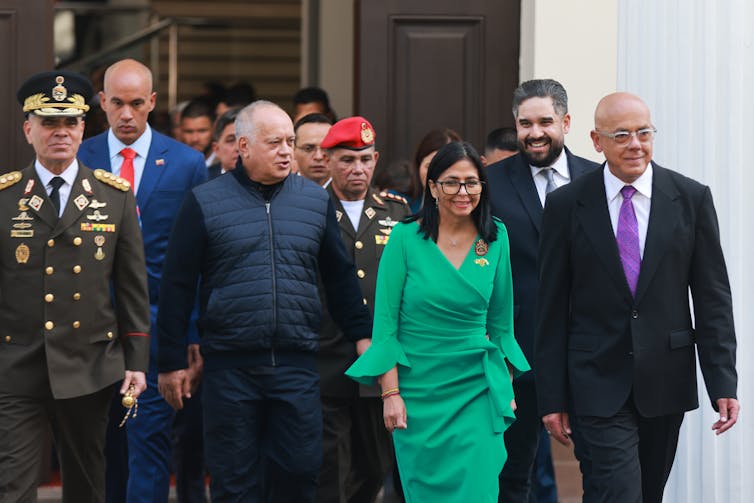
She ordered General Gustavo González López to assume command of the presidential guard and appointed Calixto Ortega Sánchez as vice president for the economy.
Both posts are sensitive: the first will oversee her personal security; the second will negotiate the distribution of Venezuela’s oil wealth with the Americans.
A new chavista-in-chief
Trump’s orders are now being implemented in what many critics are now calling his Venezuelan protectorate.
A few political prisoners have been released in what has been seen as a goodwill gesture. The core US interest, however, is oil. Trump has said “billions” of barrels will be handed over to the US. Exclusive trade agreements will be signed. The ground is prepared for the reopening of a US embassy, destined to function as the office of a proconsul (an administrator of a colony or occupied territory).
This is not a democratic transition. It is chavismo in a new form: power without Chávez’s anti-imperialist rhetoric, without promises, and without a people.


