

The Pout-Pout Fish visually exemplifies contemporary animation – but something is lost in translation
- Written by The Conversation
Adapting the much beloved and best-selling picture book series The Pout-Pout Fish is no easy feat.
Staying core to the source material, the new Australian animated movie follows surly Mr Fish (Nick Offerman) as he goes on a journey with youthful and bombastic leafy sea dragon Pip (Nina Oyama) to have a wish granted by the mysterious Shimmer (Jordan Sparks).
The film is one of emotional self-discovery. It uses a classic narrative structure that introduces obstacles, a wide variety of side characters, and moments of doubt before arriving at an optimistic outcome for the whole reef.
Expanding this slim narrative into a feature-length animated film is an ambitious undertaking that reveals both the strengths and limitations of the film’s approach to storytelling, design and emotional landscape.
World-class Aussie-mation
This production marks a significant outcome for Australian animation, with a theatrical release to over 2,000 cinemas in the United States.
The film is produced by woman-run Like a Photon Creative, the studio behind The Lost Tiger (2025), The Sloth Lane (2024) and Scarygirl (2023). Founded in Brisbane in 2014, the studio focuses on family-oriented feature films and original intellectual property, combining technically sophisticated computer-generated pipelines with narrative and character design.
The studio recently opened an office in Ireland to strengthen its international offerings. This will enable international co-production, larger-scale workflows and round-the-clock production capacity.
Since 2018, the studio has produced eight animated theatrical feature films sold in over 179 territories; two television series; 75 digital picture books; and five apps. They have pumped over A$52 million through the screen economy in Queensland.
A simple tale
The Pout-Pout Fish is a classic tale of curmudgeon meets youthful eternal optimist.
The story allows for emotional literacy into how individuals have different temperaments. It frames emotional change as something that occurs through connection, empathy and self-recognition. The supporting characters play a key role in this expansion.
From the well-meaning but misguided sea creatures who encourage Mr. Fish to “cheer up” to those who simply accept him as he is, the film subtly critiques the ways adults and peers often respond to visible sadness.
But plot and core message gets a little lost with so many different characters and multiple plot lines on the go. Conflict remains minimal, stakes are low, and the film is content to move steadily toward reassurance rather than tension.
It relies heavily on dialogue to move the plot along. This may lose some younger viewers. In a landscape increasingly interested in representing complex inner lives, The Pout Pout Fish feels conservative in its ambitions.
Older viewers will notice the film’s reluctance to push beyond familiar structures or to trust young audiences with emotional uncertainty.
Animation polish
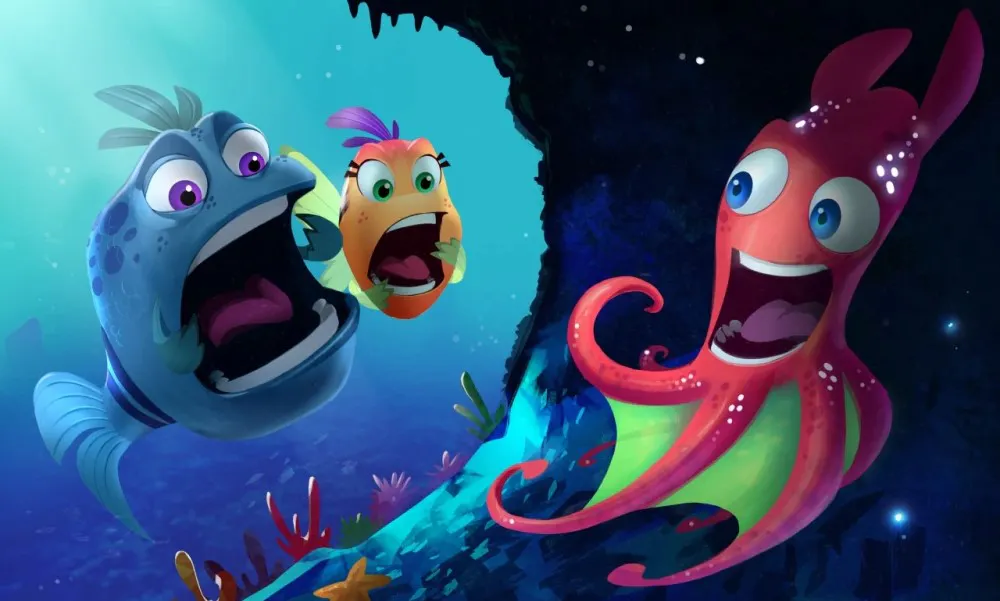
Visually, The Pout-Pout Fish exemplifies contemporary mainstream animation polish. The underwater world is rendered in bright, saturated colours, with rounded coral formations and softly glowing environments.
Computer-generated animation has increasingly developed a particular look and feel. This identifiable visual language is shaped by shared tools, pipelines and commercial pressures.
This look prioritises surface polish, volumetric lighting, cinematic depth of field and recognisable character design – often at the expense of diversity in style.
Characters have oversized and expressive eyes that prioritise children being able to read emotions quickly. Although highly effective and commercially successful, this approach can flatten stylistic diversity, encouraging homogeneity across studios.

Cultural expectations have emerged to further establish this homogeneous look, with audiences and children perhaps used to a particular feel.
The film borrows an aesthetic from a number of Disney and Pixar titles, leaning into the the underwater legacy established by Finding Nemo (2003) and Shark Tale (2004), created over 20 years ago.
Aussie accents on the silver Screen
The film uses both Australian actors and world-class voice talent.
The film includes elements of “Australian-ness”, similar to the “British-ness” on both individual and national identity permeating Aardman Studio’s stop-motion Wallace & Grommit and Shaun the Sheep.
The creators attempted to internationalise the film with side characters who have French and Latin American accents, but the general accent mish-mash becomes a little confusing with an American lead.
It feels the film is trying to bridge the gap between the domestic and international markets. Choices seem to prioritise international legibility and commercial circulation over local specificity.
This reflects a broader tendency in Australian animation to sometimes smooth out national markers to pursue exports.
From an industry perspective, the strategy can be effective. American accents reduce the perceived cultural distance for international audiences and align the film with familiar modes of US children’s animation familiar to the Disney, Pixar and Sony Animation audiences.
Like A Photon Creative is consolidating its position as a leading force in contemporary 3D animation, capable of competing confidently on the global stage while retaining creative authorship and independence.
The Pout Pout Fish is in Australian cinemas now.


