

News Daily

The Times

Australia

  • Written by The Conversation

Beachgoers in Australia are on high alert following four shark incidents in New South Wales in 48 hours.

On Tuesday morning, a surfer was bitten by a shark at Point Plumer, on the state’s mid-north coast. He was taken to hospital with minor injuries to one of his legs.

This came after a man was bitten by a shark on Monday evening, while surfing at Manly, on Sydney’s northern beaches. He suffered major wounds to his leg and was rushed to Royal North Shore hospital in a critical condition.

Only a few hours earlier, a shark knocked an 11-year-old boy into the water at Dee Why – just north of Manly – and bit a chunk out of his surfboard. And on Sunday afternoon, a 12-year-old boy was bitten by what authorities believe was a bull shark while swimming at a popular beach in Sydney Harbour. He is still in a critical condition in hospital.

It can be tempting to blame these incidents on sharks alone. But there’s emerging evidence the pollutants, pesticides and parasites we send into the ocean from land could shape not just where and when sharks and people cross paths – but also shark behaviour.

Recognising this bigger picture helps shift the focus from blaming sharks to addressing human impacts, supporting smarter policies that protect both public safety and ocean health.
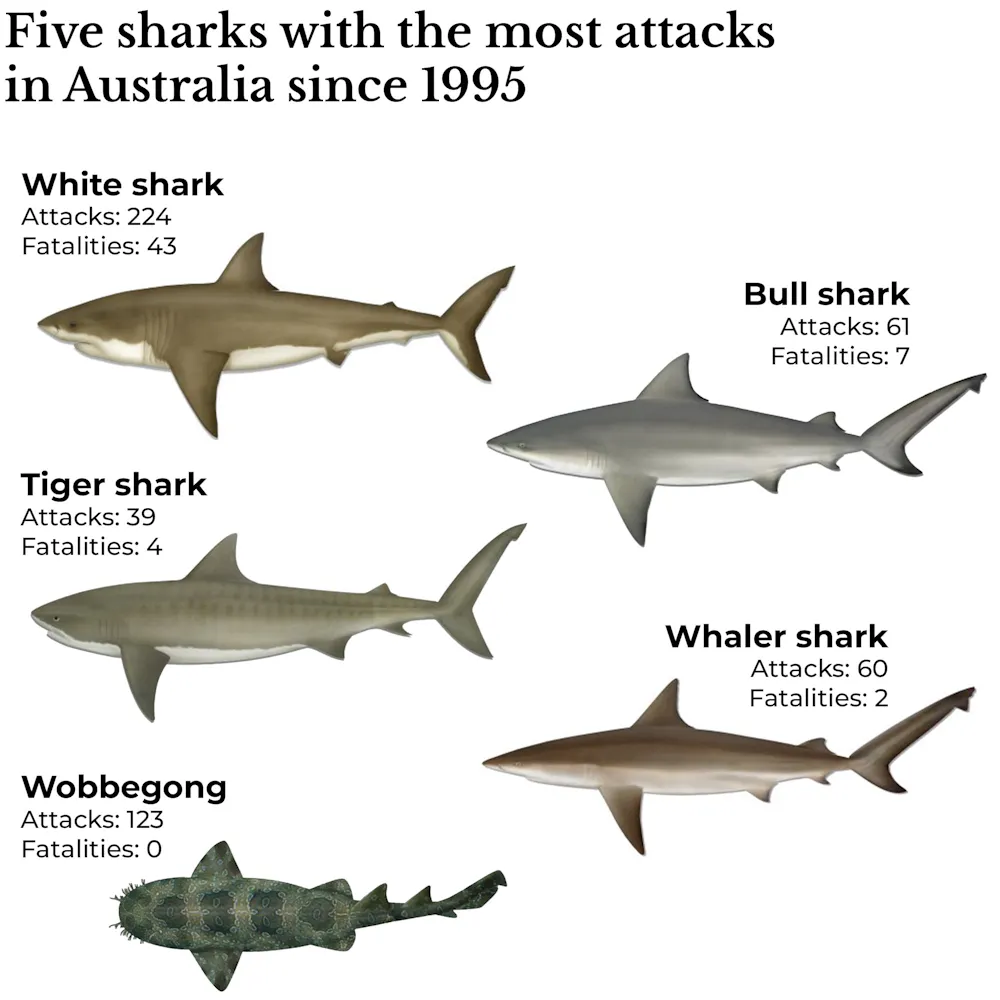
A graphic of the five sharks with the most attacks since 1995
Australian Shark Incident Database, NSW Government SharkSmart A deeper reality When shark attacks occur, the pain is real and profound. People are injured, families are shattered, and lives are changed forever. No discussion about ecology should ever minimise the human cost. Fear and anger in these moments are entirely understandable. Yet public debate often moves quickly from grief to blame, with sharks portrayed as the problem to be removed. This framing offers a sense of control. But it can also obscure a deeper reality: we still know surprisingly little about the many pressures shaping shark health and behaviour. What happens on land doesn’t stay on land. When heavy rain washes into the ocean, it doesn’t just carry pollutants and microorganisms with it. It also changes the water itself. Salinity shifts, visibility drops, oxygen levels change and temperatures can fluctuate. Think about how unsettled you would feel if the air you breathe, the water you drink and the streets you walk suddenly changed overnight. Marine animals experience similar disruption. Heavy rainfall and heightened risk The four recent shark incidents in New South Wales followed an intense rainstorm that flushed runoff from land into the state’s coastal waters, reducing visibility and carrying pollution and waste into the sea. A 2019 study found tiger and white sharks are more likely to attack after heavy rainfall. This is partly because heavy rainfall flushes out more nutrients to sea, which leads to higher fish populations near the shore. In turn, this attracts sharks. Heavy rainfall also creates a very turbid, silty environment. Runoff-driven changes in water quality can disrupt the sensory cues sharks rely on, potentially increasing stress and altering behaviour, while reduced visibility also limits people’s ability to assess risk. Pollutants and parasites On land, scientists have long recognised that environmental pollutants can interfere with how the nervous system works. For example, exposure to certain pesticides is linked to neurological diseases in people, such as Parkinson’s disease, because these chemicals can disrupt nerve cell function, energy production and brain signalling pathways. Emerging research shows similar processes occur in animals. For example, experiments in laboratory rats exposed to a common chemical used in pesticides displayed significant long-term deficits in mood, anxiety, depression and aggressive traits. While these findings don’t automatically translate to wildlife in the ocean, they help explain how chemicals can affect the brain. There’s also growing evidence that pollutants and pharmaceutical contaminants can alter swimming behaviour, aggression, memory and stress responses in freshwater fish such as Nile tilapia and zebrafish. Although we know far less about these effects in marine species, the pattern is clear: chemicals entering aquatic environments can influence animal behaviour. Pollution isn’t the only thing moving from land into the ocean. Microorganisms do too. One of the most striking examples is Toxoplasma gondii, a microscopic parasite best known for infecting humans and domestic animals. On land, it’s shed by cat faeces, and its hardy eggs can survive for months in soil and water. Research shows these parasite stages can be washed into rivers, estuaries and coastal waters, where they’re taken up by fish and other marine animals. Toxoplasma has been detected in species ranging from fish to dolphins and sea otters. What makes this parasite particularly important is its ability to influence behaviour. In studies on land, toxoplasma infection has been shown to reduce fear responses, increase risk-taking and alter how the brain processes threats. Emerging evidence suggests similar effects may occur in marine animals, with potential consequences for predator–prey interactions and ecosystem balance. Toxoplasma has not yet been reported in sharks, largely because sharks are rarely examined for this parasite. This gap reflects limited investigation, rather than clear evidence that sharks are unaffected. This doesn’t mean parasites cause shark incidents. But it does highlight how microorganisms originating on land can enter the ocean and influence animal health and behaviour in subtle ways we are only beginning to understand. Long-term solutions lie upstream One practical step to reduce the risk of shark attacks is clearer public guidance around swimming after major rain or similar events, when water quality and visibility change rapidly. Temporary beach closures and consistent warnings following heavy rainfall are low-cost, evidence-based measures that reduce risk without targeting wildlife. Longer-term solutions lie upstream – in policy and research. Investment in stormwater management, wastewater infrastructure and runoff reduction helps stabilise coastal conditions and improve ocean health. It can also help reduce biological pressures by limiting parasite exposure. There is also a clear need to invest in research in areas that remain poorly studied. Even major research efforts on iconic species such as great white sharks have tended to focus on movement and behaviour, while largely overlooking parasites and disease.

Read more https://theconversation.com/4-shark-bites-in-48-hours-how-what-we-do-on-land-may-shape-shark-behaviour-273889

Split Corrugated Conduit for Flexible Cable Protection

For wiring assemblies in vehicles, machinery and equipment, choosing suitable cable protection helps keep cables organised and reduces direct contact with surrounding parts. Mojak Plastics supplies plastic tubing and conduit options for different installation needs, and split corrugated conduit can... Read more

Trailers Melbourne Buyers Can Compare: When Box Trailers Make Sense

For many homeowners, businesses and tradespeople, trailers Melbourne customers use every week need to be versatile enough for changing loads. A box trailer can be particularly useful because its enclosed sides help contain cargo while providing a straightforward loading area... Read more

Bottle Label Printing That Balances Design and Readability

Product labels need to attract attention while making information easy to find and understand. On a bottle, the available space may be limited by the container’s shape, so every design decision matters. Bottle label printing should account for visual hierarchy... Read more

Office Cleaning Melbourne: Planning a Consistent Workplace Routine

Businesses looking for office cleaning Melbourne need a plan that reflects the way their workplace operates. A clean office supports day-to-day organisation, helps shared spaces remain presentable and gives employees and visitors a more orderly environment. Eco Green Cleaning Management... Read more

Pinboard Solutions for Offices, Schools and Shared Information Spaces

Why a Pinboard Remains Useful A pinboard provides a simple way to display information that needs to remain visible without being rewritten. Lawdex supplies fabric and cork options for offices, schools, staff areas and other environments. A pinboard can be used... Read more

Retractable Hose Reel: A Practical Guide To Choosing The Right Hose Storage

A retractable hose reel can make hose storage more organised, accessible and practical in workshops, commercial facilities, service areas and other working environments. Instead of leaving a hose coiled across the floor or requiring staff to manually wind it after... Read more