

New fear unlocked: runaway black holes
- Written by The Conversation
Last year, astronomers were fascinated by a runaway asteroid passing through our Solar System from somewhere far beyond. It was moving at around 68 kilometres per second, just over double Earth’s speed around the Sun.
Imagine if it had been something much bigger and faster: a black hole travelling at more like 3,000km per second. We wouldn’t see it coming until its intense gravitational forces started knocking around the orbits of the outer planets.
This may sound a bit ridiculous – but in the past year several lines of evidence have come together to show such a visitor is not impossible. Astronomers have seen clear signs of runaway supermassive black holes tearing through other galaxies, and have uncovered evidence that smaller, undetectable runaways are probably out there too.
Runaway black holes: the theory
The story begins in the 1960s, when New Zealand mathematician Roy Kerr found a solution of Einstein’s general relativity equations that described spinning black holes. This led to two crucial discoveries about black holes.
First, the “no-hair theorem”, which tells us black holes can be distinguished only by three properties: their mass, their spin and their electric charge.
For the second we need to think about Einstein’s famous formula E = mc ² which says that energy has mass. In the case of a black hole, Kerr’s solution tells us that as much as 29% of a black hole’s mass can be in the form of rotational energy.
English physicist Roger Penrose deduced 50 years ago that this rotational energy of black holes can be released. A spinning black hole is like a battery capable of releasing vast amounts of spin energy.
A black hole can contain about 100 times more extractable energy than a star of the same mass. If a pair of black holes coalesce into one, much of that vast energy can be released in a few seconds.
It took two decades of painstaking supercomputer calculations to understand what happens when two spinning black holes collide and coalesce, creating gravitational waves. Depending on how the black holes are spinning, the gravitational wave energy can be released much more strongly in one direction than others – which sends the black holes shooting like a rocket in the opposite direction.
If the spins of the two colliding black holes are aligned the right way, the final black hole can be rocket-powered to speeds of thousands of kilometres per second.
Learning from real black holes
All that was theory, until the LIGO and Virgo gravitational wave observatories began detecting the whoops and chirps of gravitational waves given off by pairs of colliding black holes in 2015.
One of the most exciting discoveries was of black hole “ringdowns”: a tuning fork-like ringing of newly formed black holes that tells us about their spin. The faster they spin, the longer they ring.
Better and better observations of coalescing black holes revealed that some pairs of black holes had randomly oriented spin axes, and that many of them had very large spin energy.
All this suggested runaway black holes were a real possibility. Moving at 1% of light speed, their trajectories through space would not follow the curved orbits of stars in galaxies, but rather would be almost straight.
Runaway black holes spotted in the wild
This brings us to the final step in our sequence: the actual discovery of runaway black holes.
It is difficult to search for relatively small runaway black holes. But a runaway black hole of a million or billion solar masses will create huge disruptions to the stars and gas around it as it travels through a galaxy.
They are predicted to leave contrails of stars in their wake, forming from interstellar gas in the same way contrails of cloud form in the wake of a jet plane. Stars form from collapsing gas and dust attracted to the passing black hole. It’s a process that would last for tens of millions of years as the runaway black hole crosses a galaxy.
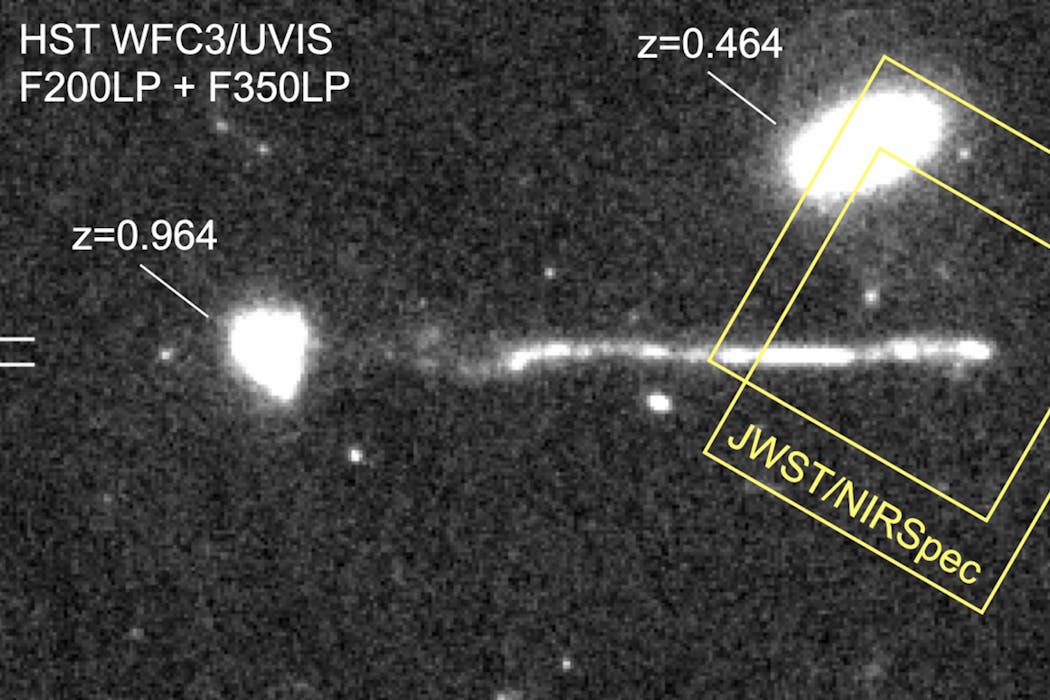
In 2025, several papers showed images of surprisingly straight streaks of stars within galaxies such as the image below. These seem to be convincing evidence for runaway black holes.
One paper, led by Yale astronomer Pieter van Dokkum, describes a very distant galaxy imaged by the James Webb telescope with a surprisingly bright contrail 200,000 light years long. The contrail showed the pressure effects expected from the gravitational compression of gas as a black hole passes: in this case it suggests a black hole with a mass 10 million times the Sun’s, travelling at almost 1,000km/s.
Another describes a long straight contrail cutting across a galaxy called NGC3627. This one is likely caused by a black hole of about 2 million times the mass of the Sun, travelling at 300km/s. Its contrail is about 25,000 light years long.
If these extremely massive runaways exist, so too should their smaller cousins because gravitational wave observations suggest that some of them come together with the opposing spins needed to create powerful kicks. The speeds are easily fast enough for them to travel between galaxies.
So runaway black holes tearing through and between galaxies are a new ingredient of our remarkable universe. It’s not impossible that one could turn up in our Solar System, with potentially catastrophic results.
We should not lose sleep over this discovery. The odds are minuscule. It is just another way that the story of our universe has become a little bit richer and a bit more exciting than it was before.
Read more https://theconversation.com/new-fear-unlocked-runaway-black-holes-272429


