

The only remaining US-Russia nuclear treaty expires this week. Could a new arms race soon accelerate?
- Written by The Conversation
The New START treaty, the last remaining agreement constraining Russian and US nuclear weapons, is due to lapse on February 4.
There are no negotiations to extend the terms of the treaty, either. As US President Donald Trump said dismissively in a recent interview, “if it expires, it expires”.
The importance of the New START treaty is hard to overstate. As other nuclear treaties have been abrogated in recent years, this was the only deal left with notification, inspection, verification and treaty compliance mechanisms between Russia and the US. Between them, they possess 87% of the world’s nuclear weapons.
The demise of the treaty will bring a definitive and alarming end to nuclear restraint between the two powers. It may very well accelerate the global nuclear arms race, too.
What is New START?
The New START or Prague Treaty was signed by then-US President Barack Obama and his Russian counterpart, Dimitri Medvedev, in Prague on April 8, 2010. It entered into force the following year.
It superseded a 2002 treaty that obligated Russia and the United States to reduce their operationally deployed, strategic nuclear warheads to between 1,700 and 2,200 by the end of 2012.
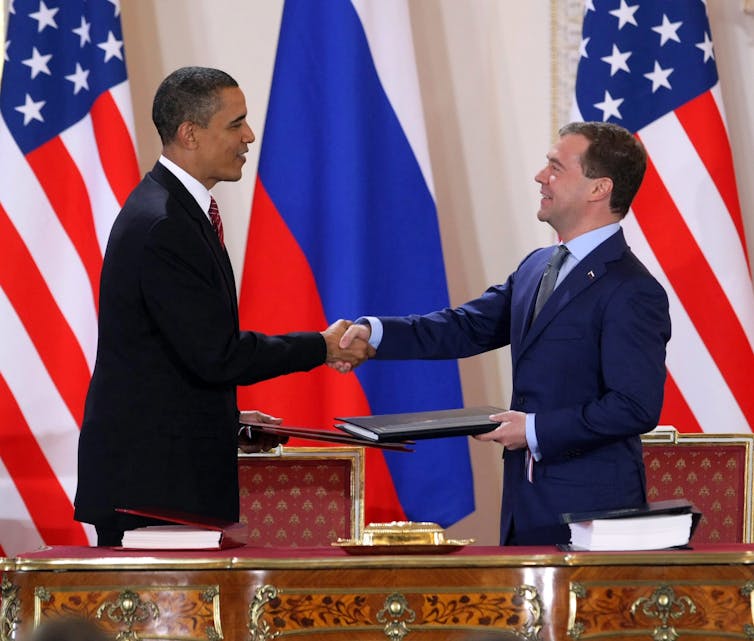
The New START Treaty called for further reductions on long-range nuclear weapons and provided greater specificity about different types of launchers. The new limits were:
- 700 deployed intercontinental and submarine-launched ballistic missiles (together with heavy bombers)
- 1,550 nuclear warheads deployed on those platforms, and
- 800 launchers (both deployed and non-deployed).
These reductions were achieved by February 5, 2018.
The treaty included mechanisms for compliance and verification, which have worked effectively. It provided for twice-yearly exchanges of data and ongoing mutual notification about the movement of strategic nuclear forces, which in practice occurred on a nearly daily basis.
Importantly, the treaty also mandated short-notice, on-site inspections of missiles, warheads and launchers covered by the treaty, providing valuable and stabilising insights into the other’s nuclear deployments.
Lastly, the treaty established a bilateral consultative commission and clear procedures to resolve questions or disputes.
Limitations of the deal
The treaty was criticised at the time for its modest reductions and the limited types of nuclear weapons it covered.
But the most enduring downside was the political price Obama paid to achieve ratification by the US Senate.
To secure sufficient Republican support, he agreed to a long-term program of renewal and modernisation of the entire US nuclear arsenal – in addition to the facilities and programs that produce and maintain nuclear weapons. The overall pricetag was estimated to reach well over US$2 trillion.
This has arguably done more harm by entrenching the United States’ possession of nuclear weapons and thwarting prospects for disarmament.
As the New START treaty was about to expire in 2021, Russia offered to extend it for another five years, as allowed under the terms. US President Donald Trump, however, refused to reciprocate.
After winning the 2020 US presidential election, Joe Biden did agree to extend the treaty on February 3, 2021, just two days before it would have expired. The treaty does not provide for any further extensions.
In February 2023, Russia suspended its implementation of key aspects of the treaty, including stockpile data exchange and on-site inspections. It did not formally withdraw, however, and committed to continue to abide by the treaty’s numerical limits on warheads, missiles and launchers.
What could happen next
With the imminent expiry of the treaty this year, Russian President Vladimir Putin announced in September 2025 that he was prepared to continue observing the numerical limits for one more year if the US acted similarly.
Besides an off-the-cuff comment by Trump – “it sounds like a good idea to me” – the US did not formally respond to the Russian offer.
Trump has further complicated matters by insisting that negotiations on any future nuclear arms control agreements include China. However, China has consistently refused this. There is also no precedent for such trilateral nuclear control or disarmament negotiations, which would no doubt be long and complex. Though growing, China’s arsenal is still less than 12% the size of the US arsenal and less than 11% the size of Russia’s.
The New START treaty now looks set to expire without any agreement to continue to observe its limits until a successor treaty is negotiated.
This means Russia and the US could increase their deployed warheads by 60% and 110%, respectively, within a matter of months. This is because both have the capacity to load a larger number of warheads on their missiles and bombers than they currently do. Both countries also have large numbers of warheads in reserve or slated for dismantlement, but still intact.
If they took these steps, both countries could effectively double their deployed strategic nuclear arsenals.
The end of the treaty’s verification, data exchanges, and compliance and notification processes would also lead to increased uncertainty and distrust. This, in turn, could lead to a further build-up of both countries’ already gargantuan military capabilities.
An ominous warning
The most unsettling part of this development: it means nuclear disarmament, and even more modest arms control, is now moribund.
No new negotiations for disarmament or even reducing nuclear risks are currently under way. None are scheduled to begin.
At a minimum, after New START expires this week, both Russia and the US should agree to stick to its limits until they negotiate further reductions.
And, 56 years after making a binding commitment in the nuclear Non-Proliferation Treaty to achieve nuclear disarmament, both nations should work to implement a verifiable agreement among all nuclear-armed states to eliminate their arsenals.
But Russia, the US and and other nuclear-armed states are moving in the opposite direction.
Trump’s actions since taking office a second time – from bombing Iran to toppling Venezuela’s leader – show his general disdain for international law and treaties. They also affirm his desire to use any instrument of power to assert US (and his personal) interests and supremacy.
Putin, meanwhile, has used of a nuclear-capable intermediate-range ballistic missile to strike Ukraine, made repeated threats to use nuclear weapons against Kyiv and the West, and continued his unprecedented and profoundly dangerous weaponisation of Ukraine’s nuclear power plants.
These moves signal a more aggressive Russian stance that rides roughshod over the UN Charter, as well.
All of this bodes ill for preventing nuclear war and making progress on nuclear disarmament.


