

Indonesia’s leader is going after critics with a vengeance. This could complicate relations with Australia
- Written by The Conversation
Indonesian President Prabowo Subianto waited decades for his chance to lead the country. The controversial former general finally won the office on his third attempt in a 2024 landslide election.
Since then, Prabowo has wasted little time moving against Indonesia’s fragile democracy, accelerating a process that began under his predecessor, Joko “Jokowi” Widodo.
As Australia and Indonesia grow closer, this matters. The two neighbours agreed on an important bilateral security treaty in November, and it is expected to be formally signed in the coming days during Prime Minister Anthony Albanese’s trip to Indonesia.
Yet, the countries seem to be moving further apart when it comes to freedom of speech and respect for civil society. This could complicate matters for Albanese, particularly as Prabowo ramps up his crackdown on critics of his administration.
Distaste for democracy
Indonesia’s vulnerable democratic system has been under repeated attack from government for most of the last decade. Under the administrations of Widodo and now Prabowo, a laundry list of actions have been taken to chip away at it. To name just a few:
the independence of the once-feared anti-corruption commission (KPK) has been profoundly compromised
blatant efforts have been made to stack the Constitutional Court
the army has been invited back into civil administration, with laws passed to make it possible
nepotistic appointments have been made to high public offices, including ministries, the central bank, the courts and even the vice presidency
unconstitutional laws prohibiting criticism of the government have been reinstated
laws have passed allowing the government to ban civil society organisations without judicial intervention
a new proposal has been made to end direct elections of local government heads.
Many predicted these events. Prabowo has never made secret his distaste for democracy and enthusiasm for the authoritarian New Order regime of Soeharto, his former father-in-law.
In fact, Gerindra, Prabowo’s political party, still has as its No. 1 objective reinstating the old constitution under which Soeharto ruled. This would mean dumping most of the key democratic reforms of the past 30 years.
But recent developments suggest the dismantling of democratic freedoms is speeding up. Prabowo seems to be using the Soeharto playbook to move against those who oppose what he is doing – mainly pro-democracy activists.
Increasing attacks on critics
It’s not hard to understand why. Prabowo’s grand ruling coalition now includes almost every party in the legislature – all of them right or centre-right – and political discourse rarely involves detailed policy debates.
This means civil society – in particular, Indonesia’s tiny but vibrant activist community – has become the only real source of opposition.
After Soeharto’s fall, activist NGOs emerged as key drivers of reform, progressive policy and government monitoring in Indonesia. At times, they partnered with government to deliver new policy initiatives. But under Jokowi, NGOs also led massive demonstrations against regressive policies.
Now, Prabowo’s administration has identified them as the enemy.
In August, huge protests broke out after politicians voted to give themselves extravagant allowances. A brutal police response then triggered wild violence against authorities across the archipelago. These riots shook the ruling elite to the core.
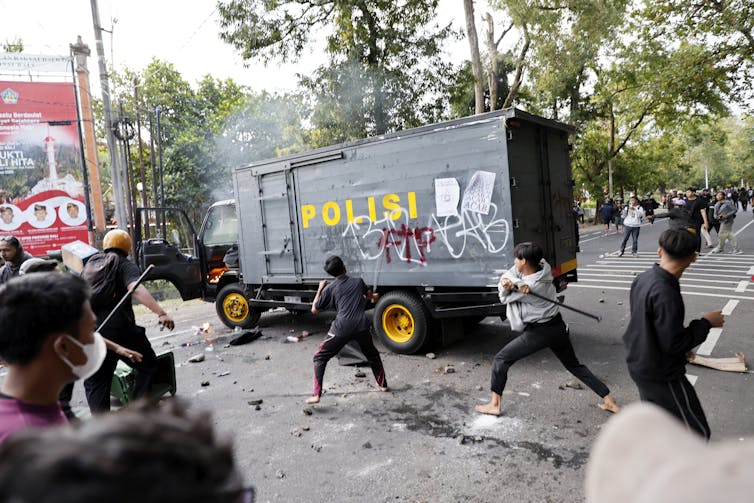
In response, the government came down heavily on civil society activists. It blamed them for the riots, even though they were mostly a spontaneous popular response to abusive actions by the authorites. Prabowo, however, said activists were engaging in “treason and terrorism”.
Thousands were arrested and, detainees claim, some were tortured. Hundreds now face trial for subversion and incitement. This has tied up the small activist groups working frantically to defend their colleagues.
Prabowo has also used the Soeharto-era approach of associating his critics with shadowy foreign enemies. He has railed against “foreign intervention” he says is intended to “divide the country”. He claims there are “foreign lackeys” backed by foreign powers “that do not want to see Indonesia prosper”.
Last year, Prabowo even accused the highly-respected news outlet Tempo of being a foreign stooge because it won a grant from the Media Development Investment Fund, a not-for-profit linked to George Soros.
This week, he claimed to have unspecified proof that foreign forces were behind the August riots.
A draconian new law against ‘foreign propaganda’
“Let the dogs bark,” Prabowo told a press conference last March in response to his critics. “We will keep moving forward. We are on the right path”.
But, in reality, Prabowo is determined to stop the barking. His government has now proposed a law against disinformation and foreign propaganda that could revive Soeharto-era media controls and censorship.
A so-called “academic draft” putting forth the rationale for the law says Indonesia needs “a comprehensive and integrated legal instrument to prevent, detect, and counter disinformation and foreign propaganda”. It alleges that disinformation and foreign propaganda is being “powered by social media, artificial intelligence and transnational networks” of malicious actors.
If this law is passed in the form the draft suggests, it could be used to ramp up the government’s crackdown on civil society groups. Activists and journalists could potentially be charged with offences of spreading “foreign propaganda”.
The draft also proposes restricting “foreign capital” to stop the threat posed by so-called foreign agents.
Many civil society groups in Indonesia are affiliated with international NGOs, such as Amnesty and Transparency. Many others receive funding from overseas aid organisations, including Australia’s, or private philanthropists. Most depend on these streams of income to pay wages and day-to-day expenses. They would collapse without this funding.
It’s not clear what exactly “foreign capital restrictions” means. But it could cast a wide net over all activist groups, as well as foreign organisations working in Indonesia that have an online presence.
Indonesians targeted in Australia
But the net may reach even further than this. The draft suggests the law would apply across borders. This could effectively target government critics based overseas, including in Australia.
Despite the dramatic decline in Indonesian studies in our schools and universities, Australia is still a major global centre for research on Indonesia. Indonesian critics of different regimes in Jakarta have sought sanctuary in Australia over the decades, and many thousands of Indonesians have studied here.
Australia is also home to a small but active Indonesian diaspora community. In August, they held their own demonstrations in cities across Australia in support of the protests in Indonesia.
As Prabowo’s administration moves Indonesia closer to becoming a “new New Order”, where opposition is routinely met with repression and censorship prevails, Australia’s role as a hub for open dialogue, free speech, analysis and criticism of Indonesia will become even more important.
We can be sure this will be no more welcome in Prabowo’s Indonesia than it was under Soeharto. Then, Australian academics and journalists were often denied entry and critical articles sometimes led to a freeze in diplomatic relations.
Today, however, the Indonesian government has coercive digital capabilities, which it can deploy against its critics in the diaspora. To make matters worse, Australia and Indonesia have an active extradition agreement. Theoretically, it might be deployed against Indonesians in Australia who have fallen afoul of the proposed disinformation and foreign propaganda law.
Indonesia is the dominant economic and political force in Southeast Asia, and an emerging global player. It is crucial to Australia’s defence strategies and an important partner on immigration, trade and education.
This means Canberra must have a good working relationship with Jakarta. Agreements about trade and defence are part of that, as is the constant flow of ministerial visits between the two countries.
But all that will become way more difficult to manage if this xenophobic new law is passed and used to stifle free speech and target legitimate criticism of the government.


