

Natural hydrogen can make decarbonising industry cheaper – NZ’s turbulent geology could give it an edge
- Written by The Conversation
Hydrogen is emerging as a critical part of the low-carbon transition for industries where electrification is not a straightforward solution.
This includes the production of steel, fertiliser and methanol as well as long-haul transport. In New Zealand, these industries account for about 17% of total emissions.
Hydrogen could replace these emissions but this would require annual production of 600,000 to one million tonnes. The cost of producing low-carbon hydrogen is a critical factor.
Currently, “green” hydrogen – made by splitting water with renewable electricity – costs more than NZ$12 per kilogram.
Long-haul transport companies have already invested in green hydrogen, but it remains too expensive for heavy industry or large-scale chemical production. For these industries, the tipping point for economic viability is closer to $4–5 per kilogram.
But New Zealand could be uniquely placed to explore a potentially cheaper option – “natural” or geological hydrogen which the Earth produces and, in some cases, traps in underground reservoirs.
Around the world, researchers and companies are already turning their attention to natural hydrogen.
Near-pure hydrogen has been extracted at a single gas field in Mali, attracting interest from governments in the United States, Canada and Australia.
There is also interest from major international resource companies. By the end of 2023, 40 companies were exploring natural hydrogen globally.
One key process in the accumulation of natural hydrogen is “serpentinisation” – a reaction between water and iron-rich ultramafic rocks. When water alters these minerals, it converts ferrous iron to ferric iron, releasing hydrogen in the process.
The richer the rock is in iron, the more hydrogen is produced. Under the right conditions, these rocks can generate hydrogen at potentially economic scales.
Laboratory-based research shows that at the right temperature and pressure conditions, up to 0.6 kilograms of hydrogen can be released from a cubic metre of ultramafic rock (if it contains the right iron-rich minerals).
New Zealand’s turbulent geological history provides an unusual advantage.
The landscape has been shaped by major episodes of tectonic collision. Rapid and complex uplift of mountain ranges, active plate subduction and regular ruptures of faults that penetrate through the crust create exactly the kinds of geological settings where natural hydrogen can potentially form and accumulate.
Four promising geological situations stand out.
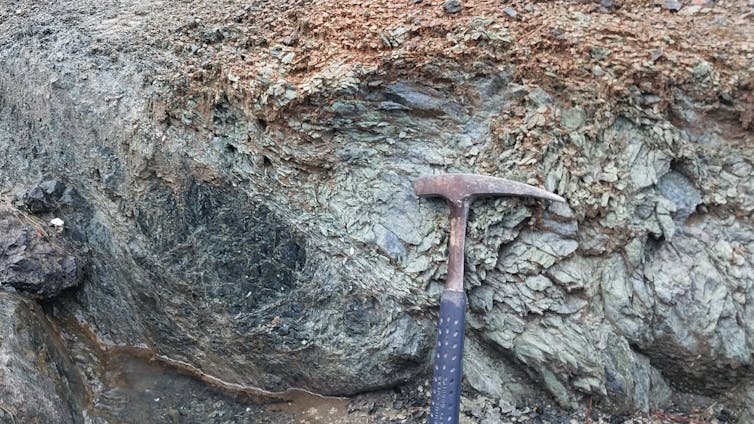
1. Belts of ancient ultramafic rock have been pushed up from deep in the Earth’s crust on both islands. In the North Island, many of these rocks lie beneath major industrial centres, raising the possibility of local “on-demand” hydrogen production close to where it would be used.
2. High-temperature geothermal systems drive powerful circulations of groundwater, enabling the generation and transport of hydrogen from magma.
3. Off the east coast of the North Island, the Pacific plate is being forced under New Zealand in a region known as the Hikurangi subduction zone. As it sinks, chemical reactions including serpentinisation produce methane and hydrogen.
Observed phenomena of this process include the presence of methane hydrates and seeps as well as plume emissions, mud volcanoes, hot springs and localised seeps of hydrogen.

4. Major faults in the South Island, including the Alpine Fault, act as deep conduits, allowing water to interact with ultramafic rocks.
In Fiordland, a remarkable site has vented gas that is 76% hydrogen for at least 40 years. This is one of the more notable seeps of natural hydrogen known worldwide.
These factors make New Zealand unusually well suited to natural hydrogen exploration. The country’s active geology, often thought of as a hazard, could also be a critical resource.
Researchers and industry are beginning to investigate whether these sources could provide hydrogen at $4–5 per kilogram or less. If natural hydrogen proves viable, New Zealand’s unique geology could put the country at the forefront of a new global energy frontier.
The authors acknowledge contributions by University of Canterbury colleagues David Dempsey, Jannik Haas, Rebecca Peer and Matt Watson.


