

Play reduces stress and lifts wellbeing – and adults benefit as much as children do
- Written by The Conversation
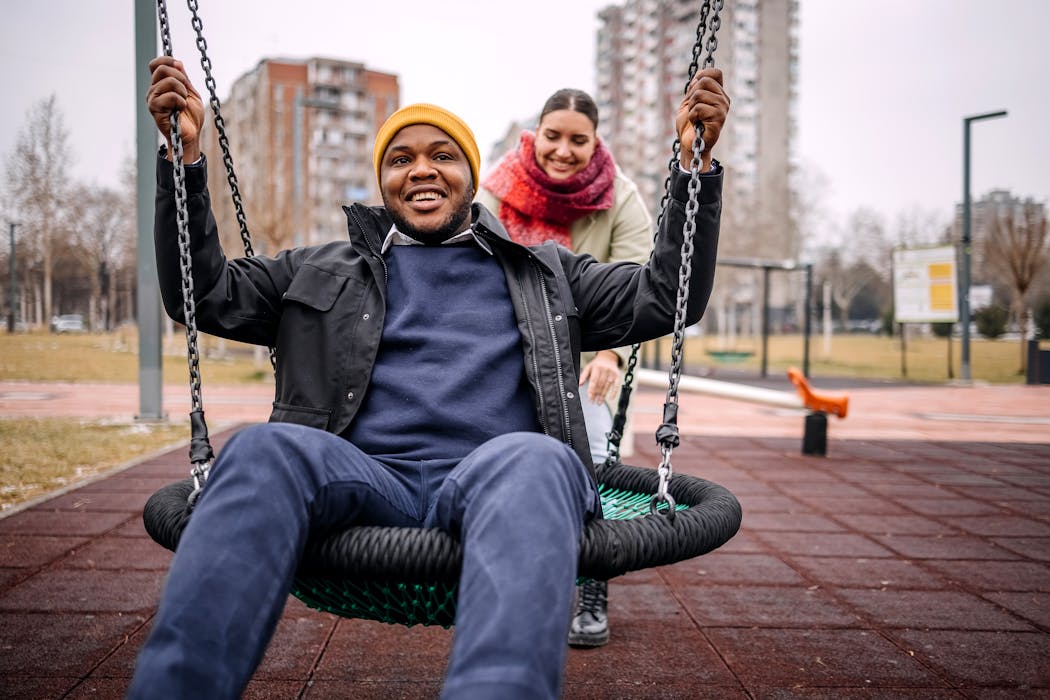
Somewhere along the way to adulthood, time to play fades away. We tend to trade silliness and imagination for seriousness and busyness.
Yet there is clear evidence that adults benefit from playfulness just as children do.
Research shows that adults who engage in playful activities tend to cope better with stress, experience more positive emotions, show greater resilience when facing challenges, and report higher levels of life satisfaction.
Our research with New Zealand families highlights how supporting unstructured play can help adults feel less stressed and more connected, while also normalising playfulness in everyday family life.
In a world that demands constant busyness, play offers essential qualities we are at risk of losing: spontaneity, togetherness and the freedom to have fun.
Play in adulthood can look different from play in childhood. It is less about toys or games and more about how we approach everyday experiences.
Adult play can be physical, social, creative or imaginative. It might involve movement, music, humour, storytelling, problem-solving or simply doing something for the pleasure of it.
What makes an activity playful is not its form, but the mindset behind it: curiosity, openness and a willingness to engage without a fixed outcome. For adults, play is often woven into hobbies and moments of exploration that sit outside work and obligation.
The benefits of play in adult life
A recent study suggests a potential neurobiological pathway between playfulness and cognitive health in older adults.
At its core, play provides a space to reset, allowing us to step outside pressure and performance. In doing so, it supports not only stress regulation, but sustains emotional balance and quality of life across adulthood.
The value of playfulness also goes beyond the individual. Playful engagement in social contexts helps build shared emotional resources, shaping how people interact and cope together over time.
Playfulness in adults is also associated with higher emotional intelligence, including stronger ability to perceive and manage emotions in social situations. Observational studies further show that adults who engage playfully are more empathetic, reciprocal and positive in their interactions with others, reinforcing social connection and belonging.
Importantly, play has a unique ability to cut across age boundaries. When adults and children play together, even if unrelated, differences in age, role and status tend to fade, replaced by shared enjoyment and interaction.
Research suggests these inter-generational play experiences can strengthen relationships, support wellbeing and reduce age-based stereotypes. Play becomes a shared language, bridging age divides that are often reinforced by modern living.
As our work highlights, unstructured play remains both possible and meaningful in contemporary life, with families reporting benefits for children’s development as well as family cohesion and shared wellbeing. These findings suggest play can function as an ordinary, rather than exceptional, feature of family and community life.
Making room for play in everyday life
If play matters across the lifespan, the spaces we inhabit need to support it.
Yet most public environments continue to treat play as something designed primarily for children. Research in urban design suggests the most effective playful environments for adults are those that don’t announce themselves as playgrounds, but instead embed playful possibilities into everyday settings.
Features such as oversized steps, stepping stones, interactive seating or winding paths can invite exploration, balance and movement. In some cities, this extends to adult-sized play elements integrated into public space, such as musical swings that turn routine movement into playful interaction.
Despite these examples, play-oriented design remains the exception rather than the norm, with most public play infrastructure still concentrated in children’s spaces. Designing cities that invite adult play as part of everyday life could be a valuable investment in inclusion, social connection and population wellbeing.
Environments that support play are not just physical, but social. Just as urban design can invite or discourage playful movement, social norms shape whether play feels acceptable in adult life.
When play is treated as embarrassing, indulgent or something to apologise for, it quickly disappears. But when playful behaviour is visible and unremarkable, it becomes easier for others to participate.
Play has long been treated as something separate from adult life, confined to childhood or reserved for rare moments of leisure. Yet the evidence suggests playfulness continues to matter well beyond early development.
Reframing play as a legitimate part of adult life opens up new ways of thinking about wellbeing across the lifespan.


