

Good fungus may one day help save plants from bad fungus like deadly myrtle rust disease
- Written by The Conversation
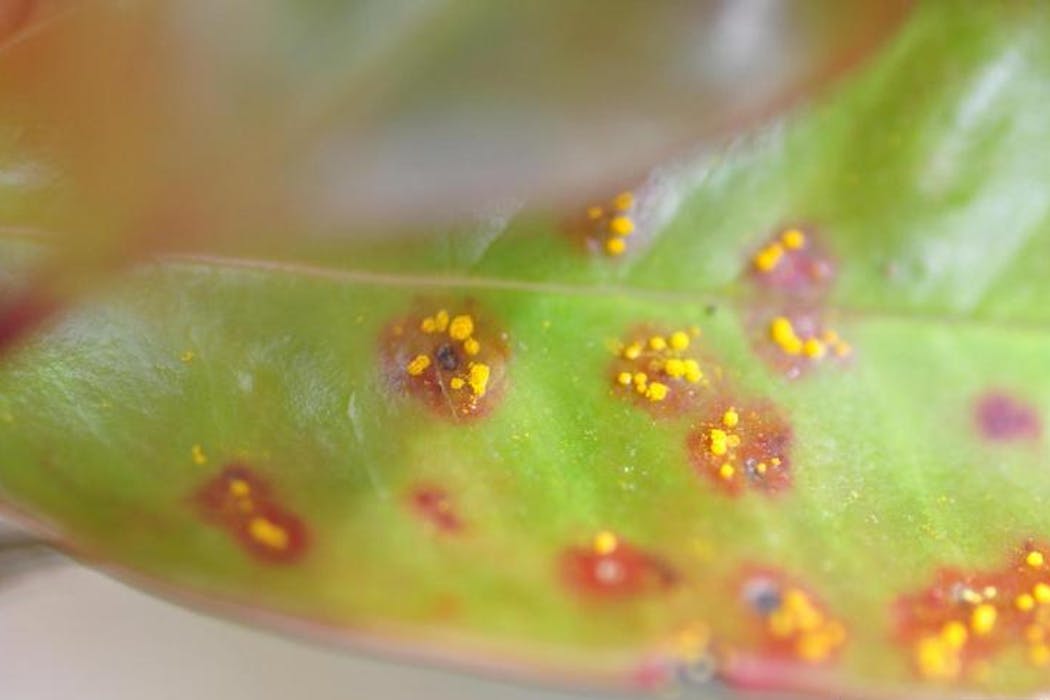
What do coffee, sugar, wheat, soy, eucalypts and paperbarks all have in common?
They are all susceptible to parasitic rust diseases caused by fungi. Plant rust disease can easily be spotted by the characteristic orange or yellow spores that cover plant leaves, making them look rusty.
The spores are easily transferred to your skin by touch or carried by the wind to other host plants.
Despite their symptomatic similarities, each species of rust fungus is restricted to a single type of plant host.
Farmers and nursery managers often use fungicide to tackle plant rust disease, but we need to find ways to decrease our reliance on fungicide treatment. Otherwise, we risk fuelling fungicide resistance.
Could treating with natural beneficial fungi be a viable alternative?
What we did and what we found
To find out, we grew 143 species of fungi that were living in association with the leaves of the Australian native scrub turpentine tree, a species now considered critically endangered due to the effects of myrtle rust disease.
Myrtle rust disease, cause by the exotic fungus Austropuccinia psidii is a type of plant rust disease, and it’s a huge problem. At least 380 Australian native plants are susceptible to it.
Myrtle rust threatens trees and shrubs in the Myrtaceae family of plants. This is Australia’s largest plant family in Australia, and includes tea tree and eucalypts. It also threatens several rainforest tree species.
The recent arrival of this disease into Australia, in 2010, means little is known about how we may feasibly control it within natural ecosystems.
Our research found that of the 143 species of fungi we grew, nine of them naturally stopped the germination of the myrtle rust spores in the lab.
This suggests native plants may already harbour beneficial fungi that could protect them from this deadly disease.
How? Our research shows one way beneficial fungi can protect the plant from the rust disease is by producing chemicals that attack the disease and prevent it from infecting the plant.
It’s like a biological machine, producing microscopic amounts of fungicide directly onto the rust as it grows.
Other ways these fungi can protect the plant are through competition for nutrients or by stimulating the plant’s immune system to protect itself.
One advantage over fungicides may be that if the fungi establishes a symbiotic relationship with the plant, repeated applications may not be necessary.
So far, we’ve only shown this in the lab. More research is clearly needed.
Now, we need to make sure the fungi can effectively do their job in the environment on our most susceptible plants. We may even one day be able to incorporate these fungi into our plant conservation breeding programs.
A growing body of research
A similar study of myrtle rust disease in Hawaii found that adding multiple beneficial fungi to the leaves of the native Hawaiian Koʻolau eugenia or nioi plant increased the effectiveness of the beneficial fungi over using a single strain alone.
This highlights that we have a lot to learn about how beneficial fungi can protect plants.
Our previous research also identified that fungi can protect crop plants such as wheat, barley and oats from rust disease.
Similar studies around the world have found fungi can also protect against coffee rust and soybean rust, among others.
Despite many successful lab studies, there remains a gap between lab studies and field applications. And even if it could be proven to work in the field, then we’d need to find efficient ways to get the beneficial fungi onto the plants that need it.
That said, it’s worth persevering. If we want strategies to reduce fungicide usage on farms and in the environment we must continue to learn more about beneficial fungi and how we can best use them to our advantage.


