

New police powers to ‘move on’ rough sleepers only mask NZ’s deeper homelessness problem
- Written by The Conversation
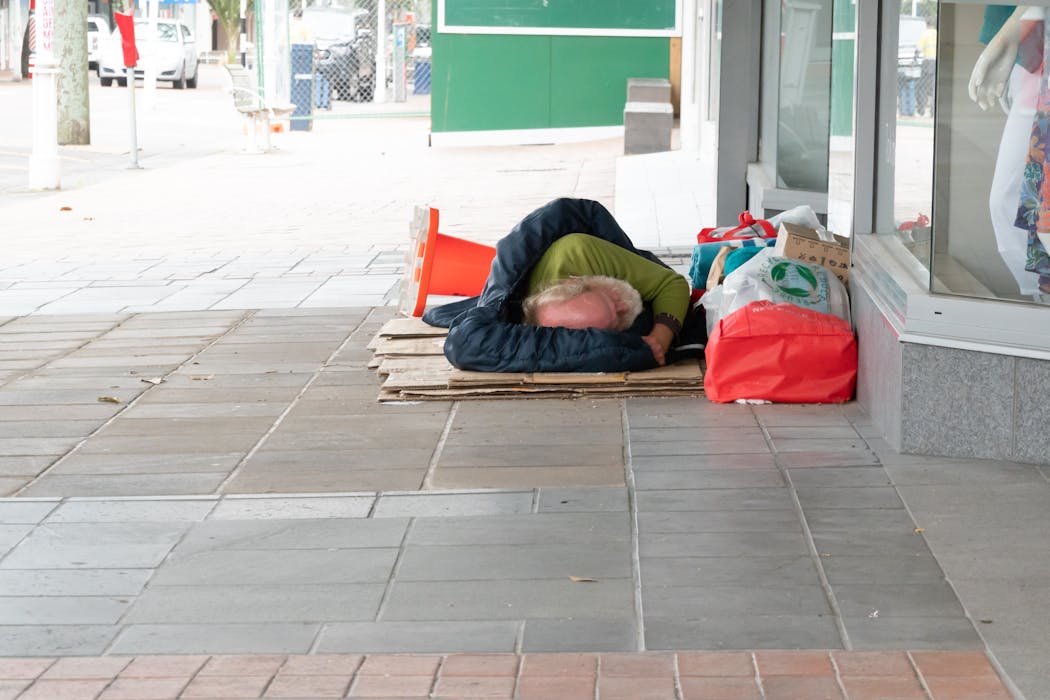
The government’s plan to empower police to “issue move-on orders as a tool to deal with disorderly behaviour in public places” will effectively apply to people as young as 14 who are experiencing homelessness and who “obstruct” access to businesses, beg or sleep rough.
Critics have called the policy unworkable and “draconian”, particularly the provisions for NZ$2,000 fines or up to three months in prison as penalties for breaches.
While the approach may move people out of central business districts temporarily, it won’t tackle homelessness in the long term. In fact, the focus on those who are visibly sleeping rough obscures the true extent and nature of homelessness in New Zealand.
Rough sleeping is just the tip of the iceberg. On the night of the 2023 Census, there were 112,496 people experiencing homelessness. The most common form of homelessness was living in uninhabitable housing, followed by sharing accommodation.
New Zealand is also an outlier internationally in that more than half of those experiencing homelessness are women. This is in large part because New Zealand defines and measures homelessness comprehensively as:
[…] living situations where people with no other options to acquire safe and secure housing are: without shelter, in temporary accommodation, sharing accommodation with a household, or living in uninhabitable housing.
Unfortunately, we are set to lose the continued collection of such high-quality data with the end of the traditional Census.
Homelessness among women, and mothers in particular, also occurs because our welfare state doesn’t provide sufficient support to prevent homelessness. Homelessness is systemic; quick-fix “solutions” like move-on orders don’t solve anything.
Housing first
There are many different ways to tackle homelessness but there is no evidence to suggest simply moving people away will do anything to address the problem.
Despite the Census data, there is very little research, policy or funding focused specifically on the needs and experiences of women experiencing homelessness. This makes it difficult for housing support services to provide appropriate accommodation.
However, one successful model New Zealand has adopted is called Housing First. Initially championed in the US, it starts with the idea that the complex issues that lead to people experiencing homelessness are best addressed with permanent housing as the starting point.
Then, once people are housed, staff provide ongoing intensive and specialist support for any other needs a person may have. To obtain housing, clients don’t have to meet any strict behavioural criteria such as sobriety, which is often a requirement in “treatment first” models.
Instead, housing is treated as a human right.
In partnership with The People’s Project, New Zealand’s first Housing First provider, we have evaluated the outcomes of about 400 of their first clients to see whether this approach works in New Zealand. Our findings repeatedly show it does.
In our newly published research, we examined the demographic differences of the women in this cohort and found they were much more likely to be younger than men in the group, Māori and have dependent children.
Findings after five years
In the fifth year after being housed and supported by The People’s Project, circumstances had improved noticeably for these women.
Most striking were their health-related outcomes. There was a statistically significant drop in hospitalisations; 65% less than in the one year before they were housed.
Their pharmaceutical dispensing increased significantly by 14%, which suggests they were able to access healthcare earlier and get the medications they needed in a timely fashion.
Once people have been housed, one of the first things The People’s Project does is to enrol them in a general practice clinic and help them sort out any ongoing health issues they might have.
While not statistically significant, other healthcare results showed a promising decrease across all forms of mental health related events and a drop in emergency department visits.
Overall, access to permanent housing has improved health and wellbeing.
When examining justice sector outcomes, we did not find any statistically significant changes for women in the cohort; although there was a drop in offences and charges.
What we did see, though, was a significant drop in police offences, criminal charges and major events for the men in the cohort.
What about poverty?
We also looked at changes in incomes, both from wages or salaries and social welfare benefits.
For women in the cohort, their incomes from wages and salaries rose by a significant 101%, and a 19% increase from benefits.
Over the years, we have heard repeatedly from our community partners about how hard it is for people to navigate the social welfare system and to know what financial support is available to them.
A key role of Housing First providers across the country is to help make sure their clients are getting the correct financial support they are eligible for.
However, despite these great improvements in income, the women were only earning about $20,000 per year; not enough to raise a thriving family. Most of these women (84%) had children.
As the saying goes, raising a family takes a village, and for women experiencing homelessness, the support from Housing First providers can contribute to that village. However, no amount of support can fully ease the impact of living in poverty.
To support women and their children, we need better policies to prevent poverty and homelessness in the first place, alongside increased and targeted funding for successful models such as Housing First.


