

A cosmic explosion with the force of a billion Suns went unseen – until we caught its echo
- Written by The Conversation
Some of the universe’s most extreme explosions leave behind almost no trace. The original explosion is unseen, but our observations can capture the long-lived echo it leaves behind as the shock front ploughs into its surrounding environment.
In new research accepted for publication in The Astrophysical Journal, we have discovered what may be the clearest example yet of one of these hidden explosions: the radio afterglow of a powerful gamma-ray burst whose initial blast went unnoticed.
The only other viable explanation for what we see is an extraordinarily rare event in which a star is torn apart by an intermediate-mass black hole: a long-hypothesised, elusive class of black holes that has proven difficult to detect.
Either way, we’re watching the slow-motion aftermath of one of the most extreme, rare events the cosmos can produce.
The explosions we usually miss
Gamma-ray bursts are brief but powerful jets of high-energy radiation. Within seconds, they release as much energy as the Sun will emit over its entire lifetime. They are caused when massive stars die and form black holes.
While these jets are launched in all directions, we only observe the small fraction whose emission is directed towards us. When it is directed away from us, the initial flash goes unseen, and all we can observe is the slowly fading afterglow.
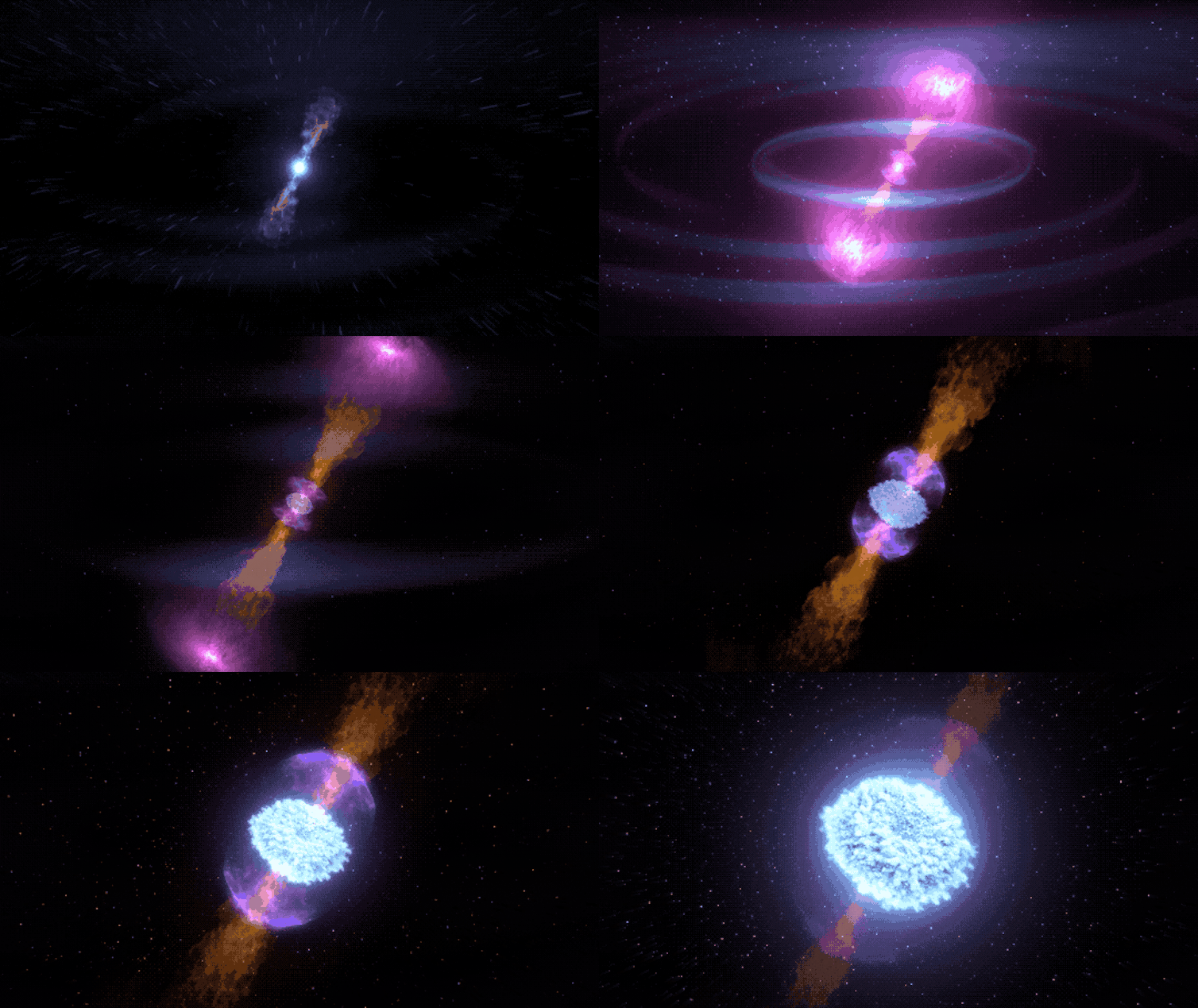
Although these so-called “orphan afterglows” of gamma-ray bursts have been predicted for decades, finding them has proven extraordinarily difficult. Without a high-energy flash to announce their arrival, astronomers have to search thousands of square degrees of sky.
As a result, these cosmic explosions are easy to miss, and hard to recognise when they do appear – until now.
A cosmic ghost appears
Using the Australian SKA Pathfinder (ASKAP), a 36-antenna radio telescope at Inyarrimanha Ilgari Bundara in Western Australia, we scanned vast regions of sky for unexpected long-lived radio transients (astronomical objects that appear and change over weeks to years). We were trying to catch rare events that reveal themselves only through their fading radio emission.
In data from one of these wide-field surveys, we noticed a radio source (named ASKAP J005512-255834), that hadn’t been there before.
It brightened rapidly, releasing 10³² Watts of energy into space – comparable to the total radio energy output of billions of Suns – and then began to fade slowly over time.
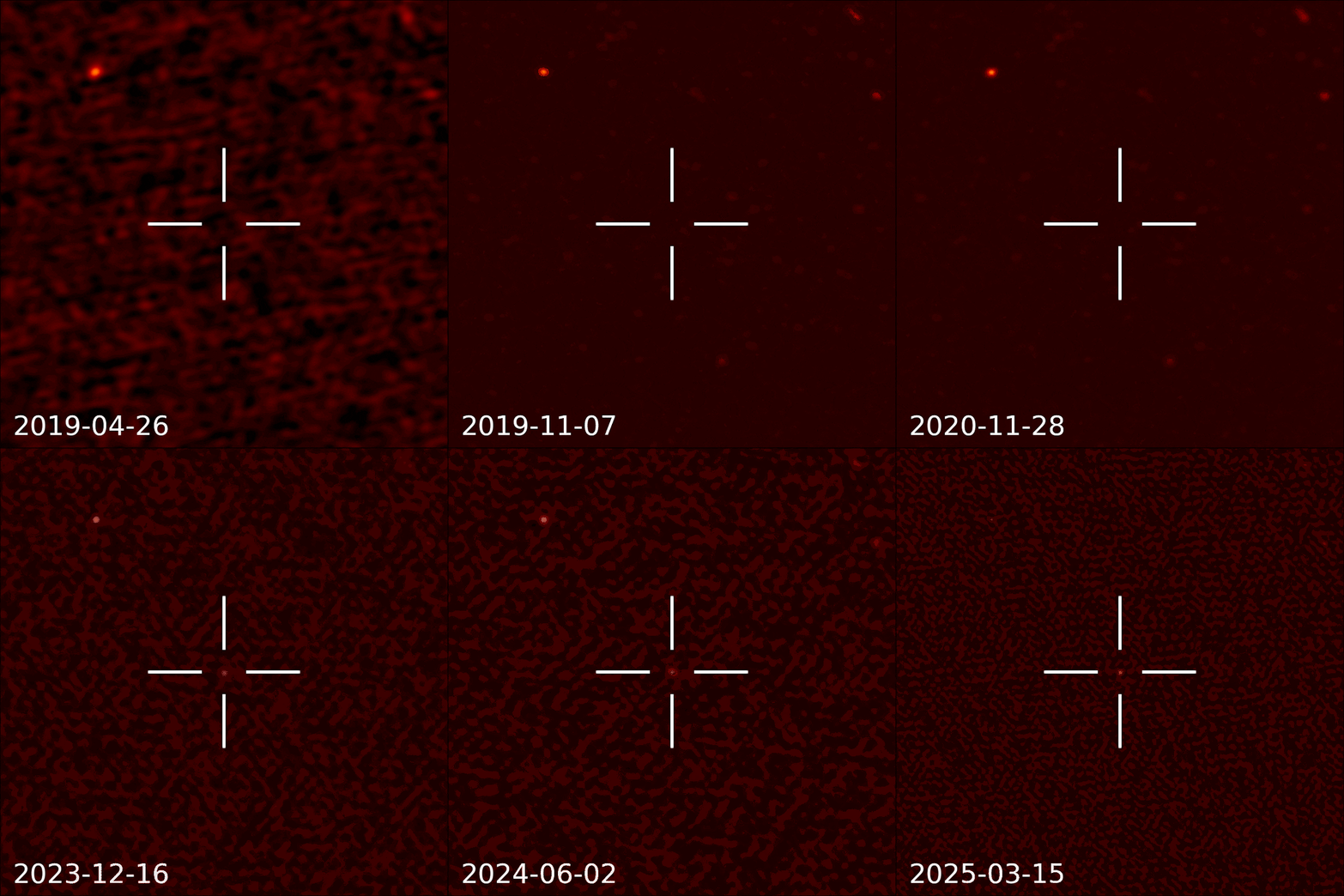
This behaviour immediately set it apart. Most radio transients either evolve quickly or flare repeatedly. This source did neither. Instead, it behaved like the lingering echo of a single, immensely powerful explosion.
Although ASKAP J005512-255834 was bright at radio wavelengths, it left almost no signal at other wavelengths. We could not see a counterpart in visible light or X-rays.
This is exactly what astronomers expect from an orphan afterglow: the fading, widening glow of a tightly focused cosmic jet that was not initially pointed towards Earth, becoming visible only after it slows and spreads.
A busy neighbourhood, billions of light-years away
This rare transient is located in a small but bright galaxy around 1.7 billion light-years from Earth. The galaxy has an irregular structure and is actively forming stars, making it a natural environment for extreme stellar events such as stellar collapse or violent stellar disruption.
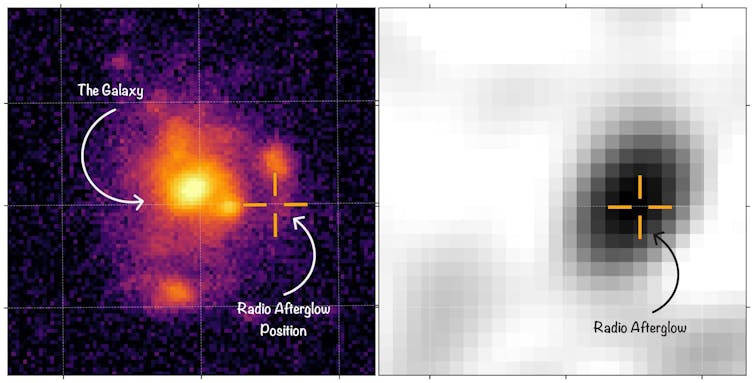
The position of the explosion is off to one side, not aligned with the galaxy’s central nucleus. Instead, it appears to lie within a compact star-forming region, possibly a nuclear star cluster.
This raises new questions about what kinds of environments can host such powerful cosmic events.
Could it be something else?
Because ASKAP J005512-255834 is so unusual, we had to do some detective work to figure out what it might be. We carefully examined (and ruled out) some alternative explanations, including stars, pulsars and supernovae.
The only other scenario capable of reproducing the observed radio behaviour involves a star being torn apart by an intermediate-mass black hole. These are a rare class of black holes that sit between stellar remnants and the supermassive giants found in galaxy centres.
Such events are thought to be extremely rare at radio wavelengths, but we cannot completely rule out this explanation. Confirming it would make this the first example of its kind, a discovery just as interesting as an orphan gamma-ray burst.
A hidden universe revealed by radio waves
Was this discovery a stroke of luck, or the first glimpse of a long-hidden population? Until recently, we simply didn’t have the tools to know.
ASKAP J005512-255834 is the most convincing orphan gamma-ray burst afterglow yet identified. It was found by using our radio telescope to search for the long-lived echo of an explosion we didn’t know had occurred.
Using the same approach, we now hope to uncover many more of these orphan afterglows and finally give them a place in our cosmic story.
In doing so, we may be able to build a full picture of the gamma-ray burst population, including those that never announced themselves with a flash, but lingered quietly as ghosts in the radio sky.


