

Do Middle-earth and Westeros make sense? Climate scientists modelled them to find out
- Written by The Conversation
When English author J.R.R. Tolkien crafted his fantasy world Middle-earth, he argued storytellers are essentially “sub-creators” – they build fictional realms with internally consistent laws.
For a world to be truly immersive and believable, readers apply what is known as the “principle of minimal departure”. This assumes anything not explicitly magical, such as a planet’s weather or gravity, must adhere to the laws of the real world.
In this spirit of rigorous worldbuilding, we just published a new study where we merged the disparate disciplines of literary worldbuilding and climate modelling.
We used complex computer programs – the same ones used to forecast Earth’s future warming scenarios – to simulate the climates of famous fantasy settings such as Tolkien’s Middle-earth, the continents of Westeros in the Game of Thrones, and the far-future Earth in The Wheel of Time series. We also built a model for a fictional world developed by one of us.
It’s a seemingly whimsical exercise, but it serves serious purposes.
For starters, it provides new details on fictional worlds beyond what the author shared, “filling the gaps” with science.
More importantly, it offers a new way for us to communicate the fundamental physics of climate science to a broad, general audience. And exploring climate model behaviour under fantastical settings helps our understanding of model physics.
Why the Misty Mountains are so misty
Tolkien, the author of The Lord of the Rings, was known for his extraordinary attention to detail. He meticulously calculated distances, times, and even phenomena such as the direction of the wind at every step along the characters’ journey.
Working from Tolkien’s own detailed maps, we fed Middle-earth’s topography (land height) and bathymetry (ocean depth) into an advanced climate model.
Since Tolkien intended Middle-earth to be our own Earth at a distant point in the past, we assumed its physical parameters – such as the planetary radius, rotation rate, and distance from the Sun – were identical to ours. We then simulated the world’s climate.
The results were a remarkable confirmation of Tolkien’s intuitive worldbuilding.
The model predicted a climate similar to Western Europe and North Africa – unsurprising, given Tolkien’s geographical inspiration.
The highest precipitation fell on and to the west of the Misty Mountains, with a drier “rain-shadow” effect to the east. This effect is caused by prevailing westerly winds forcing moist air to rise and cool over the mountains, condensing water vapour into rain or snow before it reaches the eastern side.
The model’s prediction of extensive forest cover across much of Middle-earth was consistent with Elrond’s claim that in the past, squirrels could travel from the Shire to Dunland without touching the ground.

Climate scientist Dan Lunt first released this climate simulation in a fictional paper in 2013, and it became an unexpected success in the classroom. Educators used the exotic setting of Middle-earth to explain complex concepts underpinning weather and climate. They were able to relate this to the physical laws that govern why climate changes in the real world.
The unstable seasons of Westeros
One of the defining features of George R.R. Martin’s Game of Thrones is the unpredictable and prolonged seasons of Westeros. This unique climatic feature is not just backstory. It’s a crucial plot device, allowing the White Walkers to move southward across an ice-covered world.
Astrophysicists and climatologists have long nerded out over the possible cause. Theories have ranged from binary star systems to volcanic activity, but all have struggled to create a viable, habitable world.
We focused on the idea of a chaotically-varying axial tilt. On Earth, the stable tilt of our axis is what gives us regular seasons. We used a real-world climate model where the planet’s axis “tumbled” throughout the year, like a wobbly spinning top.
The result was striking: if the planet tumbled exactly once per orbit, one hemisphere would constantly face the sun in a fixed season, creating a permanent summer or winter.
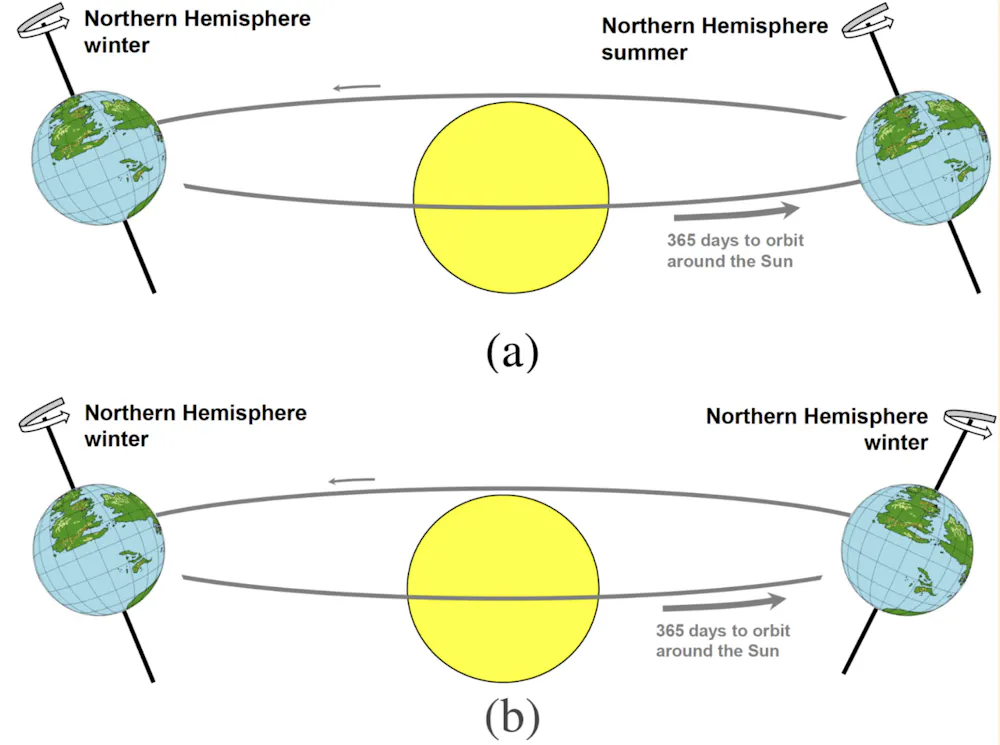
But what causes the season to suddenly flip from a long summer to a long winter? The tilt of our planet’s axis is stabilised by the gravitational influence of its moon.
Martin’s world has only one moon, but legend says it once had two, until the second moon “wandered too close to the sun and it cracked from the heat”. The loss of a second moon may have caused the planet’s axis to become unstable, providing a plausible, physics-based explanation for the world’s greatest mysteries.
Building new worlds with climate science
The benefits of climate modelling are not limited to just filling gaps in classic stories.
Our models can also inform the worldbuilding of new fantasy realms. The work now published in our new paper started when climate communicator John Cook was developing an allegorical, speculative story exploring the denialist response to environmental damage.
He worked with climate scientists to simulate the climate of his fantasy world, Terrios. The subsequent model output provided concrete details such as temperature, precipitation, and wind conditions at every step along the characters’ journey through a variety of biomes.
This ensured the world was internally consistent and richly detailed, enhancing verisimilitude and creating a more immersive experience for the reader.
 How simulated biomes from a climate model inform the design of a map of a new fantasy world.
Cook et al. 2026
Ultimately, applying physics to fictional lands provides an engaging way to connect general audiences with complex environmental science.
By using climate models, scientists honour Tolkien’s demand that even the most fantastical worlds must maintain a credible, finely-tuned balance between the familiar laws of realism and the fantastic.
The enduring legacy of these simulated worlds proves that when science and art collide, the resulting discoveries can be just as compelling as the stories themselves.


