

News Daily

The Times

Australia

  • Written by The Conversation

“Dress appropriately.”

Soon after becoming General Motors’ vice president of global human resources in 2009, Mary Barra used those two words to replace a clunky employee dress code that had grown to ten pages long.

One might think that move by Barra, who now heads the company, simply signalled a return to “common sense” – meaning fewer rules and more freedom.

But in practice, “dress appropriately” actually requires something else: authority.

Employees gain more discretion, but inevitably some will get it wrong. When that happens, managers must step in and say so – a responsibility that, in General Motors’ case, some senior managers had been reportedly reluctant to exercise.

This speaks to two deeper points.

If we cede authority to people in a hierarchy – or empower them to decide what is appropriate – then we can make the rule book much shorter. And if the prospect of exercising that discretion feels uncomfortable, it suggests how unused to authority we have become.

Contemporary society, particularly in the Anglo-American world, produces rules in abundance. In this era, bosses and bossing are viewed as something of an embarrassment.

How stupid rules made for more ‘sludge’

In my new book, Stupid Rules: Reducing Red Tape and Making Organisations More Effective and Accountable, I describe how a flight from authority in recent decades has stripped organisations of command capacity. This is the ability to tell others what to do without having to reference formal guidance, standards or legal rules.

I’m far from the only observer to have identified problems with the rule-heavy approach we often see taken today.

In their 2025 book Abundance, US journalists and podcasters Ezra Klein and Derek Thompson describe how land-use rules can prevent homes from being built and mire infrastructure projects in delays, rising costs and litigation.

More broadly, people struggle with red tape and pervasive “sludge” – the term used by behavioural economists for obstructive paperwork and administrative burdens.

And despite the proliferation of rules, the powerful have not been effectively restrained. Corporate lobbying has flourished and market competition has declined, as well-resourced actors have learned how to bend complex rules to their advantage.

How did we get here?

Dismantling authority was meant to make organisations more efficient and accountable. Over time, hierarchies were replaced with markets and market-like systems designed to incentivise the delivery of services such as healthcare, electricity and environmental protection.

Paradoxically, the attempt to reduce hierarchy produced more red tape. Sometimes described as neoliberal, this shift ushered in what scholars call the regulatory state.

Private markets providing services such as electricity, sewage treatment and drinking water now operate under complex rules and performance targets meant to guide their behaviour.

Yet these systems have often failed spectacularly. Each failure – whether sewage leaks, leaky buildings, healthcare scandals or other disasters – tends to trigger another round of regulation: more rules, more detailed standards and ever more elaborate performance metrics.

Is more authority the antidote?

In many cases, more detailed rules are not the answer. Organisations would often function better if they made more space for the logic of hierarchy.

Nearly a century ago, pioneering British American economist Ronald Coase explained why: firms exist because it is often more efficient to organise work through authority than through contracts and rules.

The same principle applies today. Giving decision-makers greater discretion could cut through the regulatory mire that can thwart democratically made decisions.
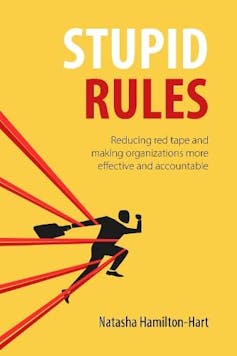
Too many ‘stupid rules’, too little authority: how organisations create their own red tape
In another American example from my book, I describe how a city government in Oregon was forced to stop construction for seven months on a water-treatment plant, even after years of planning and approvals. The city lacked authority to proceed in the face of legal objections, leading to another court hearing and increased costs. Similar problems have appeared in New Zealand. An environmental official in Christchurch described how a popular project to rewild the city’s earthquake-affected red zone ran into difficulty. He explained how situations like this are not uncommon, with planning mechanisms intended to protect the environment sometimes reducing the ecological benefits they are meant to achieve. Such “stupid rules” are not just a bureaucratic phenomenon. Many of the rules that companies work to are created by private bodies that create standards, accreditation requirements and auditing processes. Technology giant Apple’s sustainability rules, for example, set out a detailed code of conduct for its suppliers. But Apple’s own flight from authority makes these rules cumbersome and weak. Because Apple does not directly control the making of its products, its sustainability rules need to be imposed on suppliers outside the boundaries of Apple itself. Over the past 20 years, recurrent scandals saw Apple ratchet up these rules, while moving the cost of compliance onto its suppliers. Some things have improved, but the rules are in conflict with the basic structure of the supply chain set up by Apple to grind down costs. It replaced the direct control – and responsibility – of hierarchy with market exchange and contractual standards. Authority, of course, needs to be checked. But stupid rules can turn organisations into “accountability sinks” in which no one is truly responsible. Empowering decision makers – just as in that simple “dress appropriately” rule – helps restore clear lines of responsibility.

Read more https://theconversation.com/too-many-stupid-rules-too-little-authority-how-organisations-create-their-own-red-tape-277608

Split Corrugated Conduit for Flexible Cable Protection

For wiring assemblies in vehicles, machinery and equipment, choosing suitable cable protection helps keep cables organised and reduces direct contact with surrounding parts. Mojak Plastics supplies plastic tubing and conduit options for different installation needs, and split corrugated conduit can... Read more

Trailers Melbourne Buyers Can Compare: When Box Trailers Make Sense

For many homeowners, businesses and tradespeople, trailers Melbourne customers use every week need to be versatile enough for changing loads. A box trailer can be particularly useful because its enclosed sides help contain cargo while providing a straightforward loading area... Read more

Bottle Label Printing That Balances Design and Readability

Product labels need to attract attention while making information easy to find and understand. On a bottle, the available space may be limited by the container’s shape, so every design decision matters. Bottle label printing should account for visual hierarchy... Read more

Office Cleaning Melbourne: Planning a Consistent Workplace Routine

Businesses looking for office cleaning Melbourne need a plan that reflects the way their workplace operates. A clean office supports day-to-day organisation, helps shared spaces remain presentable and gives employees and visitors a more orderly environment. Eco Green Cleaning Management... Read more

Pinboard Solutions for Offices, Schools and Shared Information Spaces

Why a Pinboard Remains Useful A pinboard provides a simple way to display information that needs to remain visible without being rewritten. Lawdex supplies fabric and cork options for offices, schools, staff areas and other environments. A pinboard can be used... Read more

Retractable Hose Reel: A Practical Guide To Choosing The Right Hose Storage

A retractable hose reel can make hose storage more organised, accessible and practical in workshops, commercial facilities, service areas and other working environments. Instead of leaving a hose coiled across the floor or requiring staff to manually wind it after... Read more