

What is Nowruz, the Iranian new year?
- Written by The Conversation
Nowruz (meaning “new day” in the Persian language) is the Iranian, or Persian, festival celebrating the coming of spring – and the regeneration it brings. It is the first day of the year in the Iranian solar calendar (which began in 1079), marking the exact moment of the spring equinox. The date varies, between March 19 and 21 – this year, it’s March 21.
Within Iran, this year’s Nowruz will be especially emotionally charged, as its cities are under bombardment by Israel and the United States, leaving nearly 1,500 dead since February 28. By celebrating, Iranians will be reaffirming their unique identity and deep-rootedness in their homeland.
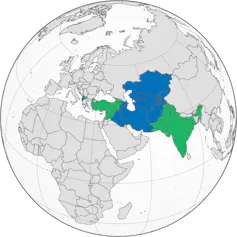
Rooted in the Middle East and Central Asia, Nowruz is celebrated in countries that were once part of Iranian empires: including Turkey, Iran, Iraq, Afghanistan, India, Pakistan and the Caucasus region, particularly Azerbaijan.
Iranian culture was absorbed and integrated into local cultures during the pre-modern period – and it often remained as these territories were gradually lost. This wider sphere of Iranian influence is called Iranzamin or “Greater Iran”.
When Nowruz was first established, during the early period of the pre-Islamic Sassanian dynasty (224–651 CE), it was celebrated throughout the Persian Empire.
In Iran, the span of Nowruz is two weeks, with a four-day national holiday. Happily for students, schools are closed. In some other countries that celebrate the festival, government and retail sectors are closed, and public ceremonies and gatherings are common.
Today, it is part of UNESCO’s list of intangible cultural heritage.

Origins, rituals and symbols
The origins of Nowruz are tied to the practices of Zoroastrianism, the religion of the ancient Persian world – and one of the world’s oldest living ones. It is based on the teachings of the prophet Zoroaster, believed to have lived around the 6th century BCE.
In the lead-up to the festival, people embark on vigorous spring cleaning (khaneh tekaani – literally, “shaking of the house”), participating symbolically in clearing, or sweeping away, the old – and any lingering negativity.
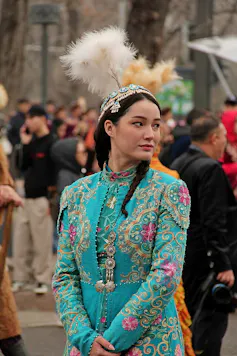
New clothes are often bought, and decorative dresses are prepared for the Nowruz festivities to come.
The last Wednesday of the year before Nowruz is Chaharshanbeh Soori, literally “Scarlet Wednesday”. Fire is a sacred element within Zoroastrianism. Chaharshanbeh Soori is an improvised ritual centred on purification by proximity to it. Small fires are lit in public places, fireworks are let off and decorative lights adorn the streets.
Special foods are prepared: rich soups, pastries and servings of dried nuts and fruits. Sometimes, young children go through the streets banging on pots and pans to drive out the “unlucky” Wednesday.
At the centre of Nowruz rituals is a decorative setting (sofreh), artfully arrayed on household tables – which are placed with the haft seen: seven items beginning with the letter s, or “seen” in Persian.
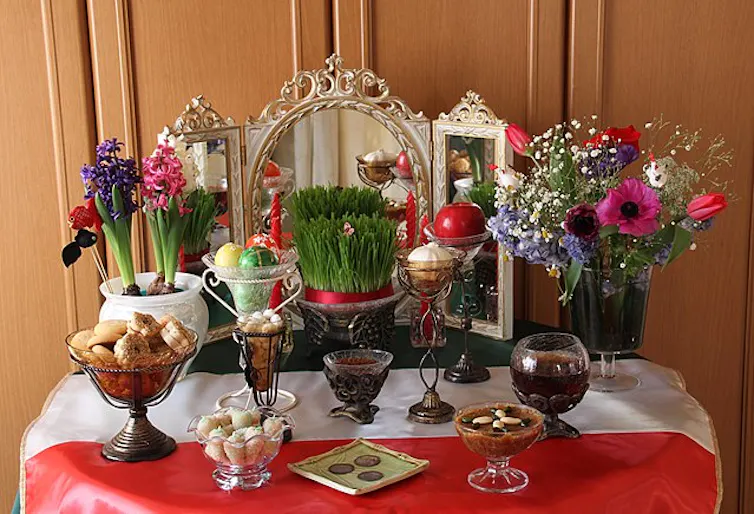
The seven items most often placed are: seeb (apple), sabzeh (shoots from wheat or lentils), serkeh (vinegar), samanou (a pudding made with wheat), senjed (a berry), sekkeh (a coin), and seer (garlic). Each item symbolises some aspect of living systems: birth, growth, health, beauty and wisdom.
The sabzeh grass, representing new growth, is grown in a flat dish, then placed outdoors on the 13th day of the New Year.

The central books of Irano–Islamic culture also feature. Readings are made from the Qur’an, and the collected poems (or The Divan) of beloved 14th-century Persian poet Hafez.
The first few days of the Nowruz festival are spent visiting family and friends. Presents are exchanged, with older family members giving small gifts of cash to younger ones. In Central Asia, athletic competitions may take place, such as traditional equestrian games in Kyrgyzstan. Public gatherings in town squares featuring treats and festive foods are common in Tajikistan and Uzbekistan.
Sizdah Bedar, also known as Nature Day, brings the Nowruz period to an end, 13 days after the equinox. People gather outdoors in a park or green space for a picnic lunch, to bring good luck for the year.

Politics, revolution and nationalism
Iranian monarchies used Nowruz to reinforce prestige for centuries: from the Safavid dynasty (1501–1736), which birthed the modern Iranian state, through the Qajar dynasty (1789–1925) and the Pahlavi dynasty – which ruled from 1925 and was ousted in the 1979 Islamic Revolution.
The Shia Muslim clergy have long been a powerful faction within Iran. The Iranian monarchy embraced Nowruz and its non-Islamic roots to counterbalance the clergy’s power.
After the revolution, some Iranian authorities attempted to downplay Nowruz due to its non-Islamic character. But unsurprisingly, given the deep-rootedness of the festival, they failed. Today, Nowruz co-exists with Islamic festivals, highlighting the synthetic and dual nature of Iran’s culture.
The Soviet Union went much further than Iran: it outright banned the festival in Central Asian nations with Nowruz traditions. These traditions weren’t officially revived until post-Soviet independence in 1991.
Nowruz was a minor part of the Ottoman world, but it began to be revived at the end of World War I by the Turkish state, as part of Turkish political nationalism. At the same time, Kurds within Turkey embraced Nowruz more publicly, to promote the cause of Kurdish identity.
 Kurds within Turkey publicly embrace Nowruz to promote the cause of Kurdish identity, like at this rally.
Sedat Suna/AAP
Kurds within Turkey publicly embrace Nowruz to promote the cause of Kurdish identity, like at this rally.
Sedat Suna/AAP
Nowruz in Iran in 2026
For many years, the US president has traditionally given a Nowruz message. But Donald Trump’s war against Iran and constant use of ultra-violent rhetoric against Iranians would sour any message he might give during this year’s Nowruz.
Similarly, this week Israeli Prime Minister Benjamin Netanyahu mentioned Nowruz while praising the destruction Israeli forces were carrying out in Iran. “Our aircraft are hitting the terror operatives on the grounds, in the crossroads, in the city squares,” he stated. “This is meant to enable the brave people of Iran to celebrate the Festival of Fire.” He ended with the threat: “We’re watching from above.”
This is all happening in the wake of attacks on Iran’s schools and hospitals, bombings of oil depots in Tehran releasing toxic elements into the atmosphere, and damage to dozens of Iran’s cultural heritage sites.

This year, Iranians’ Nowruz celebrations will signal their intent to stay together in the face of threats demanding, in Trump’s words, “unconditional surrender”.
The Nowruz focus on regrowth and regeneration will allow celebrants to look to something beyond destruction. To wish for new birth, health and flourishing of life.
“Nowruz Khosh Amad”: Welcome Nowruz, Nowruz has come joyously.
Read more https://theconversation.com/what-is-nowruz-the-iranian-new-year-278779


