

Australia’s alpine ash forests are now officially endangered. Can we save them?
- Written by The Conversation
The tall alpine ash forests in Australia’s high country have lived in a delicate relationship with fire for tens of thousands of years.
Intensifying fire seasons are threatening this balance to the extent the Federal Government has just officially listed this forest type as an endangered ecosystem. This means these forests face a high risk of collapse or extinction.
It is alarming that alpine ash forests are facing an existential threat. What does this mean, and what can we do to save them?
What is alpine ash?
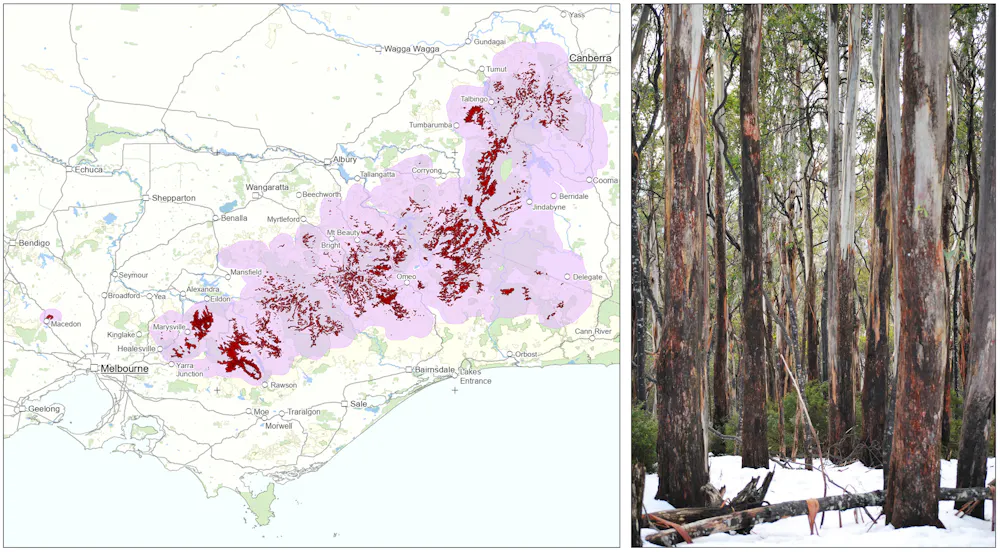
Alpine ash (Eucalyptus delegatensis) on the Australian mainland (there is a related species in Tasmania) is a tall species of eucalypt that covers over 350,000 hectares of high country across the Great Dividing Range, stretching from Canberra to east of Melbourne.
Alpine ash can grow to 90 metres tall, and when dusted with snow it forms a stunning forest that provides shelter and habitat for a range of rare mammals, such as Leadbeater’s possums and greater gliders.
It is also an important part of First Nations cultural landscapes – in north-east Victoria, the Taungurung people harvested Bogong moths (or Deberra) when the moths migrated to mountain forests where alpine ash is a key part of the landscape.
Alpine ash is a “fire sensitive” eucalypt – but its relationship with fire is paradoxical.
While mature trees die after intense fire, it also clears the way for a prolific flush of regeneration from fallen seeds. But these regenerating alpine ash trees won’t produce their own seed for 20 years.
Another severe fire during this time – the Achilles heel of the species – kills the regenerating forest, with no seed to save it. It can only be recovered by artificially sowing seeds, usually by aircraft.
This Goldilocks-like balance of fire has served Alpine ash well until now. But the increased frequency of severe fire over the last 20 years – including the Black Summer fires – has raised such concern about its ecological health that it has now been listed as “endangered” under Australia’s nature laws.
Why is alpine ash now endangered?
There are a range of factors the federal government uses to assess the status of an ecological community, those naturally-occurring species that live together in the same habitat.
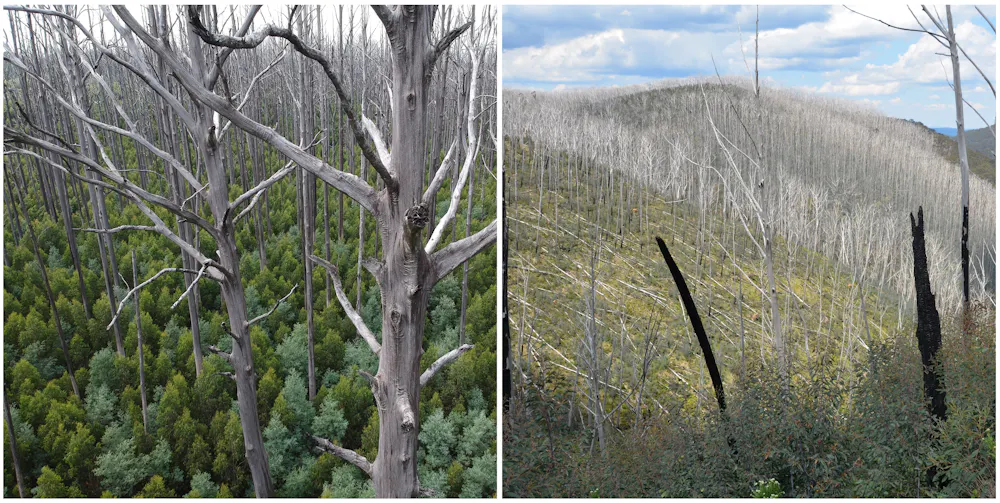
There has been a major decline in numbers of alpine ash trees because of extensive and severe bushfires over the past 20 years. During these, a third of all alpine ash forest burned more than once during their vulnerable immature regrowing phase.
The frequent fires have severely affected these forests, which have lost tree cover, the usual rich mix of species and their ability to function.
 L: Mature alpine ash forest in the Rubicon Valley in Victoria. R: Repeatedly burned alpine ash in the Alpine National Park, Victoria, where repeat fires have turned the forest into grassland.
Tom Fairman, CC BY-ND
In the future, we predict alpine ash forests may decline by half within the next 60 years because of more-frequent fires, which will lead to regeneration failure. To lose this much forest would be devastating for the landscape and the species that live there, and release the carbon these forests store.
Can we save alpine ash forests?
These predictions should prompt a substantial rethink of how we manage, protect and care for these forests.
Firstly, we need to change what it means to “protect forests”. Typically, mainstream forest protection focuses on stopping logging and creating national parks. In the case of alpine ash, these solutions have limited use.
Alpine ash forests are already well represented in conservation reserves, with over half in existing national parks. And climate change and more frequent fires will occur inside national parks as well as outside them. Furthermore, logging is now banned in Victoria and the ACT, and does not occur in the majority of alpine ash forests.
For alpine ash forests to flourish, we need creative and active management, such as:
But we must be realistic about how many alpine ash forests can be saved. Even with our best management, extensive areas of alpine ash will be lost.
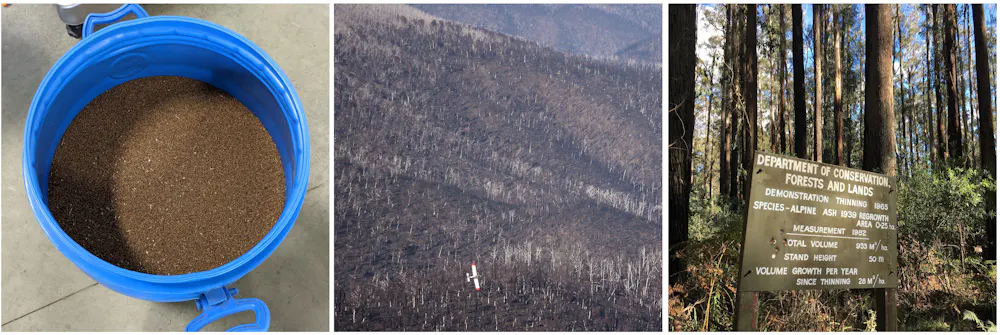 L: Ash seed collected and in storage. C: Resowing of alpine ash after the 2019/20 wildfires. R: Ecological thinning can help protect alpine ash forests.
Tom Fairman, Owen Bassett, CC BY-ND
Accepting loss
We need to work out which forests can be saved and those that cannot. One approach which may help is the ‘Resist-Accept-Direct’ framework developed by the US National Parks Service.
This acknowledges our ecosystems will be severely stressed by climate change and change is unavoidable. It gives forest managers three options:
resist change by maintaining the current forest type. This could mean suppressing fire or resowing alpine ash after repeat fires
accept change and embrace new ecosystems that arise. This means not intervening after frequent disturbance, and monitoring what happens
direct change to a new type of ecosystem. This approach – the most controversial – means in forests likely to be frequently burned, alpine ash is replaced with more fire-tolerant eucalypts.
Working out which of these paths are suitable for alpine ash is a major task for land managers, researchers, and the community.
A clear warning
The listing of alpine ash as endangered is a clear warning to Australians. One of the most widespread types of forest in our high country is facing an existential threat.
Doing nothing is not an option.
We need bold and innovative action to steward alpine ash forests through the next century, before it is too late.


