

Does Amber Heard really have the world's most beautiful face? An expert explains why the Golden Ratio test is bogus
- Written by The Conversation
Amber Heard has one of the world’s most beautiful faces – that is, according to cosmetic surgeon Julian De Silva. The claim has been recycled for some years now, and recently resurfaced in the wake of Heard’s (widely reported) trial with ex-husband Johnny Depp.
But what is this claim based on?
Well, according to De Silva, Heard rates highly on the “Golden Ratio test”. This test rates a person’s facial beauty based on how close their facial proportions are to the Golden Ratio. But is it really a formula for beauty?
The Pythagoreans and the Golden Ratio
The Pythagoreans first discovered the Golden Ratio, also called the “Divine Proportion”, about 2,400 years ago. It’s a mathematical value called “phi”, represented by the Greek symbol φ, and equal to about 1.618.
The Pythagoreans were a mystic cult of mathematicians who saw many numbers as having mystical, philosophical and even ethical significance. They chose the pentagram as their symbol. With its five-fold symmetries, it symbolised health to them.
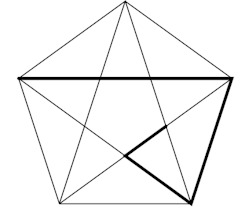
Pentagrams are mathematically fascinating, not least because they evince the curious ratio φ. In the pentagram pictured, the four bolded black lines grow in length by φ at each step. So the long horizontal line is φ longer than the bolded side length.
Similarly, consider six circles of the same size, arranged in two rows of three, and nestled inside one large circle (as pictured). The radius of the large circle is φ times larger than the diameter of the small circles.
The Golden Ratio is also related to the famous Fibonacci number sequence (which goes 1, 1, 2, 3, 5, 8, 13, 21, 34 …). The ratios between one number and the next grow closer and closer to φ as the numbers get bigger. For instance: 13/8 = 1.625, 21/13 = 1.615, 34/21 = 1.619 and so on.
Fibonacci numbers and their Golden Ratio are surprisingly prevalent in maths. They also appear in nature, creating pretty spirals in some flowers, pine cones and the whirling arms of certain galaxies.
Plato’s realm of ideals
Influenced by the Pythagoreans and their love of beautiful maths, Greek philosopher Plato (423-347 BC) proposed the physical world is an imperfect projection of a more beautiful and “real” realm of truth and ideals. After all, no perfect triangles or pentagrams exists in real life.
According to Plato, these truths and ideals can only be glimpsed in the physical world via logical reasoning, or by creating symmetry and order, through which they might shine.
This greatly influenced Western thinking, including modern science and its presumption of universal laws of nature – such as Isaac Newton’s Laws of Motion, or Albert Einstein’s equation for special relativity: E = mc2 .
One promoter of Plato’s ideas was Renaissance mathematician Luca Pacioli. In 1509, Pacioli published a written trilogy on the Golden Ratio, titled Divina Proportione, with illustrations by Leonardo da Vinci. This widely influential work ignited the first bout of popular interest in the Golden Ratio.
It also promoted the Platonic idea that human bodies should ideally satisfy certain divine mathematical proportions. Da Vinci expressed this ideal in his famous illustration The Vitruvian Man.
The myth of the Golden Ratio in ancient art
Adolph Zeising, in his books published between 1854 and 1884, expanded on this idea. In his final book, Der Goldne Schnitt, he claimed all of the most beautiful and fundamental proportions relate to the Golden Ratio, not only in bodies but also in nature, art, music and architecture. This led to the popular assertion that ancient Greek art and architecture featured the Golden Ratio and were therefore beautiful.
But as Mario Livio describes in his book The Golden Ratio, this has been dispelled as a myth. There is no record of ancient Greeks mentioning the Golden Ratio outside of maths and numerology, and studies show φ is very rarely observed in ancient Greek art and architecture.
Voted the most beautiful building in the world in 2017, the Parthenon in Athens is claimed to have φ among its proportions. But careful calculations show this claim is false.
Yet the myth has endured. Today the Golden Ratio is promoted in art, architecture, photography and plastic surgery for its supposed visual beauty.
Marquardt’s mask
Among those promoting the Golden Ratio as a beauty ideal is cosmetic surgeon Stephen R. Marquardt. In 2002, Marquardt claimed to have found the Golden Ratio determines beautiful facial proportions. For example, he claimed an ideal face would have a mouth φ times wider than the nose.
Marquardt then created a geometric face mask that represents “ideal” facial proportions for the benefit of cosmetic surgeons and orthodontists – in his words, “as a paradigm of the ideal, final aesthetic result”.
He also claimed the mask could be used to objectively assess beauty, which led to the Golden Ratio test.
Marquardt’s claims have been highly influential. Plastic surgery is often guided by Golden Ratio measurements, and apps featuring the Golden Ratio test are popular.
The Golden Ratio test debunked
In order to study “attractive” faces, Marquardt measured the facial proportions of movie actors and models. So it was his research on this select group of people that led to his claims and the mask.
But Marquardt’s claims have since been disproven, and the Golden Ratio test debunked.
Studies show Marquardt’s mask does not represent sub-Saharan Africans or East Asians, nor does it represent South Indians.
In fact, it mostly represents the facial features of the small population of masculinised Northwestern European women. This is a look, as one study notes, “seen in fashion models”.
In fact, evidence suggests that, while facial ratios may correlate with perceived facial beauty, these ratios depend on biological and cultural factors.
One study of the 2001-2015 Miss Universe winners illustrated this strikingly. These winners are seen across many cultures to be very beautiful.
However, unlike masculinised fashion models from Northwestern Europe, the correlation between their facial ratios and the Golden Ratio of Marquardt’s mask were “statistically significantly invalid”.
So it’s clear: there is no magic number that universally determines beauty.
Who’s the fairest?
Researchers have identified some “Platonic” traits of facial beauty, including averageness and symmetry, sexual dimorphism, skin texture, emotion and randomness.
However, there is currently no evidence suggesting the Golden Ratio φ determines facial beauty – or any visual beauty for that matter.
You can (informally) test this yourself. Below are rectangles with ratios φ:1, 3:2, 1.414:1, 4:3 and 1:1. Does one of these have a beauty surpassing the others?
Read more: Is there really a single ideal body shape for women?


