

What's causing Australia's egg shortage? A shift to free-range and short winter days
- Written by The Conversation
Australia is experiencing a national egg shortage. Prices are rising and supermarket stocks are patchy. Some cafes are reportedly serving breakfast with one egg instead of two. Supermarket giant Coles has reverted to COVID-19 conditions with a two-carton limit.
We became used to grocery shortages throughout the lockdowns of 2020 and 2021. These were due to changes in buying patterns, stockpiling and panic-buying. Eggs were temporarily part of this, along with flour, as people at home got baking.
Read more: Why flour is still missing from supermarket shelves
But with lockdowns long past, what’s causing this egg shortage now?
News reports have quoted eggs producers blaming, at least in part, pandemic restrictions – because they reduced their laying flocks due to lower demand from restaurants and cafes.
That was the case in countries such as India, where misinformation about poultry being a source of COVID-19 led to a sharp decline in demand. But in Australia, an initial 30% drop from hospitality was compensated by a growth in retail sales.
What changed during that time was the way people got their eggs. Food delivery, food boxes and home cooking exploded for a time.
More fundamentally, this shortage reflects a long-term trend in egg-buying preferences, with a shift to free-range eggs, whose production is more affected by the colder, shorter days of winter.
Shifting to free-range eggs
Australians consume about 17 million eggs every day. In the 2020-21 financial year, egg farmers produced about 6.3 billion eggs. Of those, 52% were free-range. This compares to about 38% a decade ago.
This growth, however, has not been consistent. Between 2012 and 2017, free-range eggs’ share of the market grew about 10 percentage points, to about 48%. Growth in the past five years has been half that.
But with more rapid growth predicted, and the promise of higher profits, many egg farmers invested heavily in increasing free-range production. In New South Wales, for example, total flock size peaked in 2017-18.
Like many agricultural industries where farmers respond to price signals and predictions, this led to overproduction, leading to lower prices and profits. This in turn led to a 10% drop in egg production the next year.
Compliance costs also increased. In 2018 the Australian Competition and Consumer Commission introduced rules to police the marketing of eggs as “free-range”.
These rules mean hens need to have “meaningful and regular access” to an outdoor range during the daylight hours of their laying cycle (with a maximum density of 10,000 hens per hectare).
This experience has likely influenced farmers’ reticence to increase their flocks based on predictions of higher demand.
Winter affects free-range production
Producing free-range eggs is more expensive not just because it requires more land. Free-range hens are less consistent layers.
Hens kept in cages or barns are more regular producers because conditions are optimised to stimulate laying. Temperatures are constant, and hens are exposed to 16 hours of light every day.
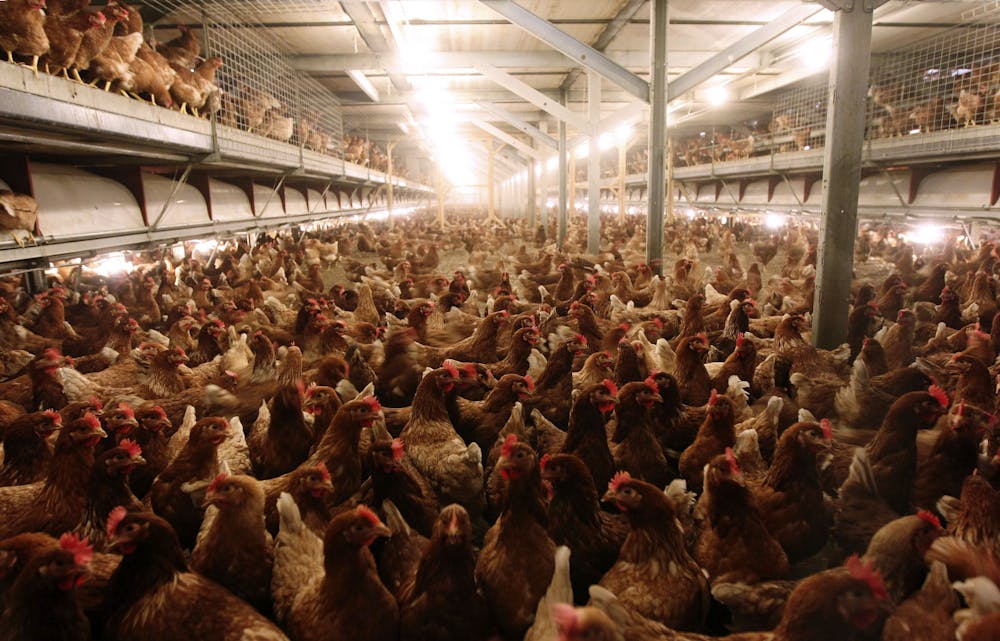
Free-range hens are affected by hot or cold temperatures, wind and rain, and length of daylight. In winter months they have less energy and produce (on average) 20% fewer eggs than a chicken confined indoors in controlled conditions.
Read more: National plan to allow battery cages until 2036 favours cheap eggs over animal welfare
Pressures on farmers
The egg industry is flexible and adaptable – but the confluence of economic and environmental events in 2022 has made things difficult. Farmers will want to meet demand, but face time lags and cost pressures.
Increasing a laying flock takes about four months. An egg takes about three weeks to hatch. Under ideal conditions, chicks need another 17 weeks before they are ready to begin laying.
Any farmer who has begun this process in the past month will be producing more eggs by December. But then it will be summer, when they won’t need 20% more hens to make up for their winter slump.
Feed costs, which typically represent 60-70% of layer production costs, have been increasing along with transport, electricity and interest rates.
So farmers must be cautious if they are to stay in business. It is preferable to undersupply than go bankrupt through oversupply.
Are farmers willing to invest in increasing production in an uncertain economic environment, with interest rates and costs going up and a recession on the horizon? Probably not.
So a short-term fix seems unlikely. Weather forecasts are not favourable. The Bureau of Meterology expects a wetter August to October, with “more than double the normal chance of unusually high rainfall”. That means less daylight and more cold. Blame the negative Indian Ocean dipole, not the chickens.
Come spring, with longer days and milder temperatures, along with an agricultural visa program, things should return to “normal”.
Read more: Eight cracking facts about eggs
Unless consumers are willing to pay more to ensure a constant supply in winter months, our shift to free-range eggs carries a higher likelihood of winter shortages.
We must do what we have done through every disruption in recent times: endure, adapt and prepare for the next crisis.


