

If your landlord wants to increase your rent, here are your rights
- Written by The Conversation
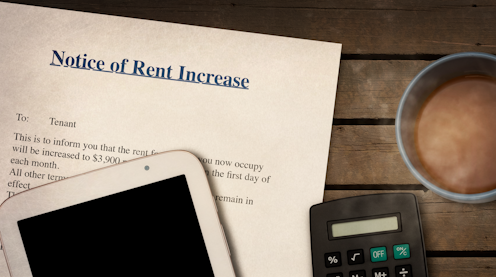
Inflation is pushing up interest rates. Interest rates are pushing up mortgage costs. There’s talk of a rental supply crisis. This means there’s a good chance your landlord wants to increase your rent.
So what are your rights as a renter? That depends on where you live, because residential tenancy laws are determined by state and territory governments. There are, however, many commonalities. Here’s a rundown.
When can your landlord raise the rent?
In every state and territory there are limits on when and how often your landlord can raise the rent.
If you are on a fixed-term lease your rent cannot be increased during the lease period, unless the lease itself specifically provides for such an increase. This makes it worthwhile to negotiate a longer fixed-term lease if you can.
If you are on a periodic (month-to-month) lease, state and territory laws set limits on the frequency with which the rent can be increased. For the Northern Territory, Queensland and Western Australia, rent can be raised every six months. Elsewhere, it is every 12 months.
What must the landlord inform me of?
Landlords do not need to provide a reason for increasing the rent.
They are, however, required to strictly follow notification procedures – informing you in writing, using forms that are specified in relevant regulations, and giving you advance notice of the increase.
Minimum notice periods for increasing rent differ, from 30 days in the Northern Territory to 90 days in New South Wales. For the other state and territories it is about 60 days (see the table above).
If your landlord does not comply with these requirements, you are not obliged to pay the higher rent.
Is there any limit on how much my rent can increase?
The Australian Capital Territory is the only jurisdiction that puts a cap on rent increases. They are limited to no more than 10% above the Consumer Price Index for Canberra. Any larger increase must be approved by the ACT Civil and Administrative Tribunal.
In all jurisdictions, however, you can appeal to the tribunal or court that oversees residential tenancy laws if you believe a rent increase is excessive.
These bodies have the power to reduce or refuse the increase. They can also order landlords to reduce the rent in some circumstances (such as if disrepair or damage makes the property less fit for living).
Read more: How 5 key tenancy reforms are affecting renters and landlords around Australia
No state and territory residential tenancy legislation defines what makes rent “excessive”. But they do include similar lists of things a tribunal or court may consider to determine whether rent is excessive.
These include the rent of comparable premises, and the property’s value and condition. You will need to provide this evidence, because the burden of proving your rent is excessive is on you.
Can I be evicted so the landlord can charge more rent?
A landlord can terminate a fixed-term lease at its expiry for any reason (as long as they follow the notice provisions).
They cannot terminate a fixed-term lease earlier than its expiry just so they can raise the rent for new tenants. They must have a legitimate reason, for instance if you are continually breaching the terms of the lease, or making the property uninhabitable. They must provide the reason in writing.
With the exception of Victoria, a landlord can terminate a periodic lease for any reason. The only requirement is a minimum notice period. In Victoria, your landlord must give and substantiate a valid reason. Wanting to lease out the property at a higher rent is not a valid reason.
In short, what to check?
1) Check your lease. If it’s a fixed-term lease, look to see if the terms allow for a rent increase.
2) Check your landlord has used the correct form for the notice and given you at least the minimum notice period.
3) Seek advice from your local tenants’ advisory service or relevant government tribunal or agency if you are in doubt. The organisations in the following table are a good place to start.
Read more: Rent crisis? Average rents are increasing less than you might think
Read more https://theconversation.com/if-your-landlord-wants-to-increase-your-rent-here-are-your-rights-190126


