

Repairing gullies: the quickest way to improve Great Barrier Reef water quality
- Written by The Conversation
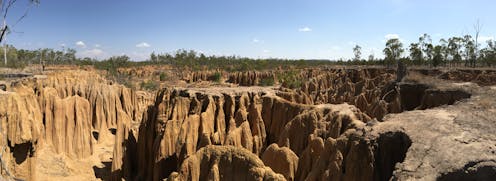
Back-to-back bleaching events have highlighted the critical threat that climate change poses to the Great Barrier Reef. But few people are aware of the network of gullies pumping out about half the sediment that is polluting reef water quality and threatening its World Heritage status.
These gully networks are like miniature Grand Canyons, some with walls up to 20 metres high. They make a spectacular sight but are a disaster for the land, the reef and the rivers that connect them.
In the UNESCO delegation’s latest report on the reef, dramatically scaling up gully repair efforts is the top recommendation.
Along with global warming, degraded water quality is a key threat to the reef. But as the world continues to debate how to combat climate change, the report recognises that fixing gullies will give the reef a fighting chance to survive warming oceans. This is something Australia can do right now.
Over more than a century, land use changes have disturbed fragile soils in grazing country. The unearthed fine sediment from below the surface dissolves like a Berocca tablet when it rains, creating a gully. Left alone, this process will continue for hundreds of years and keep eating into the landscape.
Our team at Griffith university have been researching gullies since 2005. Over the last decade we’ve developed the tools to identify and target the highest priority gullies, and helped design ways to fix them.
Through detailed mapping we’ve found we can identify and target just a few percent of the tens of thousands of gullies to achieve a massive, cost-effective water quality improvement.
Read more: 5 major heatwaves in 30 years have turned the Great Barrier Reef into a bleached checkerboard
More than 400,000 dump trucks of sediment a year
As the planet warms, Australia is already experiencing record heat. For our team working in Queensland’s gullies, temperatures can reach over 50℃ in the midday sun.
Field work in these conditions usually feels about as comfortable as working on the surface of Mars. Nonetheless, our team of scientists keep returning because of the staggering implications of the data we’ve been collecting.
Each wet season, the exposed soils in these gullies turn to a yoghurt-like consistency. Their chemistry primes them to readily erode, which they do with every raindrop that falls on them.
The eureka moment that could help save the reef.In fact, an individual gully can produce thousands of tonnes of fine sediment each year from just a few hectares of land. If you look at the total flow of sediment from all gullies, on average over 400,000 truckloads are dumped across the reef every year, mostly within the inner lagoon.
As sediment and nutrients travel freely down the rivers, they pollute fragile ecosystems, filling water holes, clouding the water and reducing biodiversity. Once they reach the reef lagoon, they smother corals and seagrasses, which struggle to survive.
As the UNESCO report identifies, degraded water quality severely affects the resilience of the reef, limiting its ability to recover from bleaching and cyclones, and to withstand the changes caused by global warming.
Read more: We all know the Great Barrier Reef is in danger – the UN has just confirmed it. Again
The most effective solution for improving water quality
Stabilising gullied landscapes requires an approach akin to mine site rehabilitation. In 2016, we demonstrated that if you reshape (with major earthworks), recap (with rock, soil and mulch) and revegetate the gullies, you can rapidly repair them. Our research has shown that erosion from priority gullies can be reduced by 98% within a space of one to two years.
We’ve now mapped more than 25,000 individual gullies in three hot spot areas in the Normanby, Burdekin and Fitzroy River catchments.
Remarkably, we discovered that only a small proportion of the mapped gullies in each area are contributing a large proportion of the sediment pollution.
For example, in the Burdekin hot spot, we found only about 2% of the gullies contribute 30% of the sediment load to the reef. Targeting these gullies provides the best and quickest way to improve the reef’s water quality.
But the number of gullies repaired to date is a drop in the ocean compared to what still needs to be done.
So far, our method of identifying priority gullies for repair has been implemented across only 1% of the 44-million-hectare reef catchment. The urgent task, as the UNESCO report notes, is to identify other hot spot areas and rapidly roll out the prioritisation mapping to enable targeted remediation to get under way.
What needs to happen now
UNESCO highlights the critical need to speed up effective action, recommending:
there is a need to secure a greater reduction of [sediment and nutrient] pollutants in the next three years than has been achieved since 2009.
The good news is the research has already been done. The data demonstrates it is possible to achieve this ambitious goal. The implementation of on-ground gully repair works with economies of scale is the quickest and most cost-effective way to do it.
Since 2008, Australian governments have set sediment reduction targets and invested considerable funds to improve reef water quality. The federal government intends to spend an additional A$580 million over nine years, and a further $270 million has been committed by the Queensland government.
Importantly, rapid progress can be made given the current funds earmarked for reef water quality. There are also proven working relationships already in place between our Griffith team, Traditional Owners , government and other stakeholders.
The challenge ahead is delivery. The next step requires a coordinated program to develop a pipeline of targeted gully projects.
The pieces of the puzzle are now all in place and there is no reason for delay.
Read more: Does tourism really suffer at sites listed as World Heritage In Danger?


