

How the John Wick franchise fits into the bloody tradition of the revenge film genre
- Written by The Conversation
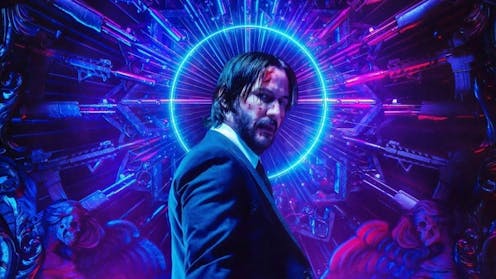
At the beginning of the first John Wick film, the tools of his deadly trade lie entombed beneath concrete, buried alongside Wick’s worst self - the pitiless assassin only his happy marriage permitted him to retire.
Fans of the series know what happened next. In order to exact his revenge, he destroys his vault with a sledgehammer, revealing an arsenal of guns. The real John Wick is back. Carnage ensues.
The carnage continues in John Wick 4, which is currently in cinemas. The franchise owes much to acclaimed Hong Kong action film director John Woo and the “gun-fu” fighting style his films established, which blends slick pistol skills with kung-fu.
Revenge narratives share well-recognised tropes: a murder, a ghost, madness, a stronger enemy and a vengeful hero. Each Wick film honours these elements separately, while at the same time containing them within Wick himself. Murder is Wick’s business. Motivated by murders, he commits them as revenge. Often.
Visited by the “ghost” of his dead wife (videos of her on his phone), he also functions as a ghost in the minds of his enemies, the mythic Baba Yaga of their nightmares. Driven to extremes, others believe him mad. He is both the vengeful hero and the stronger enemy.
Wick is by turns all these things because in seeking his own revenge, he becomes the object of the revenge of others.
Revenge and consequence
Keanu Reeves’ performance in the first Wick film is never more powerful than when, tied to a chair by his captors, he bellows the righteous justifications of his revenge. Wick does not threaten vengeance, he promises it, shouting “you can either give me your son, or die screaming alongside him!” All that follows in the subsequent films is consequence – the price Wick pays for seeking revenge in the first place.
Revenge tales are deeply satisfying because they permit us to imagine the retribution we might mete out for our own hurts – how we might right perceived wrongs if we only had the courage to act. We cheer on steely heroes and count the cost later. The cost is always high.
The John Wick saga harvests Western tropes, beginning much as Clint Eastwood’s Unforgiven (1992) does, with the mute burial of a wife and reluctant retrieval of weapons. Eastwood’s William Munny is not bent on revenge. Munny is revenge’s servant, a gun for hire, coaxed out of retirement by others. The grim events that follow are awful enough, but it is only when Munny’s friend Ned (Morgan Freeman) is murdered that Munny exacts a terrible revenge all his own.
Read more: Revenge: the neuroscience of why it feels good in the moment, but may be a bad idea in the long run
The Coen brothers’ fine re-make of True Grit (2010) re-visits the theme. Again, the gunman is a servant (Jeff Bridges’ Marshal Cogburn), this time of 14-year-old Mattie Rose’s (Hailee Steinfeld) revenge. Mattie enlists Cogburn to pursue her father’s killer and pays a terrible price. She loses an arm to snakebite, leads a spinster’s life without hope of family, and in the film’s bleak denouement, arrives too late to even thank Cogburn for saving her life.
Wick is likewise too late to save or thank Marcus (Willem Defoe) in film one, loses a finger in film three, and throughout the series is without hope of family.
In Christopher Nolan’s puzzle film Memento (2000), Leonard Shelby (Guy Pearce) is the amnesiac captive of a revenge narrative he barely comprehends. Nolan’s confounding circular design has Leonard pursuing himself, as both perpetrator and avenger, in perhaps the surest cinematic examination of revenge’s futility.
In the John Wick series, the narrative may be linear, but revenge’s cyclic, repetitive nature is amply demonstrated, confirming John Ford’s quote that “revenge proves its own executioner.”
Revenge as a propellant
In Keanu Reeves, Wick had an established star around whom The Matrix Trilogy had already been built. Mad Max (George Miller, 1979), and Taken (Pierre Morel, 2008), had already confirmed revenge as a kind of industrial propellant, possessing the capacity to launch or re-launch stellar careers like those of Mel Gibson and Liam Neeson.
Mad Max grew so successful it outlasted its star, a role in which other actors have since flexed their muscles. The Taken series neatly resolved the problem of the revenge plot’s exhaustion in advance, by kidnapping rather than murdering Bryan Mills’ (Neeson) family members. After all, family members can always be kidnapped again. They are in Taken 2, before Taken 3 brings the series to its climax.
Read more: 'Rape-revenge' films are changing: they now focus on the women, instead of their dads
In these ways, revenge is passed between protagonist and antagonist, from film to film, like a baton, as it is in the John Wick series. The series’ accomplishment is that it synthesises its many influences while asserting its originality.
Audiences have responded. In welding his diverse, multi-cultural world to the revenge narrative, director Chad Stahelski (accomplished martial artist and former stunt double/coordinator for Reeves), has built a billion dollar box-office behemoth as dominant as Wick himself.
At the end of John Wick 4, Wick’s fate is uncertain. While it is determined, the Wickiverse continues to expand. A baton will soon be passed in the spin-off film Ballerina. Now in post-production, it is set between John Wick 3 and John Wick 4. Reeves will play a supporting role. Surely only an epic, deeply personal revenge story could rouse Reeves one more time.
If there is to be a John Wick 5, it will only be because success is the best revenge, and just as surely, revenge is the best success.


