

Who owned this Stone Age jewellery? New forensic tools offer an unprecedented answer
- Written by The Conversation
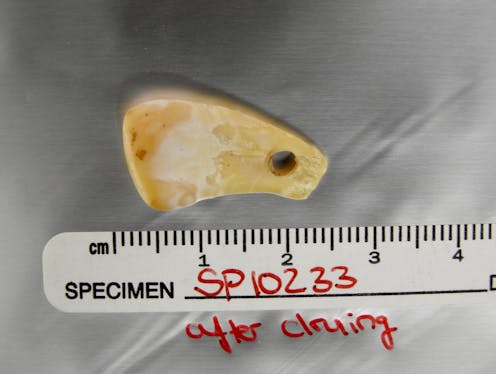
An international team of researchers has recovered DNA from the owner of a deer-tooth pendant that was buried inside a remote Siberian cave for tens of thousands of years.
In research published in Nature, Elena Essel of the Max Planck Institute for Evolutionary Anthropology in Germany and colleagues detail how they developed a new technique to extract DNA left behind on an artefact.
In much the same way police solve crimes using “touch DNA” – DNA recovered from skin cells or trace bodily fluids left behind when somebody touches an object – archaeologists will now be able to recover genetic traces of ancient humans from the artefacts they left behind.
These traces will reveal the biological sex and genetic ancestry of the individual who once held or wore a particular artefact, allowing archaeologists to link genetic and cultural evidence as they attempt to unravel the deep past.
Prehistoric artefacts and touch DNA
When archaeologists find artefacts such as tools and ornaments at a site, it’s not easy to work out who used them.
Until now, we have had to rely on finding artefacts in “direct association” with buried people. That is, we could only link an individual to an ornament if we found them buried wearing it.
Even then, this funerary association isn’t always a guide to what happened in life. The dead are buried with things their community think they should have, which may not have been theirs when they were alive.
This new method of ancient DNA extraction provides a more direct way of determining who used specific items in everyday life.
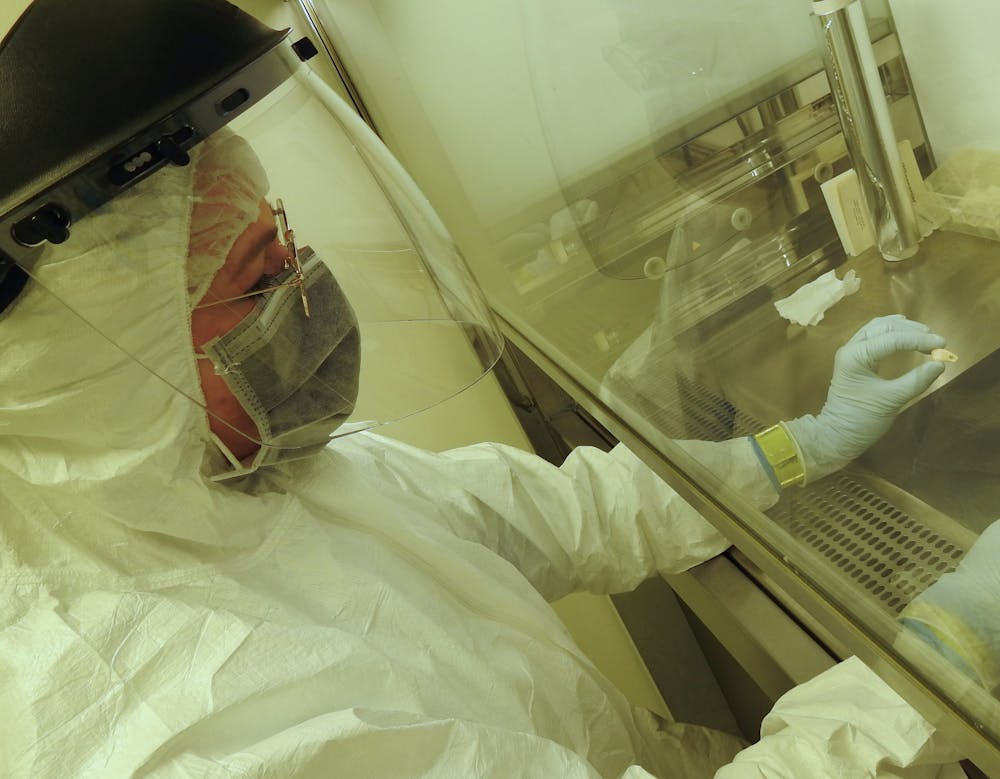
The method can only be used for artefacts made from bone or tooth as these materials are porous and can soak up human DNA from repeated contact with bodily fluids (sweat, blood, saliva). Luckily, the bones and teeth of animals (and sometimes humans) were widely used throughout the past to create everyday tools, sacred items, and personal adornment.
These osseous artefacts were held in the hand or worn against the body for extended periods, resulting in sweat and other fluids soaking into their surfaces over time. As a result, the artefact records the genetic information of the wearer.
Through experimentation with different techniques, Essel and her team found a way to recover that DNA record in a form that is intact enough to be read.
Is this yours?
Using this new method of DNA extraction, the researchers were able to extract a wealth of archaeological information from a single tooth pendant recovered from the famous archaeological site of Denisova Cave in Siberia.
The cave, tucked away in the foothills of the Altai mountains, has fascinated researchers for decades as its past inhabitants included not only Homo sapiens but also Neanderthals and another enigmatic extinct human species known as Denisovans.
First, they were able to extract the DNA of the animal the tooth belonged to, a wapiti deer (Cervus canadensis).
They were then able to extract human DNA from the pores of the tooth and deduce that this DNA had come from a female individual whose ancestry is most similar to ancient people found further east in Siberia and with Native Americans.
They were also able to use the DNA data to estimate the date of the pendant’s creation, somewhere between 19,000 and 25,000 years ago. This date fits with previous radiocarbon dating of the layer of the cave floor sediment in which the artefact was found.
DNA found in soil, or “environmental DNA”, can also inform our understanding of who used an archaeological site such as Denisova Cave.Without the extraction and analysis of the human DNA held in the tooth, archaeologists would have been able to tell what animal it had come from and how old it was. However, we could never have guessed the owner of this ornament. Now we can identify a specific individual.
Using the additional DNA information attached to individual artefacts, archaeologists will be able to create an understanding of past societies with a level of detail never before possible.


