

Disaster, opulence, and the merciless ocean: why the Titanic disaster continues to enthral
- Written by The Conversation
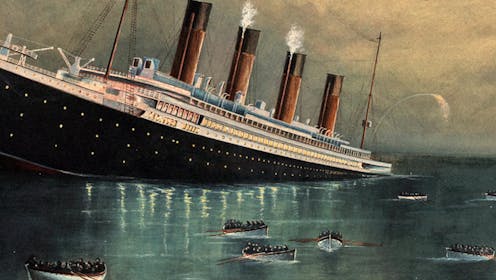
The question on many minds this week is why did some of the world’s richest men risk death to venture to the bottom of the sea in a cold and cramped “experimental” submersible for a chance to glimpse the wreck of the Titanic?
The “unsinkable” ship that sunk on its maiden voyage across the Atlantic in 1912 after colliding with an iceberg is arguably the world’s most well-known boat. The Titanic is recognisable to more of the world’s population than, say, the Niña, the Pinta, and the Santa Maria (Christopher Colombus’s fleet that launched the Spanish conquest of the Americas), or Captain Cook’s HMS Endeavour (the tall ship that set in motion the British conquest of Australia). The Endeavour’s long-forgotten wreck was found scuttled off the coast of Rhode Island just last year.
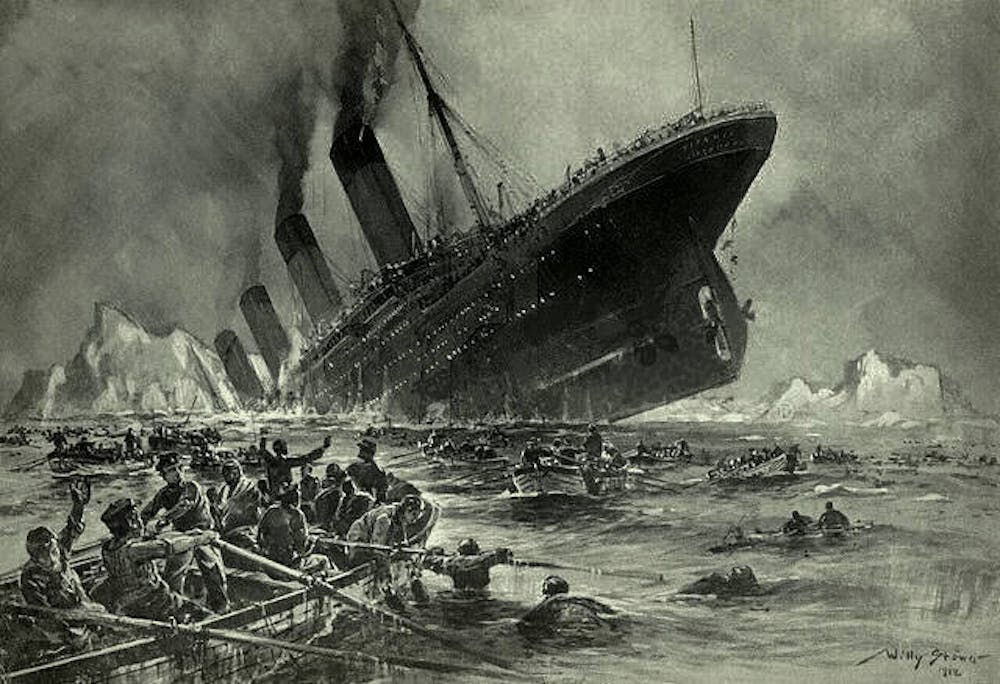
The Titanic’s maiden voyage and calamitous end was one of the biggest news stories of 1912, and has continued to fascinate us ever since. The disaster inspired songs and multiple films in the twentieth century, including James Cameron’s 1997 epic romance, which long reigned as the highest-grossing film of all time. More recently, Titanic exhibitions that invite visitors to examine relics and explore the ship’s recreated rooms have attracted huge crowds in New York, Seville and Hong Kong.
Opulence and immigrants
There are two reasons why we are so drawn to the Titanic, and why the super-rich are apparently willing to part with their money and even risk their lives to catch a glimpse of its broken hull.
The first is its opulence. The White Start Line that built the Titanic advertised the ship as the most luxurious ever to set sail. Wealthy passengers paid up to £870 for the privilege of occupying the Titanic’s most expensive and spacious first-class cabins. To put this 110-year-old money in perspective, when the first world war broke out in 1914, infantry soldiers in the British army were paid a basic salary of around £20 per year.
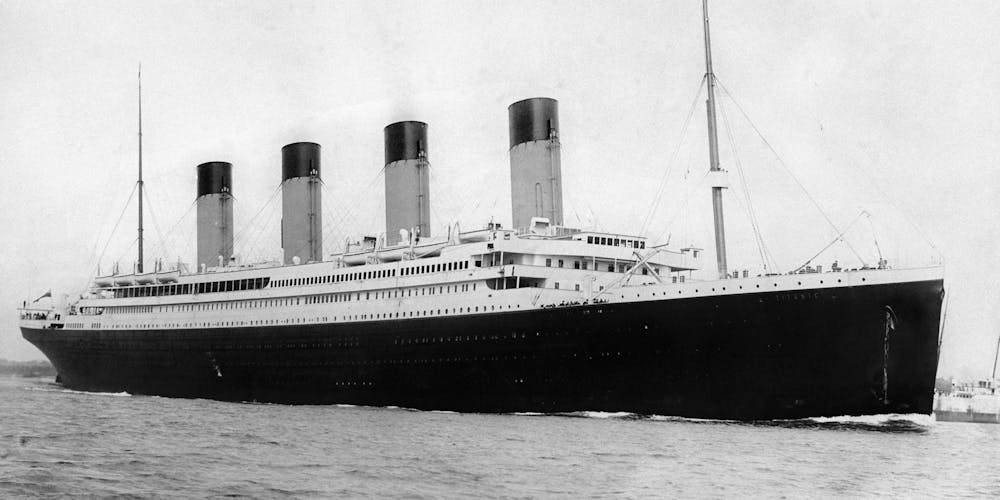 Titanic departing Southampton on 10 April 1912.
Wikipedia
Titanic departing Southampton on 10 April 1912.
Wikipedia
Titanic movies and exhibitions are popular because audiences enjoy the voyeurism of gazing on the ship’s beautiful furnishings, the stunning clothes worn by its rich and beautiful passengers, and their elaborate meals in fancy restaurants. First-class passengers feasted on multi-course dinners with salmon, steak, and pâté de foie gras. Chefs in Australia and around the globe occasionally recreate Titanic meals for curious clients.
Hundreds of poor immigrant passengers, represented by Jack (played by Leonardo DiCaprio) in Cameron’s movie, were also aboard the Titanic. They lived in crowded quarters and enjoyed less thrilling meals such as boiled beef and potatoes. If their ilk were the only people on board the Titanic, the ship would arguably have faded quickly from memory.
The power of the sea
The fact the Titanic was touted as unsinkable also adds to its allure. The ship, whose name evoked its massive size, was engineered to cheat the ocean. When it departed England it symbolised man’s domination over nature. At the bottom of the Atlantic, it serves as a visceral reminder of the indomitable sea’s awesome power.
The same two factors - the excess of the voyage, and its defeat by the sea – are now driving the current global interest in the Titan submersible disaster. Few world events garner so much attention, including statements from Downing Street and the White House, and live news blogs from The New York Times and the Guardian.
The Titan, like the Titanic, commands our attention because of its obscenely rich passengers, who each reportedly paid US$250,000 (or between four and five times the average US salary) to visit the wreck of the famous ship that battled the sea and lost.
And then there is the intriguing mystery and power of the sea. News outlets are publishing helpful graphics that try to teach our terrestrial brains to comprehend just how deep the ocean is, and how far below the sea’s surface the Titanic and possibly the Titan lie.
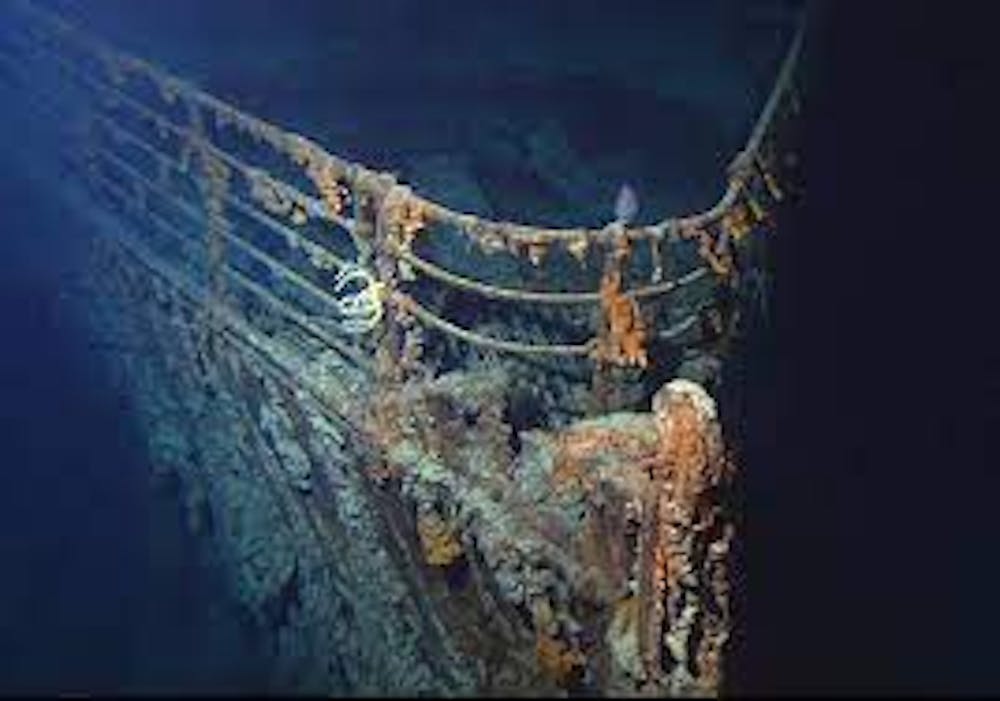 The Titanic’s bow, photographed in June 2004.
Wikipedia
The Titanic’s bow, photographed in June 2004.
Wikipedia
The limits of human knowledge
Last night I spied Neal Argawal’s Deep Sea website circulating on social media. The site allows viewers to scroll from the sea surface to the sea floor, diving down past images of various marine animals that inhabit different oceanic depths.
At 114 metres is an orca, and 332m marks the the deepest depth a human has ever reached using SCUBA gear. It takes a lot of scrolling to descend to the Titanic almost 4,000m below the waves.
Besides gross income inequality, reflecting on the Titan and the Titanic invite us to confront just how little we can “see” of the sea in this age of mass surveillance. Not even the powerful US navy, assisted by the Canadian, UK and French governments, can muster the resources and technology required to locate, let alone rescue, the missing submersible.
As the sea seems to have swallowed yet another ship, we are reminded of limits of human knowledge and mastery over the ocean.


