

Life in maars: why it's worth protecting a spectacular fossil site NZ almost lost to commercial mining interests
- Written by The Conversation
One of New Zealand’s most exceptional fossil sites may soon be open to scientists again following a land purchase that saved it from commercial mining.
Foulden Maar is a small, deep lake that formed 23 million years ago in Otago, at the start of the Miocene epoch when New Zealand’s climate was much warmer and wetter. A rainforest thrived around the lake’s fringes, and algae known as diatoms bloomed each summer.
As the algal blooms died off and sank to the lake bed, they formed sedimentary layers of diatomite and preserved the most exquisite and delicate fossils of flowers, insects and fish as well as a climate record covering 100,000 years.
But the diatomite was also of interest to mining company Plaman Resources - until, following long negotiations, the Dunedin City Council bought most of the land earlier this year.
Fossil sites are relatively common, but examples representing entire ecosystems are extremely rare. Foulden Maar is one of only two such sites in New Zealand that preserve ecological interactions and features such as eyes, skin, stomach contents and original colour patterns.
Such sites yield remarkable information about the history of life, which is impossible to obtain from other sources.
The other site is the nearby Hindon Maar complex, which is 15 million years old. Both sites preserve ecosystems of small crater lakes and the animals and plants of surrounding rainforests. Recent discoveries at these sites are transforming our understanding of New Zealand’s past biodiversity and climate.
Lake ecosystems: freshwater galaxiids and eels
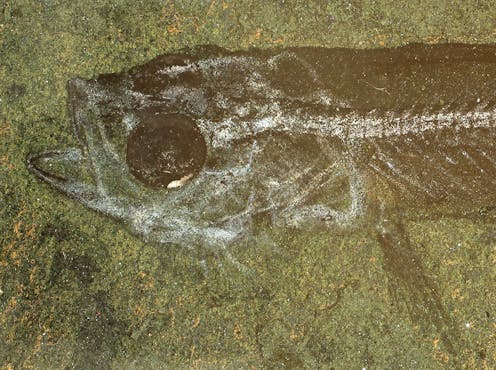
All fossils of the iconic southern-hemisphere family Galaxiidae derive from Otago Miocene lake deposits, with the entire life cycle from larvae (whitebait) to juveniles and fully grown adults present at Foulden Maar.
Remarkable preservation of numerous articulated skeletons includes eyes, gaping mouths and skin, the last including the star-like patterning that gave galaxiids their name.
Gut contents and an abundance of fossilised poo (coprolites) provide evidence of a changing diet. Larvae dined on diatoms while adults were lake-margin ambush predators feeding on terrestrial and aquatic insects. Fish debris in other less common coprolites show the galaxiids were themselves prey.
Slender, elongated articulated fish skeletons with rows of curved conical teeth provide the only southern-hemisphere records of the freshwater eel, Anguilla. This was likely the top predator in these lakes.
Trapped in these small, closed lakes, the eels would have been unable to return to the sea to breed and were effectively “living dead”, unlike the galaxiids which could reproduce in the maars.
Forest ecosystems: insects, spiders, leaves, flowers
These ancient maar lakes also contain a treasure trove of spiders and insects. When our research programme began in 2003, only six fossil insects more than two million years old were known from New Zealand. We now have more than 600, almost all different.
Foulden Maar has yielded 270 insects from 17 genera in 15 families and nine orders.
Spiders are commonly the top terrestrial invertebrate predators in modern New Zealand forests, but rarely fossilise because they lack hard parts. But in Foulden Maar, we found several specimens, including a juvenile trapdoor spider.
Early studies at Hindon Maar have already added 240 more insects in five orders and 20 families.
Insects are often completely preserved with details of antennae, fragile wings and compound eyes visible.
Fossils from the Foulden and Hindon maars include ancient lineages of termites, armoured scale insects in life position along leaf veins, bark bugs and a lace bug that probably lived on Astelia (kakaha, bush lily) as its close living relative does today.
Others include leaf beetles with structural colour, weevils, rove beetles, numerous ants and wasps, caddis flies with larvae still in their cases, crane flies with well preserved compound eyes and a hairy cicada whose closest relative today is found in Tasmania.
These taxa are only the tip of the taxonomic iceberg. Hundreds more terrestrial arthropods are also being revealed in our research on inclusions in New Zealand amber – 90 specimens in one block of layered amber alone.
Rainforest leaves and flowers
Myriad leaves with excellent preservation show that both maars were surrounded by subtropical to warm, temperate rainforests, dominated by members of the laurel and cinnamon plant families at Foulden Maar and a southern beech forest at Hindon.
To date we have recorded at least 100 species from 35 plant families between the sites, including many taxa now extinct locally, but with relatives still living in New Caledonia, Australia and South America.
Of particular importance are diverse fossil flowers with reproductive structures such as petals, stamens and anthers with pollen still present, as well as abundant fossilised fruits and seeds.
These reproductive structures are treasures of a different kind – fragile, seasonal and fleeting. But they provide critical information about the ecology of the parent plants and their possible pollination and dispersal mechanisms.
Close comparisons to the biology of living plants also suggest the fossil species reproduced in a similar manner to their living relatives. This implies that reproductive mechanisms were conserved for 23 million years in the New Zealand flora.
Currently, the Dunedin City Council is exploring management options for the site, which will once again allow public and scientific access to this remarkable fossil-rich, ancient lake deposit well into the future.


