

Do phrases like 'global boiling' help or hinder climate action?
- Written by The Conversation
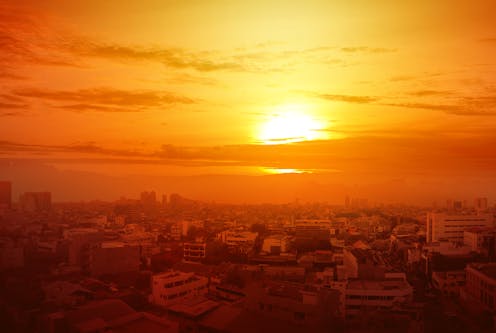
Last week, United Nations General Secretary António Guterres coined an arresting new term. The era of global warming has ended, he declared dramatically, and the era of “global boiling” has arrived.
You can see why he said it. July was the hottest month on record globally. Searing temperatures and intense wildfires have raged across the Northern Hemisphere. Marine heatwaves are devastating the world’s third-largest coral reef, off Florida. And as greenhouse emissions keep rising, it means many even hotter summers await us.
But critics and climate sceptics have heaped scorn on the phrase. Taken literally, they’re correct – nowhere on Earth is near the boiling point of water.
Is Guterres’ phrase hyperbolic or an accurate warning? Do phrases like this actually help drive us towards faster and more effective climate action? Or do they risk making us prone to climate doomism, and risk prompting a backlash?

Rhetoric and reality
Guterres is rhetorically adept. He uses the moral authority of his position to vividly depict the climate crisis. For instance, he told attendees at last year’s COP27 climate summit in Egypt we are on “a highway to climate hell with our foot on the accelerator”. In many ways, it’s one of the only tools he has, given the UN has global influence but limited real power.
“Global boiling” ups the verbal ante. It’s designed to sound the alarm and trigger more radical action to stave off the worst of climate change.
Guterres chooses his words carefully. But does he choose them wisely?
At one level, “global boiling” is clearly an exaggeration, despite the extreme summer heat and fire during the northern summer.
But then again, “global warming” is now far too tame a descriptor. Prominent climate scientists have pushed for the term “global heating” to be used in preference.
Similarly, phrases such as “the climate crisis” haven’t gained traction with either elites or the ordinary public. That’s because many of us still feel we haven’t seen this crisis with our own eyes.
But that is changing. In the past few years, extreme weather and related events have struck many countries – even those who may have thought themselves immune. Australia’s Black Summer brought bushfires that burned an area the size of the United Kingdom. Germany suffered lethal flooding in 2021. The unprecedented 2022 deluge in Pakistan flooded large tracts of the country. China has seen both drought and floods. Savage multi-year droughts have hit the Horn of Africa. India has banned rice exports due to damage from heavy rain.
Once-abstract phrases are now having real-world purchase – in developed and developing nations alike.
Climate scepticism has also dropped away. Fewer doubters are trying to discredit the fundamental science than during the long period of manufactured scepticism in Western nations.
In this context, we can see “global boiling” as an expression of humanitarian concern backed by rigorous science showing the situation continues to worsen.
 Somalia’s droughts are coming more frequently. Thousands have been internally displaced after their livestock died in recent years.
AAP
Somalia’s droughts are coming more frequently. Thousands have been internally displaced after their livestock died in recent years.
AAP
The hazards of theatrical language
There are risks in warning of catastrophe. People who don’t pay close attention to the news may switch off if the predicted disaster doesn’t eventuate. Or the warnings can add to climate anxiety and make people feel there’s no hope and therefore no point in acting.
There’s another risk, too. Catastrophic language often has moral overtones – and, as we all know, we don’t like being told what to do. When we hear a phrase like “global boiling” in the context of a prominent official exhorting us to do more, faster, it can raise the hackles.
You can see this in the emerging greenlash, whereby populist-right figures scorn solar and wind farms. Even struggling mainstream leaders like UK Prime Minister Rishi Sunak can pivot this way, as evidenced by his recent positioning as pro-car and pro-oil extraction.
Opponents of climate action – who tend to be on the right of politics – often complain about what they see as the overuse of “crisis talk”. If everything is a crisis, nothing is a crisis. This view has some merit.
But even critics such as Danish controversialist Bjørn Lomborg, author of False Alarm, may have more in common with Guterres than one might think. In admittedly different ways, they pursue similar ends: a world where people can live free from harm, with dignity, and with reasonable prospects of a fulfilling life pursued sustainably. The question, as always, is how to get there.
Hot language can motivate us, just as quieter, process-heavy, technocratic language can. It can be folded into a discourse of hope and aspiration for the future, rather than of fear and trembling.
 Rice harvests in India have taken a hit after heavy rains. Authorities are expecting lower yields.
AAP
Rice harvests in India have taken a hit after heavy rains. Authorities are expecting lower yields.
AAP
Rethinking calamity
Climate writer David Wallace-Wells has written that the future will be “contested and combative, combining suffering and flourishing — though not in equal measure for every group”.
As the critics Frederick Buell and Rob Nixon remind us, a hotter Earth will worsen existing human vulnerabilities as well as creating new ones. The poor and marginalised, both authors observe, are already living through crises, year-in and year-out. They suffer what Nixon dubs “slow violence”, punctuated by dramatic environmental events such as landslides and failed harvests.
Are there better phrases to capture this? Possibly. Take the challenge yourself: can you think up a pithy, accurate phrase to cover intensifying local and regional-scale droughts, fires, typhoons and floods; damage to crops and food insecurity; water shortages; existential threats to coral reefs and low-lying communities? You can see how hard it is.
When Guterres uses highly charged phrases, he’s not inviting to us to imagine a Hollywood-style apocalypse. What he’s hoping is to make people listen – and act – now we can see what climate change looks like.
What happens if we write off his comments as overblown rhetoric? The risk is it becomes another form of denial. Climate change, global warming, global heating, the climate crisis, global boiling – whatever the phrase, it is now undeniable that it’s upon us.
Read more: The climate crisis is real – but overusing terms like 'crisis' and 'emergency' comes with risk
Read more https://theconversation.com/do-phrases-like-global-boiling-help-or-hinder-climate-action-210960


