

Incremental environmental change can be as hazardous as a sudden shock – managing these ‘slow-burning’ risks is vital
- Written by The Conversation
New Zealanders are exposed to hazards from many sources – human-made and natural – in food, water, soil and air.
Although risk assessment and management procedures try to account for hazards in a systematic way, they often overlook risks arising from incremental and seemingly insignificant environmental changes. But over time, or when aggregated, incremental changes can lead to significant impacts on human health and wellbeing.
Incremental changes in our environments can evade regulation if their effects are slow-burning, uncertain, or there is a time lag between cause and effect.
The proposed replacement of the Resource Management Act 1991 improves on past practice by enabling councils to take an adaptive approach for situations where there is likely to be a “significant change” in the environment.
However, given the requirement for significant change, it is hard to see how these provisions could be used proactively to manage incremental changes.
In risk assessment practice, it is typically assumed that risk is static, inputs are constant and the conditions remain the same during the period for which predictions are made. Climate change projections, for example, are rarely included in the risk assessment of current climate-related hazards. But by now we all know that future climates will not reflect current conditions.
When the consequences of incremental changes could be severe, we cannot afford to ignore them, even if we are uncertain of their impact. We urgently need a new paradigm for anticipatory, agile and adaptive risk management to include cumulative effects from incremental changes and multiple activities.
Two examples illustrate our point.
Respirable mineral dust
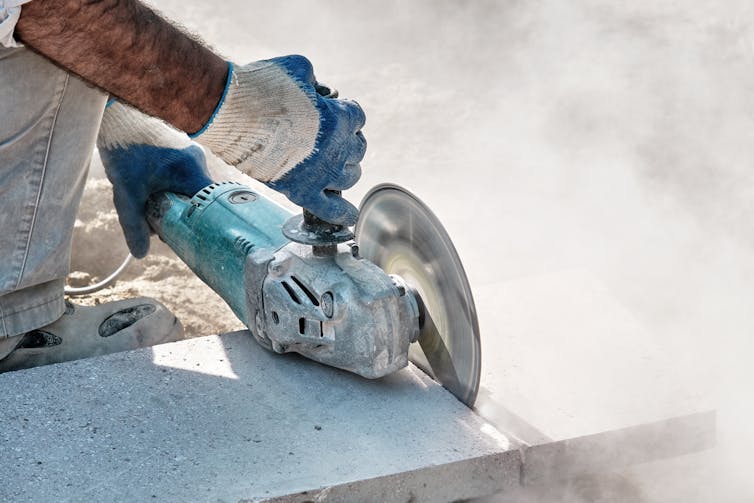
If disturbed by human activity, some rock minerals such as erionite, asbestos and silica become airborne. They can gradually accumulate in the lungs, causing diseases such as pleural changes, silicosis and asbestosis, even cancer.
However, the causes of frequent but low-level exposures to mineral dust have often escaped regulation. The development of occupational exposure limits has been slow for these examples, despite the continual emergence of evidence supporting the need for change.
This ultimately leaves the public, and the most vulnerable (highly exposed) people in particular, at risk of adverse health effects.
Cumulative effects of incremental loss of green space
Loss of permeable green spaces on private residential land is another example of how small changes to the environment can lead to serious adverse aggregate impacts.
Our built environment of impermeable surfaces is slowly encroaching on urban green spaces and gardens. Such land-use changes affect flood risk and land stability in the local area and have knock-on impacts for areas downstream.
Auckland lost about 20% of private green spaces as a proportion of the city’s urban area between 1980 and 2016, most of which was driven by changes on residential land.
Yet, there are currently insufficient requirements for land-use planning to consider how individual activities contribute to cumulative effects that could increase the risk of negative outcomes during extreme whether events.
Instead, consent applications are assessed on their individual impacts and there are few mechanisms to sufficiently assess and manage aggregate and cumulative effects.
Read more: We’re building harder, hotter cities: it’s vital we protect and grow urban green spaces – new report
What needs to happen
Cumulative changes from anthropogenic activities can layer on top of other changes to increase vulnerability of ecosystems and people to existing hazards. As Cyclone Gabrielle has shown, apparently benign incremental land-use changes can slowly alter our risk profile.
If we continue to only consider the immediate and local effects from individual actions, we are not able to protect people from future cumulative consequences. We therefore need to embed new principles of proactive and adaptive management into our legislation and planning to deal with the complexities of incremental, cumulative and hazard-increasing changes.
We need to redefine risk such that incrementally human-induced or exacerbated hazards with long-term cumulative effects can be incorporated into risk calculations, mapping and management. A regulatory framework grounded in this redefinition would enable preemptive action for hazards, even in situations where evidence is only emerging.
As we proceed into an uncertain and rapidly changing future, we urgently need a new paradigm for risk management. When the consequences are plausibly severe, we cannot afford to ignore the ways in which we as a society continue to put ourselves in harm’s way with an institutionalised focus on individual cases and an outdated calculus of probabilities.


