

Fewer of us are cycling – here's how we can reverse the decline
- Written by The Conversation
Rates of cycling are falling in Australia, a national report released today shows. More people started riding bikes early in the pandemic, but that hasn’t lasted. The percentages of people who cycle are lower now than in 2011.
Less than one in six Australians report riding a bicycle weekly. Just over one in three have ridden in the past year.
During the time of pandemic restrictions, when there was less other traffic on the road, people perhaps felt safer to ride. Creating streets that are less busy, noisy and easier to ride on and cross safely encourages more people to cycle and walk.
Most people want to walk and ride more. Two-thirds of people want more transport funding to go into walking, cycling and public transport.
Even if you’re not interested in riding a bike, you should be worried about this decline. Walking and cycling are part of the solution to several of the most pressing issues facing our cities.
The decline isn’t surprising
The decline in cycling probably shouldn’t surprise us. In the past 40 years, the percentage of children who walk or ride to school has dropped from 75% to 25%.
Furthermore, cycling receives only about 2% of transport budgets. The United Nations Environment Program recommends 20% of transport funding should go to “non-motorised transport”.
Most of our transport funding goes into building wider and longer roads, embedding car dependency. However, making it easier to drive leads to more driving and ultimately more congestion, an effect known as induced demand. The problem even featured in an episode of the TV show Utopia.
Short trips by car – everyone loses
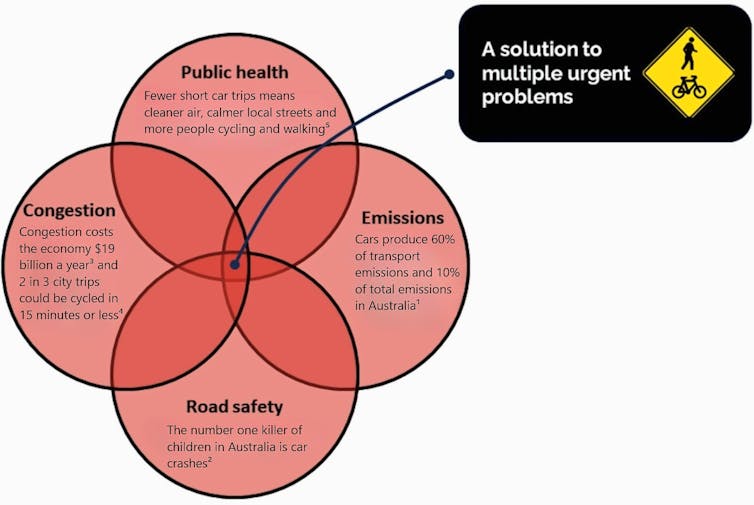
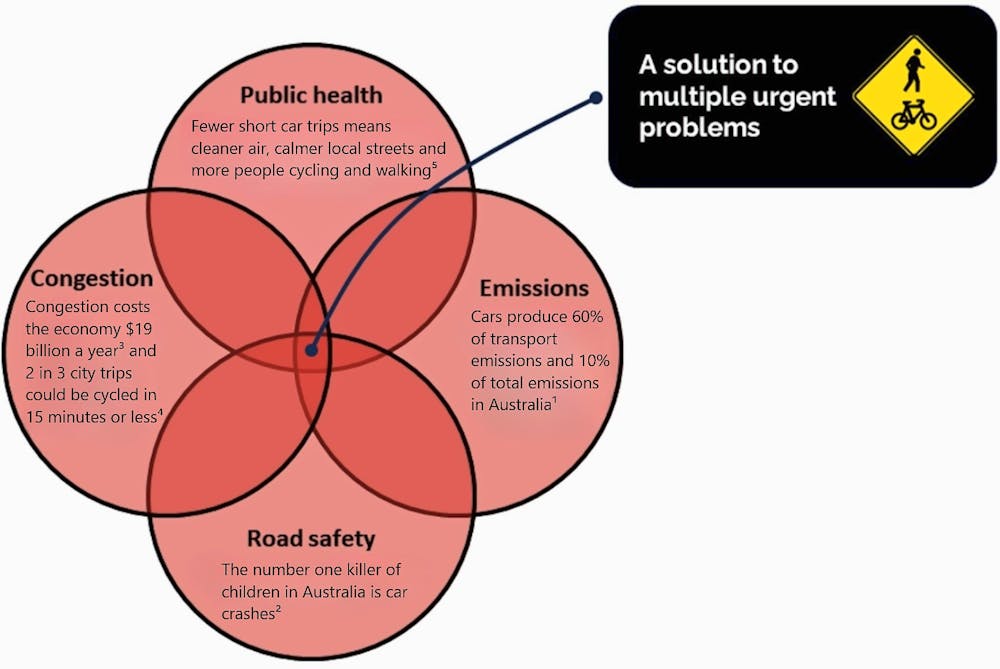
Most car journeys in Australian cities are short. Two-thirds of these trips could be done by bike in 15 minutes or less.
So, for example, of the 4.2 million daily car trips in Perth, 2.8 million are less than 5km. In Victoria, about half of all trips under 2km are driven – that’s more than 2 million a day.
These short car trips – such as the school drop-off, the short drive to the shops or the local park – are bad for public health, emissions and climate change, road safety and congestion. Walking and cycling can help solve all these problems.
Urban sprawl and car use have a high cost
Urban sprawl makes it less appealing to walk and cycle to our destination, further entrenching car dependency.
Urban sprawl costs governments too. Last week, the New South Wales Productivity Commission reported building homes closer to the city centre, rather than in outer suburbs, can save up to A$75,000 in infrastructure costs.
The extra costs of building farther away include providing schools, roads, parks, water and wastewater infrastructure.
Read more: Urban sprawl is 'not a dirty word'? If the priority is to meet all kids' needs, it should be
3 transport priorities
For people to walk and cycle, we need to provide so-called healthy streets: not too noisy, easy to cross, with clean air and where people feel safe.
In 2022, the Asia-Pacific Society for Physical Activity and cycling advocacy group We Ride Australia proposed three transport priorities for Australia supported by a national alliance of 13 public health, transport, education and climate organisations.
1. Safer default speed limits
The current default speed limit of 50km/h in built-up areas is unsafe and leads to many deaths and injuries each year.
Default 30km/h speed limits in built-up areas are an immediate low-cost way to increase road safety.
Other countries are showing it can be done. For example, this month Wales is set to adopt a default speed limit of 20 miles an hour (32km/h).
Read more: Busted: 5 myths about 30km/h speed limits in Australia
2. 1,500m school zones
Most students live within 3km of their school. That’s less than a 10-minute bike ride or a 30-minute walk.
However, to boost walking and cycling to school, parents need to feel it’s safe for their children to do so. The solution is to create safe walking and cycling routes with pedestrian priority crossings within 500–1,500m of schools. Streets along these routes are easy to cross and not too busy or noisy.
3. E-bike subsidies
Cutting carbon emissions to limit climate change and air pollution requires us to reduce private car use. Focusing purchase incentives solely on electric cars in Australia is slowing down the race to zero emissions. Indeed, research shows cycling is ten times more important than electric cars for achieving net-zero cities.
E-bikes assist the rider with pedalling, which makes them slightly faster than a regular bike. Typically e-bike users ride greater distances than regular push-bike users.
However, the upfront price of e-bikes is one of the main barriers to buying one. Providing incentives for people to buy an e-bike would increase their uptake. Research shows a return on investment of $2–$3 for every $1 spent on these incentives.
What else can we do?
As well as the three transport priorities, we can of course take many more actions that would help increase walking and cycling. These measures include: boosting housing density, beautifying our neighbourhoods, programs to build people’s confidence and skills to walk and cycle, such as beginners bike tours, and more frequent public transport.
Read more: 12 best ways to get cars out of cities – ranked by new research
By prioritising walking and cycling for short trips, Australia can reduce the national combined cost of $67 billion a year of traffic injuries and deaths, traffic congestion, air pollution and physical inactivity.
Here are four actions you can take to help boost walking and cycling in your area:
look for opportunities where you can walk, wheel or cycle short journeys
join a community-led coalition, such as Better Streets
score your local neighbourhood for walkability using this tool
write to your local MP asking for the three transport priorities to be adopted.
Read more https://theconversation.com/fewer-of-us-are-cycling-heres-how-we-can-reverse-the-decline-212260


