

Suicide rates increased after extreme drought in the Murray-Darling Basin – we have to do better as climate change intensifies
- Written by The Conversation
The impact on mental health of weather extremes such as drought is a growing concern due to climate change.
Rural communities feel the impact of drought much more than urban residents. Our new research looks at the link between drought and suicide rates in one of Australia’s biggest farming areas, the Murray-Darling Basin.
Drawing on monthly data from 2006 to 2016, our findings were alarming. We found, for instance, that one more month of extreme drought in the previous 12 months was strongly associated with a 32% increase in monthly suicide rates.
Climate change is predicted to bring more heat and longer, more extreme droughts. More effective approaches will be needed to prevent suicides in affected regions.
Read more: Drought increases rural suicide, and climate change will make drought worse
Drought hits rural areas hardest
Droughts induce post-traumatic stress disorder, anxiety and depression. Hotter temperatures can also reduce levels of the brain chemical serotonin. This has negative effects on the central nervous system and moods.
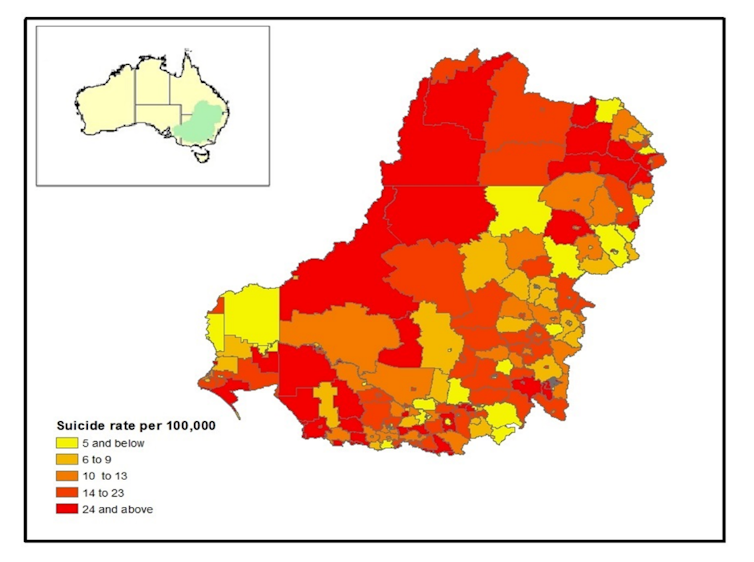
In Australia, suicide is a leading cause of death – especially for people aged 18-44. And the suicide rate in remote areas is almost double that of major cities. This is because drought can:
Research overseas found suicide rates rise with higher average temperatures. In Australia, a study found some evidence linking drought and suicide in New South Wales. However, a Victorian study found no significant association.
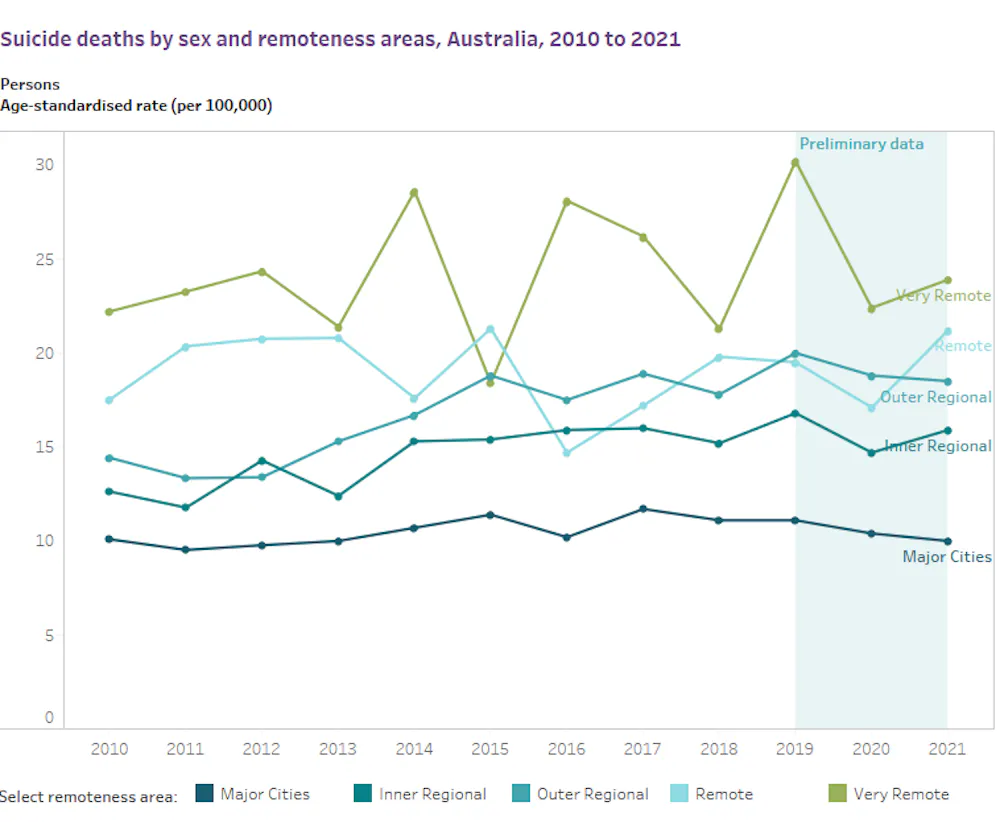
 Average suicide rate per 100,000 by local area in the Murray Darling Basin.
Source: Xu et al (2023) using data from National Cause of Death Unit Record File from Australian Coordinating Registry (2006-2016) and ABS Population Census, 2006, 2011, 2016
We sought to control for as many local area characteristics as possible. Our modelling included unemployment, income, education, proportion of farmers, proportion of Indigenous people, health professionals, green space and various climate and drought variables. We modelled suicide rates for different age and gender sub-groups.
Key findings include:
one more month of extreme drought in the previous 12 months was strongly associated with the total suicide rate increasing by 32%
one more month of moderate drought in the previous 12 months was very weakly associated with a 2% increase in the suicide rate
a 1℃ increase in average monthly maximum temperature in the previous 12 months was associated with up to an 8% increase in the suicide rate
in males and younger age groups, suicide rates are more strongly associated with extreme drought and higher temperatures
a higher proportion of farmers in a local area was associated with an increased suicide rate
a higher proportion of First Nations people in a local area was also associated with higher suicide rates
more green space was significantly associated with moderating impacts of both extreme drought and temperature on suicide rates
an increase in average annual household income moderated the relationship between higher temperature and suicide.
Our results suggest the association between moderate drought and suicide rates is significant but the effect was small. As the drought becomes extreme, suicide rates increase significantly.
Read more:
New findings show a direct causal relationship between unemployment and suicide
What can we do better to prevent suicides?
Given drought’s impact on farm production and finances, mental health will clearly get worse in rural areas if the impacts of climate change are not better managed.
Mental health interventions to prevent suicide in rural areas are different from what’s needed in urban areas. Areas in the basin with higher percentages of farmers and First Nations people were hot spots. These areas may need special intervention.
Many have emphasised the need for a systems approach to suicide prevention. Actions need to be multifaceted and co-ordinated as well as possible. One intervention or approach is not enough.
Read more:
Hairdressers in rural Australia end up being counsellors too
Interventions in the bush range from telehealth and medical services to primary health networks services, men’s sheds and drought counselling.
The relationship between drought and financial hardship seems to be key in farming areas. This points to the need for other forms of income on the farm, including from native vegetation and carbon credits. Work can also be done to promote drought preparedness, increase appropriate regional economic, social development and environmental policies and – where necessary – help people leave farming.
If this article has raised issues for you, or if you’re concerned about someone you know, call Lifeline on 13 11 14.
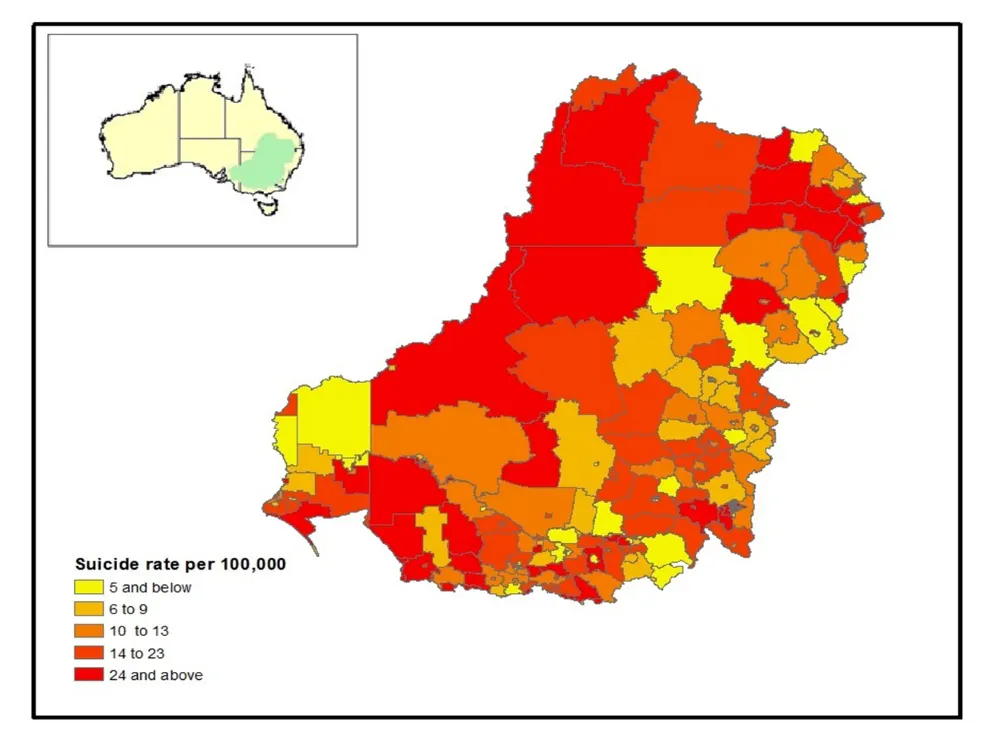
Average suicide rate per 100,000 by local area in the Murray Darling Basin.
Source: Xu et al (2023) using data from National Cause of Death Unit Record File from Australian Coordinating Registry (2006-2016) and ABS Population Census, 2006, 2011, 2016
We sought to control for as many local area characteristics as possible. Our modelling included unemployment, income, education, proportion of farmers, proportion of Indigenous people, health professionals, green space and various climate and drought variables. We modelled suicide rates for different age and gender sub-groups.
Key findings include:
one more month of extreme drought in the previous 12 months was strongly associated with the total suicide rate increasing by 32%
one more month of moderate drought in the previous 12 months was very weakly associated with a 2% increase in the suicide rate
a 1℃ increase in average monthly maximum temperature in the previous 12 months was associated with up to an 8% increase in the suicide rate
in males and younger age groups, suicide rates are more strongly associated with extreme drought and higher temperatures
a higher proportion of farmers in a local area was associated with an increased suicide rate
a higher proportion of First Nations people in a local area was also associated with higher suicide rates
more green space was significantly associated with moderating impacts of both extreme drought and temperature on suicide rates
an increase in average annual household income moderated the relationship between higher temperature and suicide.
Our results suggest the association between moderate drought and suicide rates is significant but the effect was small. As the drought becomes extreme, suicide rates increase significantly.
Read more:
New findings show a direct causal relationship between unemployment and suicide
What can we do better to prevent suicides?
Given drought’s impact on farm production and finances, mental health will clearly get worse in rural areas if the impacts of climate change are not better managed.
Mental health interventions to prevent suicide in rural areas are different from what’s needed in urban areas. Areas in the basin with higher percentages of farmers and First Nations people were hot spots. These areas may need special intervention.
Many have emphasised the need for a systems approach to suicide prevention. Actions need to be multifaceted and co-ordinated as well as possible. One intervention or approach is not enough.
Read more:
Hairdressers in rural Australia end up being counsellors too
Interventions in the bush range from telehealth and medical services to primary health networks services, men’s sheds and drought counselling.
The relationship between drought and financial hardship seems to be key in farming areas. This points to the need for other forms of income on the farm, including from native vegetation and carbon credits. Work can also be done to promote drought preparedness, increase appropriate regional economic, social development and environmental policies and – where necessary – help people leave farming.
If this article has raised issues for you, or if you’re concerned about someone you know, call Lifeline on 13 11 14.


