

The Beetaloo gas field is a climate bomb. How did CSIRO modelling make it look otherwise?
- Written by The Conversation
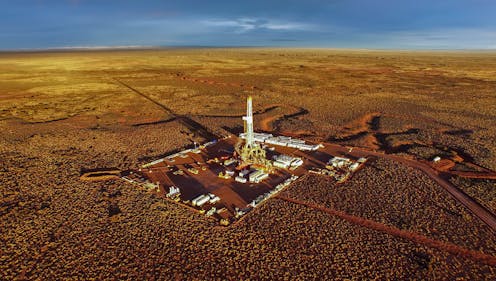
Even as Australia braces for a summer of projected extreme heatwaves and bushfires amid the intensifying climate crisis, the fossil gas industry is gearing up for a truly enormous new fracking project in the Northern Territory’s Beetaloo Basin.
In February, a CSIRO-backed report was published, stating Beetaloo could be developed without adding to Australia’s net emissions. In May, the Northern Territory government gave the green light to the project, citing the report as evidence emissions could be “mitigated, reduced or in some cases eliminated”.
This report is important. It was produced by CSIRO’s Gas Industry Social and Environmental Research Alliance in response to a key recommendation from the NT’s Pepper Inquiry into fracking. That recommendation? Territory and federal governments should “seek to ensure” no net increase in life-cycle greenhouse gas emissions in Australia from fracking in the NT.
How could it find a massive new fossil fuel field won’t add to emissions? Our forensic analysis of the report found it made the most optimistic assumptions about emissions at every stage, and placed far too much faith in Australia’s ability to offset emissions.
Remind me – how big is Beetaloo?
Big. The fossil fuel basin 500 kilometres south of Darwin is bigger than any current gas project on Western Australia’s North-West Shelf.
We estimate 1.2 billion tonnes of greenhouse gas emissions would be emitted over 25 years to 2050 – a figure 45% higher than in the report.
Our analysis shows annual domestic emissions from fracking in the Beetaloo and processing at Darwin’s Middle Arm industrial precinct would produce up to 49 million tonnes of carbon dioxide equivalent, 11% of Australia’s total emissions in 2021. That means a single project would produce more emissions than the entire reduction goal under Labor’s revised safeguard mechanism.
Our deep dive into the CSIRO report found its cumulative domestic emissions projections are underestimates of up to 84% in some cases. Emissions are underestimated at almost every stage, from how emissions-intensive fracked gas is to how much methane is lost to the atmosphere and how much is emitted in manufacturing LNG. We have submitted our report to the Senate Inquiry into Middle Arm.
The report also underestimates upstream emissions – emissions created by actually fracking the gas and transporting it to Darwin – by up to 110%, and emissions from turning gas into LNG at the plant by up to 89%.
A CSIRO spokesperson told The Conversation:
CSIRO scientists have delivered a robust and detailed technical analysis, confirmed through an intensive peer review process, of the greenhouse gas emissions associated with onshore gas production scenarios in the Beetaloo Sub-basin, and important information about realistic mitigation and offset options. CSIRO stands behind the quality of its research and the integrity of its peer review process.

No net increase – by the power of offsets?
Any large new fossil gas project would, of course, add more greenhouse gases to the atmosphere. So how could it represent “no net increase”?
The answer: offsets. The report recommends sequestering carbon in Australia’s soils and forests to offset the global warming caused by burning Beetaloo’s single product, gas.
As we and many other experts have demonstrated, offsets are riddled with flaws. Every tonne of fossil carbon we emit stays in the atmosphere far longer than the 100 years a land-based offset might store carbon. Around 40% of our emissions remain in the atmosphere after 100 years. Up to a quarter is still there after 1,000 years. And up to 20% is still there after 10,000 years.
Read more: A tonne of fossil carbon isn't the same as a tonne of new trees: why offsets can't save us
Offsets often don’t work over the short term, because many are simply not real or not additional to what would otherwise have happened. Their problems are now well known, but not broadly accepted by Australian policymakers.
CSIRO’s report uses overly optimistic estimates of how many offsets are likely to be available. If they could be realised, the offsets required for Beetaloo would take up very large areas of land in Australia – up to 2.9 million hectares, 12 times the size of the Australian Capital Territory.
The problem with blue hydrogen
Blue hydrogen is touted as another use for Beetaloo gas. Here, hydrogen is made from fossil gas, with emissions captured and stored to reduce the climate impact of Beetaloo.
CSIRO’s report assumes fossil gas facilities can capture 90% of the carbon from the project. This is way too optimistic. To date, no commercial blue hydrogen facility in the world has achieved anything close.
Even with carbon capture and storage research shows blue hydrogen is very carbon intensive. Energy experts project that green hydrogen – made by breaking water apart with clean energy – will undercut blue hydrogen on cost by around 2030.
 At present, companies are exploring the Beetaloo Basin and flaring off methane.
Nurrdalinji Aboriginal Corporation, Author provided (no reuse)
At present, companies are exploring the Beetaloo Basin and flaring off methane.
Nurrdalinji Aboriginal Corporation, Author provided (no reuse)
What about the Middle Arm LNG project?
After the gas is extracted by hydraulic fracturing, it would be transported to the Middle Arm precinct in Darwin to get ready for shipping. We analysed the total cumulative emissions, including exports. The result? 25 years of emissions from this project and its large LNG plant in Darwin would be more than three times the entire country’s emissions in 2021.
One of the companies looking to profit from Beetaloo, Tamboran Energy, has already announced plans to expand after 2030. If this gets up, it would add the equivalent of another 30–38 million cars (10–13% of Australia’s 2021 emissions). Given there are only 15 million cars in Australia, this would wipe out the benefit of making our entire light vehicle fleet electric by the mid 2030s.
The International Energy Agency has shown we have to slash demand for fossil fuels 25% by 2030 and 80% by 2050 to keep heating under 1.5°C and limit the worst effects of climate change.
If it is allowed to proceed, this single project could undo all of our efforts to cut emissions. Beetaloo and Middle Arm are a climate bomb. They will produce vast volumes of emissions which cannot be offset. The atmosphere doesn’t respond to clever accounting, overly optimistic projections and reliance on offsets – only on how many tonnes of emissions end up there.


